


What is Corruption?
(Adapted from KLITGAART et al. 1996)
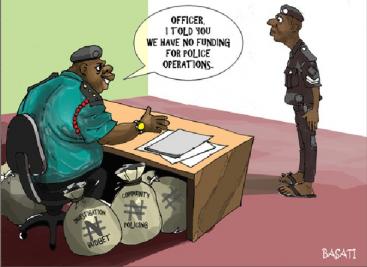
When enforcement bodies work with missing transparency, finances or statues, officials might be misled to act corrupt. Source: BASATI (2010)
There are many definitions of corruption. Most broadly, corruption means the misuse of office for personal gain. The office is a position of trust, where one receives authority in order to act on behalf of an institution, be it a private, public, or non-profit. Corruption means charging an illicit price for a service or using the power of office to further illicit aims. Corruption can entail acts of omission or commission. It can involve legal activities or illegal ones. It can be internal to the organisation (for example, embezzlement) or external to it (for example, extortion). The effects of various kinds of corruption vary widely. Although corrupt acts sometimes may result in a net social benefit, corruption usually leads to inefficiency, injustice, and inequity.
In an equation, corruption is monopoly plus discretion minus accountability: Corruption = Monopoly + Discretion − Accountability (KLITGAART 1988).This equation is very useful and relevant for understanding the problems posed for the water sector, as it highlights the aggregate effect of monopoly and discretionary power, which are common in water institutions (PLUMMER 2008).
Water and Corruption: A Destructive Partnership
(Adapted from WHO and UNICEF 2010, PLUMMER 2008, PLUMMER and CROSS 2006)
Water corruption catalyses the worldwide water sector crisis – it is corruption in resources and services vital for life and development. Each year, millions of people die of waterborne diseases because access to safe drinking water and adequate sanitation has not been prioritised. In 2010, more than 1.1 billion people live with inadequate access to safe drinking water and more than 2.6 billion people lack access to improved sanitation. Despite successes in many regions, the population without access to water and sanitation services is increasing. “Corrupt practices exacerbate these gaps, removing investment that might be used to extend services to the poor, diverting finance from the maintenance of deteriorating infrastructure and taking cash from the pockets of the poor to pay escalated costs and bribes for drinking water” (PLUMMER 2008).
The impact of corruption in the water sector can also be environmental: The lack of infrastructure for water and sanitation management whether man-made (e.g. dams, inter-basin transfers, irrigation, water supply and sanitation services) or natural (e.g. watersheds, lakes, aquifers, wetlands) in developing countries presents a management challenge almost without precedent. The ever-increasing impact of climate change and the lack of human and financial capacity to manage the water legacy (see also invalid link) result in far greater shock in developing countries, making the poorest countries ever more vulnerable. Corrupt practices that increase pollution, deplete groundwater and increase salinity are evident in many countries and are closely linked to deforestation and desertification across the globe. Stemming the leakage of funds from the sector is vital to address these issues.
At the heart of all these failures is the crisis of governance in water – a crisis in the use of power and authority over water and how countries manage their water affairs: Institutional dysfunction (see also invalid link), poor financial management and low accountability show that many governments are not able to respond to the crisis, and weak capacity and limited awareness leave citizens and non-governmental organisations in many countries unable to demand change.
Who Is Involved in Water Corruption?
(Adapted from PLUMMER AND CROSS 2006)
Corruption in the water and sanitation sector involves a vast range of stakeholders:
- International actors (donor representatives, private and public companies, and multinationals)
- National and local construction companies
- Consultancy firms and suppliers
- Large and small operators
- A range of middlemen
- Consumers
- Civil Society Organisations
- National and sub national politicians
- Civil servants and utility staff
- Enforcement Bodies
Corrupt activities between these stakeholders occur at a range of institutional levels, with different stakeholders often involved in one or more types of corruption.
Anti-Corruption
(Adapted from KLITGAART et al. 1996)

Corruption: Your no counts! Source: UNODC (n.y.)
As development processes in the water and sanitation sector are extremely hampered by water corruption, it is crucial for local (and national) governments to fight it. Generally, the following points need to be faced in the fight against water corruption:
- Improve of positive incentives facing employees/ officials in the water sector: In many areas pay levels have fallen so low that employees in the water sector literally cannot feed their families without moonlighting or accepting side payments. Even more important is to strengthen the linkages between pay and performance, and promotion and performance, which in many cases have badly eroded.
- Increase of effective penalties for corruption: Because of weak or corrupt investigatory, prosecutory, and judicial systems, accusations of corruption seldom stick. If they do, the penalties are often minimal in practice. As a result, the expected penalty for corruption does not deter. Local leaders can be creative in devising disincentives, such as firing or suspending employees, using the press to create publicity, inviting the denunciation of corrupt water sector employees/ officials by professional groups, personnel transfers to less desirable jobs, and so forth.
- Limited monopoly: Promote competition in the public and private sectors. Avoid monopoly-granting regulations when possible.
- Clarified official discretion: Simplify rules and regulations. Create “bright lines” that circumscribe duties and discretion. Help citizens learn how public systems are supposed to work (through brochures and manuals, help desks, laws (see also invalid link) and rules in ordinary language, publicity/ invalid link/ awareness raising, the use of citizen-service-providers, etc.). Improve citizens’ oversight of what the local government is doing. Social control and pressure are helpful means against corruption.
- Enhanced accountability and transparency: Clear standards of conduct and rules of the game make accountability easier. So does openness in bidding, grant-giving, and aid projects. Accountability depends on internal auditors, accounting, ombudsmen, inspectorates, specialised elements of the police, and specialised prosecutors. But it also should involve citizens, unions, NGOs, the media, and business in a variety of ways, including citizen oversight boards, hot lines, external audits, inquiry commissions, and so forth. Local governments can help external actors by generating and disseminating more information about public service effectiveness. Finally, local governments should encourage the private sector to police its own participation in corrupt schemes of procurement, contracting, regulating, and so forth.
Corruption in Nigeria
Controlling Corruption
A Practical Approach to Dealing With Municipal Malfeasance. Urban Management Programme
As malfeasance or wrongdoing by public officials operates as a critical impediment to developing accountable and transparent urban management systems, which is essential for the efficient and equitable use and distribution of resources at local level, this paper has been prepared to help officials diagnose, investigate, and prevent various kinds of corrupt and illicit behaviour. It emphasises preventive measures rather than purely punitive or moralistic campaigns.
KLITGAART, R. MACLEAN-ABAROA, R. PARRIS, H.L. (1996): A Practical Approach to Dealing With Municipal Malfeasance. Urban Management Programme. (= Working Paper No. 7 ). Marrakech: UNDP/UNCHS/WORLD BANK URL [Accessed: 22.10.2010]Water and corruption: a destructive partnership
Tackling Corruption in the Water and Sanitation Sector in Africa. Starting the Dialogue
Global Corruption Report 2008. Corruption in the Water Sector
This report contains a lot of relevant information on corruption in the water sector. It includes background knowledge about the water sector problem and corruption, it provides information the fight against it, as well as country reports from all continents.
TRANSPARENCY INTERNATIONAL (2008): Global Corruption Report 2008. Corruption in the Water Sector. New York: Cambridge University Press URL [Accessed: 07.01.2010]Corruption: Your NO Counts. Red Card
Progress on Sanitation and Drinking-Water. 2010 Update
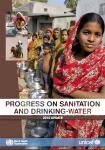
This well illustrated report describes the status and trends with respect to the use of safe drinking-water and basic sanitation, and progress made towards the MDG drinking-water and sanitation target. It presents some striking disparities: the gap between progress in providing access to drinking-water versus sanitation; the divide between urban and rural populations in terms of the services provided; differences in the way different regions are performing, bearing in mind that they started from different baselines; and disparities between different socioeconomic strata in society. Each JMP report assesses the situation and trends anew and so this JMP report supersedes previous reports (e.g. from 2004, 2006 and 2008).
WHO ; UNICEF (2010): Progress on Sanitation and Drinking-Water. 2010 Update. Geneva: World Health Organisation (WHO) / New York: UNICEF URL [Accessed: 16.05.2019]A Practical Approach to Dealing With Municipal Malfeasance. Urban Management Programme
As malfeasance or wrongdoing by public officials operates as a critical impediment to developing accountable and transparent urban management systems, which is essential for the efficient and equitable use and distribution of resources at local level, this paper has been prepared to help officials diagnose, investigate, and prevent various kinds of corrupt and illicit behaviour. It emphasises preventive measures rather than purely punitive or moralistic campaigns.
KLITGAART, R. MACLEAN-ABAROA, R. PARRIS, H.L. (1996): A Practical Approach to Dealing With Municipal Malfeasance. Urban Management Programme. (= Working Paper No. 7 ). Marrakech: UNDP/UNCHS/WORLD BANK URL [Accessed: 22.10.2010]Corruption Fighters Toolkit. Civil Society Experiences and Emerging Strategies

This Transparency International toolkit is about the fight on corruption. It is a compendium of practical civil society anti-corruption experiences described in concrete and accessible language. It presents innovative anti-corruption tools developed and implemented by Transparency International National Chapters and other civil society organisations from around the world.
TRANSPARENCY INTERNATIONAL (2002): Corruption Fighters Toolkit. Civil Society Experiences and Emerging Strategies. Berlin: Transparency International URL [Accessed: 07.01.2010]Global Corruption Report 2008. Corruption in the Water Sector
This report contains a lot of relevant information on corruption in the water sector. It includes background knowledge about the water sector problem and corruption, it provides information the fight against it, as well as country reports from all continents.
TRANSPARENCY INTERNATIONAL (2008): Global Corruption Report 2008. Corruption in the Water Sector. New York: Cambridge University Press URL [Accessed: 07.01.2010]The Anti-Corruption Plain Language Guide

The Plain Language Guide offers a set of standardised, easy-to-understand definitions, providing readers with concrete examples in practice of how TI approaches these issues. Relevant links are also provided for further background information or research.
TRANSPARENCY INTERNATIONAL (2009): The Anti-Corruption Plain Language Guide. Berlin: Transparency International URL [Accessed: 16.01.2013]Corruption Risks and Governance Challenges In the Irrigation Sector

Irrigation water supply can significantly improve the lives of poor households in developing countries. However, the reliable supply of irrigation is often hindered by corrupt practices at different levels of the irrigation sector. The main corruption risks identified in this study result from poor irrigation governance. Canal irrigation, tubewell irrigation and wastewater irrigation are identified as three types of irrigation systems with specific governance and corruption risks. In public canal irrigation, the largest risk is related to capital intensive investments, and operation and maintenance by irrigation officials. In tubewell irrigation, corruption risks are mainly related to the regulation of groundwater overdraft. Wastewater irrigation is an informal practice with few corruption risks. However, the lack of formal governance increases health risks related to wastewater use. As formalisation of the sector is on its way, vigilance is required to prevent corruption in the future. The identified corruption risks can be addressed by taking case-specific action to increase transparency, accountability and participation at different levels of the irrigation sector.
WIN (2011): Corruption Risks and Governance Challenges In the Irrigation Sector. Berlin: Water Integrity Network (WIN) URL [Accessed: 17.10.2011]Colombia: Legislative Efforts to Prevent Corruption in Large Scale Water Projects
Berlin, Germany: Corruption Prevention Strategies of the Berlin Water Utility
In this case information sheet, the corruption prevention strategies of the Berlin water utility are summarised.
WIN (2009): Berlin, Germany: Corruption Prevention Strategies of the Berlin Water Utility. Berlin: Water Integrity Network URL [Accessed: 07.01.2010]Tools to Support Transparency in Local Governance
The tools in this document focus on how to gain more transparency in local governments, to fight corruption and malfeasance in an effective and participatory way.
TRANSPARENCY INTERNATIONAL ; UNHABITAT (2004): Tools to Support Transparency in Local Governance. (= Urban Government Toolkit Series ). Nairobi: Transparency International and UN-Habitat URL [Accessed: 15.04.2019]Corruption: Your NO Counts

This poster raises awareness about the worldwide problem with corruption.
UNODC (n.y): Corruption: Your NO Counts. United Nations Office on Drugs and Crime (UNODC) URL [Accessed: 28.10.2010]http://www.transparency.org/
Transparency International is a global civil society organisation, which is very important in the fight against corruption. The website contains a lot of information and download material on corruption.
http://search.kit.nl/
On this webpage, which belongs to the Koninklijk Institute voor de Tropen, many publications about corruption and related topics can be found and downloaded.
Corruption - Act Against Corruption
As part of its two-year anti-corruption communications campaign "Your NO Counts", UNODC has produced a Public Service Announcement video spot to illustrate that people are not simply at the mercy of corruption, and often have the power to say NO.
http://www.watergovernance.org/
This website contains some documents about corruption in the water sector.
Fighting corruption in water worldwide
The Water Integrity Network (WIN) was formed to respond to increasing concerns among water and anti-corruption stakeholders over corruption in the water sector. It combines global advocacy, regional networks and local action, to promote increased transparency and integrity, bringing together partners and members from the public and private sectors, civil society and academia, to drive change that will improve the lives of people who need it most.
http://www.waterintegritynetwork.net/tool-sheets
WIN believes that organisations and individuals affected by the malfunctioning of the watersector due to lack of integrity can be the drivers of change. We are therefore committed toproviding our stakeholders with a set of effective tools for the promotion of water integrity topeople working towards improving transparency, accountability and participation in the watersector.
Integrity Management Toolbox for Water Sector Organizations
The IM Toolbox supports organizations in making integrity a part of their strategic plans, business models, and—most importantly—their daily practices to reduce risks and improve performance. The underlying approach works with a business perspective of realizing performance opportunities and advantages that arise from improving integrity.