Executive Summary
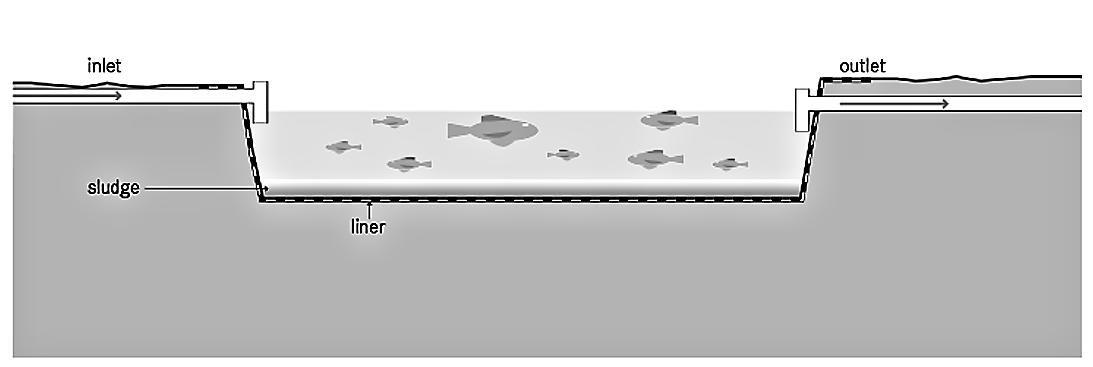
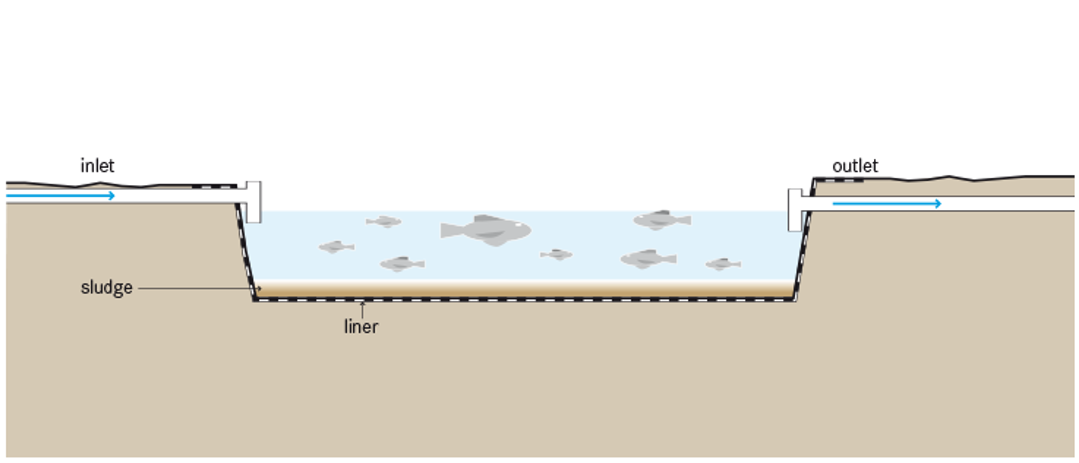
Fish can be grown in ponds that receive effluent or sludge where they can feed on algae and other organisms that grow in the nutrient-rich water. The fish, thereby, remove the nutrients from the wastewater and are eventually harvested for consumption.
| In | Out |
|---|---|
Blackwater, Faecal Sludge, Greywater, Brownwater, Fertigation Water |
Food Products |
Introduction
Three kinds of aquaculture designs for raising fish exist:
- fertilization of fish ponds with effluent;
- fertilization of fish ponds with excreta/sludge; and
- fish grown directly in aerobic ponds
Fish introduced into aerobic ponds can effectively reduce algae and help control the mosquito population. It is also possible to combine fish and floating plants in one single pond.
The fish themselves do not dramatically improve the water quality, but because of their economic value they can offset the costs of operating a treatment facility. Under ideal operating conditions, up to 10,000 kg/ha of fish can be harvested. If the fish are not acceptable for human consumption, they can be a valuable source of protein for other high-value carnivores (like shrimp) or converted into fishmeal for pigs and chickens.
Design Considerations
The design should be based on the quantity of nutrients to be removed, the nutrients required by the fish and the water requirements needed to ensure healthy living conditions (e.g., low ammonium levels, required water temperature, etc.). When introducing nutrients in the form of effluent or sludge, it is important to limit the additions so that aerobic conditions are maintained. BOD should not exceed 1 g/m2/d and oxygen should be at least 4 mg/L. Only fish tolerant of low dissolved oxygen levels should be chosen. They should not be carnivores and they should be tolerant to diseases and adverse environmental conditions. Different varieties of carp, milkfish and tilapia have been successfully used, but the specific choice will depend on local preference and suitability.
Appropriateness
A fish pond is only appropriate where there is a sufficient amount of land (or pre-existing pond), a source of fresh water and a suitable climate. The water used to dilute the waste should not be too warm, and the ammonium levels should be kept low or negligible because of its toxicity to fish.
This technology is appropriate for warm or tropical climates with no freezing temperatures, and preferably with high rainfall and minimal evaporation.
Health Aspects/Acceptance
Where there is no other source of readily available protein, this technology may be embraced. The quality and condition of the fish will also influence local acceptance. There may be concern about contamination of the fish, especially when they are harvested, cleaned and prepared. If they are cooked well, they should be safe, but it is advisable to move the fish to a clear-water pond for several weeks before they are harvested for consumption. WHO guidelines on wastewater and excreta use in aquaculture should be consulted for detailed information and specific guidance.
Operation & Maintenance
The fish need to be harvested when they reach an appropriate age/size. Sometimes after harvesting, the pond should be drained so that (a) it can be desludged and (b) it can be left to dry in the sun for 1 to 2 weeks to destroy any pathogens living on the bottom or sides of the pond. Workers should wear appropriate protective clothing.
A fish pond is only appropriate where there is a sufficient amount of land (or pre-existing pond), a source of fresh water and a suitable climate. The water used to dilute the waste should not be too warm, and the ammonium levels should be kept low or negligible because of its toxicity to fish.
This technology is appropriate for warm or tropical climates with no freezing temperatures, and preferably with high rainfall and minimal evaporation.
Health Aspects of Nightsoil and Sludge Use in Agriculture and Aquaculture
Wastewater-fed aquaculture.
Duckweed Aquaculture
This literature review provides a first overview of the possibilities, potentials and limits of duckweed aquaculture and its combined use in wastewater treatment and animal feed production in low and middle-income countries. It is somewhat limited as critical literature on duckweed field use is scarce and difficult to obtain (e.g. unpublished internal documents).
IQBAL, S. (1999): Duckweed Aquaculture. Potentials, Possibilities and Limitations for Combined Wastewater Treatment and Animal Feed Production in Developing Countries. Duebendorf: Swiss Federal Institute of Aquatic Science and Technology (Eawag) URL [Accessed: 08.05.2019]Aquaculture with Treated Wastewater
This study has shown that significant quantities of protein for either human consumption or livestock feed could be produced from wastewater—based aquaculture, which could be integrated with sewage stabilization lagoon systems. Reuse of treated sewage to fertilize the microbial food chain for aquaculture presents one of the most economic resource recovery options for cities in developing countries.
JOHNSON COINTREAU, S. (1987): Aquaculture with Treated Wastewater. A Status Report on Studies Conducted in Lima, Peru. (= Integrated Resource Recovery Project Technical Note , 3 ). Washington: The World Bank URL [Accessed: 15.04.2014]Food Safety Issues Associated with Products from Aquaculture
This is the report of a Study Group that considered food safety issues associated with farmed finfish and crustaceans. The principal conclusion was that an integrated approach — involving close collaboration between the aquaculture, agriculture, food safety, health and education sectors — is needed to identify and control hazards associated with products from aquaculture.
FAO ; NACA ; WHO (1999): Food Safety Issues Associated with Products from Aquaculture. (= WHO Technical Report Series , 883 ). Washington: World Health Organization (WHO) URL [Accessed: 08.05.2019]Domestic Wastewater Treatment in Developing Countries
The primary emphasis of the book is on low-cost, high-performance, sustainable domestic wastewater treatment systems. Most of the systems described are ‘natural’ systems – so called because they do not require any electromechanical power input. The secondary emphasis is on wastewater re-use in agriculture and aquaculture.
MARA, D. (2003): Domestic Wastewater Treatment in Developing Countries. London: Earthscan URL [Accessed: 15.04.2014]Community-Based Technologies for Domestic Wastewater Treatment and Reuse- options for urban agriculture
The report suggests that emerging trends in low-cost, decentralised naturally-based infrastructure and urban wastewater management which promote the recovery and reuse of wastewater resources are increasingly relevant. Technologies for these sanitation options are presented. The concept of managing urban wastewater flows at a decentralised or "intermediate" level, based on micro watersheds, is explored. Effluent treatment standards that are currently accepted in order to protect public health and safety are reviewed.
ROSE, D.G. (1999): Community-Based Technologies for Domestic Wastewater Treatment and Reuse- options for urban agriculture. (= Cities Feeding People (CFP) Report Series. , 27 ). Ottawa: International Development Research Center Canada (IDRC) URL [Accessed: 23.05.2018]Guidelines for the safe use of wastewater excreta and greywater. Volume III. Wastewater and Excreta Use in Aquaculture
Volume III of the Guidelines for the Safe Use of Wastewater, Excreta and Greywater deals with wastewater and excreta use in aquaculture and describes the present state of knowledge regarding the impact of wastewater-fed aquaculture on the health of producers, product consumers and local communities. It assesses the associated health risks and provides an integrated preventive management framework.
WHO (2006): Guidelines for the safe use of wastewater excreta and greywater. Volume III. Wastewater and Excreta Use in Aquaculture. Geneva: World Health Organisation URL [Accessed: 08.05.2019]