Executive Summary
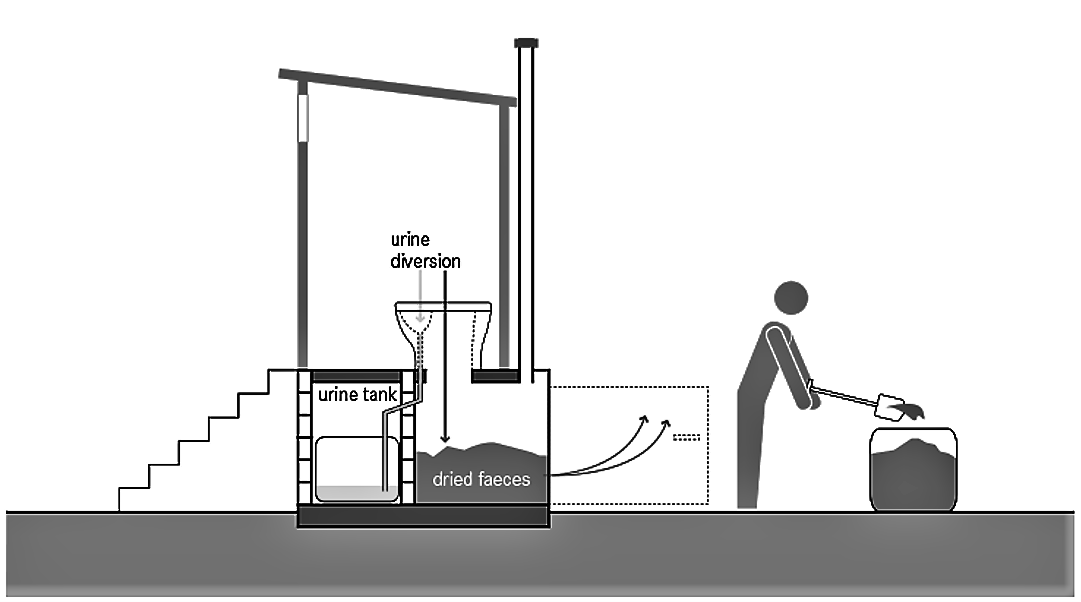
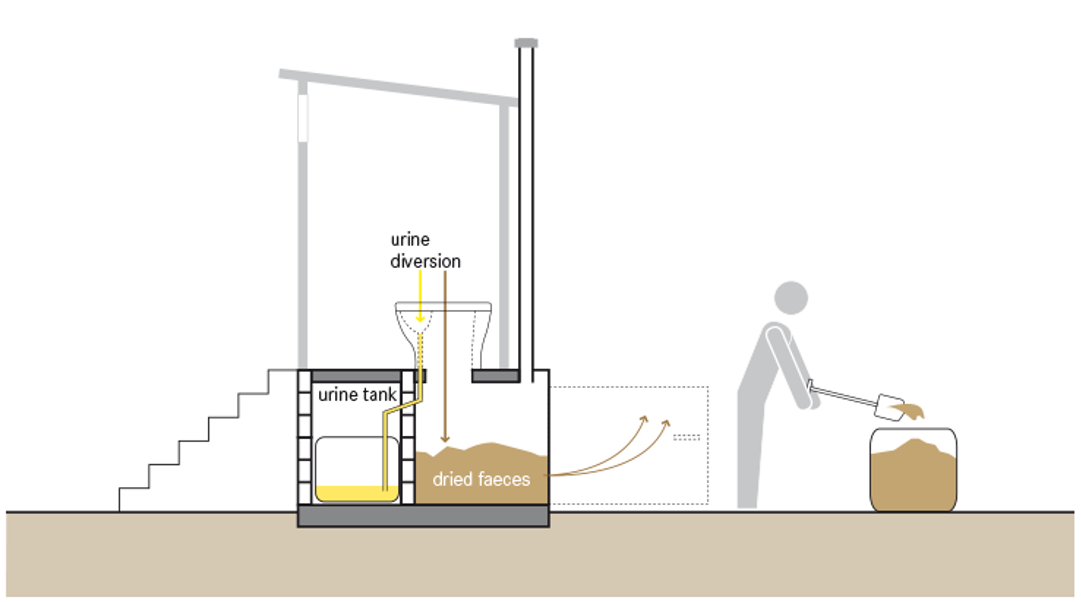
When faeces are stored in the absence of moisture (i.e., urine), they dehydrate into a crumbly, white-beige coarse, flaky material or powder. The moisture naturally present in the faeces evaporates and/or is absorbed by the drying material (e.g., ash, sawdust, lime) that is added to them. Dried faeces can be used as a soil conditioner.
| In | Out |
|---|---|
Compost / Biosolids, Food Products |
Introduction
Dehydration is different from composting because the organic material present is not degraded or transformed; only the moisture is removed. Faeces will reduce in volume by about 75% after dehydration. Completely dry faeces are a crumbly, powdery substance. The shells and carcasses of worms and insects in the faeces also dehydrate and becomes part of the dried material.
The material is rich in carbon and nutrients, but may still contain protozoan cysts or oocysts (spores that can survive extreme environmental conditions and be re-animated under favourable conditions) and other pathogens. The degree of pathogen inactivation will depend on the temperature, the pH (using ash or lime raises the pH) and storage time. It is generally accepted that faeces should be stored between 6 to 24 months, although pathogens may still exist after this time (refer WHO guidelines on excreta use in agriculture (Volume IV) for specific guidance).
The material can be mixed into soil for agriculture (depending on acceptance) or safely mixed into soil or buried elsewhere. Extended storage is also an option if there is no immediate use for the material (see surface disposal and storage).
Design Considerations
Faeces that are dried and kept at between 2 and 20° C should be stored for 1.5 to 2 years before being used at the household or regional level (see also dehydration and storage of faeces). At higher temperatures (i.e., greater than 20° C), storage over 1 year is recommended to inactivate Ascaris eggs (a type of parasitic worm). A shorter storage time of 6 months is required if the faeces have a pH above 9 (i.e., adding ash or lime increases the pH). WHO guidelines on excreta use in agriculture (Volume IV) concerning the use of excreta in agriculture should be consulted beforehand.
Health Aspects/Acceptance
The handling and use of dried faeces may not be acceptable to some people. However, because dehydrated faeces should be dry, crumbly, and odour free, using them might be easier to accept than manure or sludge. Dry faeces are a hostile environment for organisms and they do not survive long in it. If water or urine is mixed with the drying faeces, however, odours and organisms may become problematic because bacteria easily survive and multiply in wet faeces. Warm, moist environments are conducive to anaerobic processes, which can generate offensive odours.
Dehydrated faeces should not be applied to crops less than one month before they are harvested. This waiting period is especially important for crops that are consumed raw.
Operation & Maintenance
When removing dehydrated faeces from dehydration vaults, care must be taken to prevent the powder from blowing and being inhaled. Workers should wear appropriate protective clothing.
Faeces should be kept as dry as possible. If by accident, water or urine enters and mixes with drying faeces, more ash, lime or dry soil should be added to help absorb the moisture. Prevention is the best way to keep faeces dry.
Dried faeces are not as useful as a soil amendment as composted faeces. However, they can help to replenish poor soil and to boost the carbon and water-storing properties of soil, while posing low risk of pathogen transmission.
Urine-diversion. Ecological Sanitation Systems in South Africa
This publication includes directions for making a simple urinal using a 5 litre plastic container.
AUSTIN, A. DUNCKER, L. (2002): Urine-diversion. Ecological Sanitation Systems in South Africa. Ecological Sanitation Systems in South Africa. Pretoria: Council for Scientific and Industrial Research (CSIR)Technology Review of Urine-Diverting Dry Toilets (UDDTs)
This publication offers a complete overview of UDDT functions, design considerations, common operation and maintenance issues and generalised installation costs. Its focus is on applications in developing countries and countries in transition, although UDDTs are also applicable in developed countries.
RIECK, C. MUENCH, E. HOFFMANN, H. (2012): Technology Review of Urine-Diverting Dry Toilets (UDDTs). Overview on Design, Management, Maintenance and Costs. (= Technology Review ). Eschborn: German Agency for Technical Cooperation (GTZ) GmbH URL [Accessed: 11.05.2019]Guidelines for the Safe Use of Urine and Faeces in Ecological Sanitation Systems
These guidelines provide a thorough background on the safe use of urine and faeces for agricultural purposes. Aspects like the health risk associated we the use of human excreta in agriculture and how to limit them are discussed.
SCHOENNING, C. STENSTROEM, T. A. (2004): Guidelines for the Safe Use of Urine and Faeces in Ecological Sanitation Systems. (= EcoSanRes Publication Series, Report 2004-1 ). Stockholm: Stockholm Environment InstituteGuidelines for the safe use of wastewater excreta and greywater. Volume IV. Excreta and Greywater Use in Agriculture
Volume IV of the Guidelines for the Safe Use of Wastewater, Excreta and Greywater recognizes the reuse potential of wastewater and excreta (including urine) in agriculture and describes the present state of knowledge as regards potential health risks associated with the reuse as well as measures to manage these health risks following a multi-barrier approach.
WHO (2006): Guidelines for the safe use of wastewater excreta and greywater. Volume IV. Excreta and Greywater Use in Agriculture. Geneva: World Health Organisation (WHO) URL [Accessed: 09.05.2019] PDFEcological Sanitation - revised and enlarged edition
This book is one of the most fundamental and important books that defined the concept of ecological sanitation. The first version came out in 1998 - this version presents the findings of over ten years of research and development in ecological sanitation supported by SIDA (Swedish International Development Cooperation Agency).
WINBLAD, U. SIMPSON-HERBERT, M. (2004): Ecological Sanitation - revised and enlarged edition. (pdf presentation). Sweden: Stockholm Environment Institute URL [Accessed: 04.08.2010]