

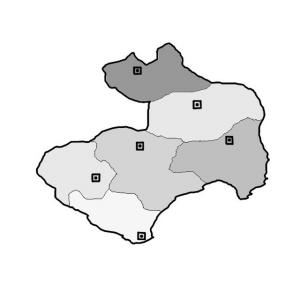
Executive Summary
In order to increase sanitation and water management efficiency and improve equity and justice for local people, a participatory and community-based approach is crucial. Democratic decentralisation is a promising means of institutionalising and scaling up popular participation that makes sustainable sanitation and water management effective (adapted from RIBOT 2002). This factsheet focuses on the decentralisation process and its possible outcomes. Two case studies from South Africa and Bolivia highlight the diversity of decentralisation outcomes for sanitation and water management and the importance of a proper implementation process.
(Democratic) Decentralisation for Sustainable Sanitation and Water Management
(Adapted from DE 2009; JONG 2009; RIBOT 2002)
Decentralisation is any act in which a central government formally cedes powers to actors and institutions at lower levels, in a political-administrative and territorial hierarchy. Democratic (or political) decentralisation occurs when powers and resources are transferred to authorities representative of and downwardly accountable to local populations. The aim of democratic decentralisation is to increase popular participation in local decision-making and to increase accountability and efficiency of the government in the delivery of services. As local governments operate more closely with the people than any other level of government, they might be able to identify the needs and preferences of communities better than authorities in centralised governments.
Thus, decentralisation could be a logical first step to implement any sustainable sanitation and water management interventions on the local level. Only if resources and powers are decentralised, it is possible for local authorities to decide on the most sustainable solution in their local area. For ensuring the efficiency of the implementation tools, the participation of the local population should be starched, which is best possible with a democratic decentralisation reform. Public participation can in turn add to sustainable sanitation and water management (DE 2009).
However, the implementation of sustainable sanitation and water management intervention tools is also possible in central states. Decentralisation is not a necessary pre-condition for the implementation of the intervention tools, but in many cases it simplifies the whole process if local governments are able to take certain decisions.
The problem of service provision by local governments is that it may be hampered by the low capacity of local governments, corruption, elite capture and political influence. The lack of political accountability, people’s participation, transparency, policy coherence, capacity at the lower level and monitoring and evaluation have held back the success of decentralisation programmes in service delivery in water supply and sanitation in developing countries (DE 2009). This factsheet aims to help understand these decentralisation problems and the whole process, to avoid negative outcomes and to facilitate positive outcomes, supporting the implementation of sustainable sanitation and water management intervention tools.
Main Benefits of Democratic Decentralisation
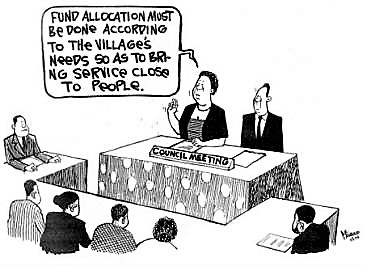
In order to increase sanitation and water management efficiency and improve equity and justice for local people, a participatory and community-based approach is crucial. “Democratic decentralisation is a promising means of institutionalising and scaling up popular participation that makes sustainable sanitation and water management effective” (RIBOT 2002). More precisely, decentralisation can lead to the following benefits (adapted from RIBOT 2002):
Equity:
Greater retention and fair or democratic distribution of benefits from local activities
Efficiency:
Increased economic and managerial efficiency through:
- Accounting for costs in decision making: When communities and their representatives make decisions, they might take into account (“internalise”) the whole array of costs to local people.
- Increasing accountability: By bringing public decision making closer to the citizenry, decentralisation is believed to increase public-sector accountability and therefore effectiveness.
- Reducing transaction costs: Administrative and management transaction costs may be reduced by means that increase the proximity of local participants, and access to local skills, labour and local information.
- Matching services to needs: Bringing local knowledge and aspiration into project design, implementation, management and evaluation helps decision makers to better match actions to local needs.
- Mobilising local knowledge: Bringing government closer to people increases efficiency by helping to tap the knowledge, creativity and resources of local communities.
- Improving coordination: Decentralisation is believed to increase the effectiveness of coordination and flexibility among administrative agencies and in planning and implementation of development.
- Providing resources: Providing local communities with material and revenues can contribute to development.
How to Decentralise Government for Sanitation and Water Management
(Adapted from RIBOT 2002)
“Most current “decentralisation” reforms are characterised by insufficient transfer of powers to local institutions, under tight central-government oversight. Often, these institutions do not represent and are not accountable to local communities.” (RIBOT 2002) These outcomes of decentralisation processes need to be avoided.
Generally, it is difficult to decentralise governments for sustainable sanitation and water management without the support of the national (central) government. Some processes might be possible within a central government, others might not. The following points should be considered within a decentralisation, especially when the central government focuses on decentralisation and supports the process:
- Central governments should work with local democratic institutions as a first priority. Governments, donors, and NGOs can foster local accountability by (1) choosing to work with and build on elected local governments where they exist, (2) insisting on and encouraging their creation elsewhere, (3) encouraging electoral processes that admit independent candidates (since most do not), and (4) applying multiple accountability measures to all institutions making public decisions.
- Sufficient and appropriate powers need to be transferred. Local and national governments, donors, NGOs, and the research community should work to develop sanitation and water management subsidiarity principles to guide the transfer of appropriate and sufficient powers to local authorities. Guidelines are also needed to assure an effective separation and balance of executive, legislative, and judiciary powers in the local arena.
- Support equity and justice. Central government interventions may be needed for reducing inequities and preventing elite capture of public decision-making processes. Central governments must also establish the enabling legal environment for organising, representation, rights, and resources so that local people can demand government responsibility, equity, and justice for themselves. Furthermore, the local governments need to set out clear policies and a legal framework (see creating policies and a legal framework) within the national framework focusing sustainable sanitation and water management issues.
- Establish fair and accessible adjudication. Local governments should establish accessible independent courts, or access to national courts, channels of appeal outside of the government agencies involved in sanitation and water management, and local dispute resolution mechanisms. Donors and NGOs can also support alternative adjudication mechanisms to supplement official channels instead of replacing them.
- Support local civic education. People need to be informed of their rights (see laws should be written in clear and accessible language, and legal texts might be translated into local languages to encourage popular engagement and local government responsibility. When there are meaningful rights it is critical for people to know them. Local authorities need to be educated about their rights and responsibilities to foster responsible local governance (see also invalid link and awareness raising (see PPT)).
- Give decentralisation time. Judge decentralisation only after it has been tried. Give it sufficient time to stabilise and bear fruit.
- Develop indicators for monitoring and evaluating decentralisation and its outcomes. By developing and monitoring indicators of progress in decentralisation legislation, implementation and outcomes can be evaluated and provide needed feedback that could keep decentralisation initiatives on track (see participatory monitoring and evaluation).
- Document the process (see also process documentation).
- Find places for local government’s meetings. It is not enough that a local government exists and has power and resources, it needs a place to enable meetings, elections, etc.
- Inform the public. For a well working local government, the public needs to be informed about its actions and ideas (see also media campaigns). It is important to work transparent for the civil society.
- Avoid corruption. Corruption needs to be avoided in local governments. It is important for the local authorities to work transparent for the civil society and for higher governmental levels (see also water corruption).
Measuring Decentralisation Outcomes Is Problematic
(Adapted from RIBOT 2002)
Has decentralisation really occurred? Can change in sustainable sanitation and water management be associated with decentralised institutional arrangements? Characterising decentralisation involves evaluating changes in laws, and their implementation, and in local institutions, their powers, and their accountability. Measuring outcomes involves adequate data before and after decentralisation, or direct observation of processes affected by new institutional arrangements. These institutional, social, and environmental changes (in the sense of the social environment) changes often are difficult to identify and quantify.
Connecting outcomes to decentralisation and separating these outcomes from other ongoing changes is difficult. Sometimes, it is hard to attribute changes to decentralisation because of the many overlapping sets of policy and legal framework reforms. How does one know whether decentralisation is responsible for these outcomes? What are the effects of other phenomena?
In addition, measuring outcomes requires historic baseline data for before-and-after comparisons. Are seemingly inequitable outcomes less inequitable than what would otherwise have happened? How has inequality changed? Aggregating outcomes is another problematic aspect of measuring decentralisations. How do we assess overall outcomes when some are positive and others are negative?
Measuring decentralisation outcomes is complicated and needs good documentation. of the whole process It depends on many factors, if the outcomes will be positive or negative. In the following, two examples show that decentralisation processes can succeed more or less.
Example South Africa: Problems With Decentralisation
(Adapted from DE 2009, JONG 2009)
Water and sanitation service delivery failures at municipal level are a widespread and fundamental problem in South Africa: Poor communities are receiving sub-standard basic services, and sometimes no services at all; municipalities continue to have service delivery backlogs; etc. There is a general problem of poor governance at municipal level and a public perception that some municipalities do not have the human skills to provide a proper service to the poor. Especially rural areas have problems with sanitation and water service delivery.>
The most important reason for this is that complex powers and functions were devolved to local authorities during the decentralisation process, but those local authorities did not have the capabilities of managing them.
There is a clear need for South African residents to play an active role in ensuring that they can enjoy the services they are entitled to. They need to be empowered to engage meaningfully with the sometimes complex municipal systems and processes (see also awareness raising (see PPT)). This requires an understanding of the rights of access to information and to public participation (see also participatory monitoring and evaluation, as well as a basic understanding of law, economics and financial accounting relevant to analysing municipal tariffs and financial statements.
Example Decentralisation in Bolivia: A Success Story for the Poor
(Adapted from FAGUET 2003)
Since 1994 Bolivia has undergone a dramatic process of political decentralisation. Recent research has analysed this decentralisation process and argues that it has made the Bolivian government more responsive to the needs of the poor by redirecting public investment to areas of greatest need.
Up until 1994, the relatively few central government officials that were stationed beyond the national and regional capital had little incentive to concern themselves with local demands. The only route to success and career advancement was to implement policies that were set by central government. In 1994 however, Bolivia introduced the Law of Popular Participation, making local authorities responsible to local voters for the first time.
As a result, there has been a dramatic change in the way government money is spent, and this has been a change which has benefited the poor. Resources have been redirected into Bolivia’s smallest and poorest municipalities and government investment has shifted from economic production and infrastructure to spending on social services, education and training. The amount of money spent on education, water and sanitation services has risen in those places where it is most needed ― areas with the highest rates of illiteracy and lowest rates of water and sewage connection.
Other results of the process included:
- The allocation of government funding amongst municipalities has switched from being based on unsystematic, highly political criteria to a strict per capita basis ― as a result the share allocated to the country’s three largest cities has declined from 86 to 27 %.
- Decentralisation has allowed groups such as neighbourhood councils, peasant communities, traditional indigenous peoples’ organisations, interest groups and business associations to be more actively involved in the political process. In the old system, these groups had very little say in how their communities were run.
- Lower tiers of government have become more accessible to lobbying and grass-roots pressure, a marked change from a centralised administration that effectively ignored large areas of the country.
Overall, FAGUET (2003) argues that under the right circumstances, decentralising resources and political authority can generate real democratic accountability where none existed before. The transformation of political institutions and of the way in which resources are distributed, can bring about significant social and political changes across the nation within a relatively short time.
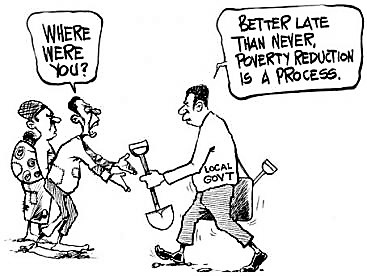
Decentralisation is a helpful means for the implementation of sustainable sanitation and water management tools on the local level. However, it is no necessary pre-condition, as sustainable sanitation and water management intervention tools can be implemented within central states as well.The applicability of decentralisation varies from case to case: Some central governments hamper local governments in service delivery, as policies and laws are set against such a decentralisation. For a successful application, a strong transfer of powers and resources from the central government to local governments is needed, as well as accordingly policies and legal frameworks. Informing the public is also important to focus their participation in the decentralisation process for designing it in a democratic way.
Can Decentralisation Improve Rural Water Supply Services?
This case study is from West Bengal. The survey of households in six villages in Birbhum district shows that decentralisation in delivery of water supply can lead to better quality of services.
DE, I. (2009): Can Decentralisation Improve Rural Water Supply Services? . Economic and Political Weekly (EPW)South Africa: Municipal Failures Put Decentralisation at Risk
Decentralisation and Local Government in Bolivia : An Overview from the Bottom Up

This paper is about the case of Bolivia to explore decentralisation’s effects on government responsiveness and poverty-orientation. The author explains how decentralisation in Bolivia made government more responsive by re-directing public investment to areas of greatest need.
FAGUET, J.P. (2003): Decentralisation and Local Government in Bolivia : An Overview from the Bottom Up. (= Working Papers Series No.1 ). London: Crisis States Programme URL [Accessed: 27.08.2012]Auditing Poverty - the Cartoons
African Decentralisation: Local Actors, Powers and Accountability. Democracy, Governance and Human Rights
This document examines design and implementation issues emerging in decentralisation in Africa. The author examines the changes that have taken place, especially concerning local actors, powers and accountabilities, with a critical approach.
RIBOT, J. (2002): African Decentralisation: Local Actors, Powers and Accountability. Democracy, Governance and Human Rights. (= Working Paper No. 8 ). Geneva: : United Nations Research Institute for Social Development (UNRISD) and International Development Research Centre (IDRC) URL [Accessed: 25.10.2010]Democratic Decentralisation of Natural Resources. Institutionalising Popular Participation

This document is helpful to get an idea of what decentralisation is meant to be like. It gives an overview on the topic and includes tips for a decentralisation process.
RIBOT, J. (2002): Democratic Decentralisation of Natural Resources. Institutionalising Popular Participation. World Resources Institute (WRI) URL [Accessed: 25.10.2010]Democratic Decentralisation of Natural Resources. Institutionalising Popular Participation
This document is helpful to get an idea of what decentralisation is meant to be like. It gives an overview on the topic and includes tips for a decentralisation process.
RIBOT, J. (2002): Democratic Decentralisation of Natural Resources. Institutionalising Popular Participation. World Resources Institute (WRI) URL [Accessed: 25.10.2010]Domestic Water and Sanitation as Water Security
As distinct from many other domains to which the concept of water security is applied, domestic or personal water security requires a perspective that incorporates the reciprocal notions of provision and risk, as the current status of domestic water and sanitation security is dominated by deficiency. This paper reviews the interaction of science and technology with policies, practice and monitoring, and explores how far domestic water can helpfully fit into the proposed concept of water security, how that is best defined, and how far the human right to water affects the situation.
BRADLEY, D.J. ; BARTRAM, J.K. (2013): Domestic Water and Sanitation as Water Security. Monitoring, Concepts and Strategy. In: Philosophical Transactions of the Royal Society: , 371. URL [Accessed: 01.11.2013]Achieving Sustainability: Encouraging Local Government Investment
Substantial local government investment is essential for sustainable services, but difficult to achieve. Barriers include institutional lack of clarity over responsibilities (particularly in sanitation provision), weak capacity to collect and manage revenues, unpredictable transfers from national to local government, and a lack of data on past spending and its effectiveness.
COWLING, R. (2013): Achieving Sustainability: Encouraging Local Government Investment. (= Practice Note , 13 ). London: Water and Sanitation for the Urban Poor (WSUP) URL [Accessed: 25.11.2013]Can Decentralisation Improve Rural Water Supply Services?
This case study is from West Bengal. The survey of households in six villages in Birbhum district shows that decentralisation in delivery of water supply can lead to better quality of services.
DE, I. (2009): Can Decentralisation Improve Rural Water Supply Services? . Economic and Political Weekly (EPW)Decentralisation and Local Government in Bolivia : An Overview from the Bottom Up
This paper is about the case of Bolivia to explore decentralisation’s effects on government responsiveness and poverty-orientation. The author explains how decentralisation in Bolivia made government more responsive by re-directing public investment to areas of greatest need.
FAGUET, J.P. (2003): Decentralisation and Local Government in Bolivia : An Overview from the Bottom Up. (= Working Papers Series No.1 ). London: Crisis States Programme URL [Accessed: 27.08.2012]Decentralisation in India: Poverty, Politics and Panchayati Raj
Based on decentralisation concepts and theories, Johnson describes a decentralisation processes in India.
JOHNSON, C. (2003): Decentralisation in India: Poverty, Politics and Panchayati Raj. (= Working Paper 199 ). London: Overseas Development Institute URL [Accessed: 15.04.2019]Assessing Decentralisation and Local Governance in West Africa. Taking Stock of Strengthening the Monitoring and Evaluation Capacity of Local Actors

This document examines a number of initiatives to build the capacity of local stakeholders to monitor and evaluate decentralisation and local governance processes. It builds on the results of case studies done in five West African countries (Benin, Cameroon, Ghana, Mali and Niger)
BAY, S. le LOQUAI, C. (2008): Assessing Decentralisation and Local Governance in West Africa. Taking Stock of Strengthening the Monitoring and Evaluation Capacity of Local Actors. European Centre for Development Policy Management (ECDPM) URL [Accessed: 25.10.2010]African Decentralisation: Local Actors, Powers and Accountability. Democracy, Governance and Human Rights
This document examines design and implementation issues emerging in decentralisation in Africa. The author examines the changes that have taken place, especially concerning local actors, powers and accountabilities, with a critical approach.
RIBOT, J. (2002): African Decentralisation: Local Actors, Powers and Accountability. Democracy, Governance and Human Rights. (= Working Paper No. 8 ). Geneva: : United Nations Research Institute for Social Development (UNRISD) and International Development Research Centre (IDRC) URL [Accessed: 25.10.2010]Decentralisation in Mali: Putting Policy Into Practice

This bulletin aims to inform readers not only about the rationale for and foundations of decentralisation in Mali, the institutional support arrangements and the first achievements of the process at local level, but also about the issues and challenges arising from this process.
SNV ; CEDELO (2004): Decentralisation in Mali: Putting Policy Into Practice. (= Bulletin 362 ). Amsterdam: Royal Tropical Institute URL [Accessed: 15.04.2019]How Can INGOs Help Promote Sustainable Rural Water Services?
This paper examines how the international NGO WaterAid supports decentralised local governments in Mali to fulfil their role of service authorities within a service delivery approach for rural water services.
JONES, S. (2013): How Can INGOs Help Promote Sustainable Rural Water Services?. An Analysis of WaterAid’s Approach to Supporting Local Governments in Mali. In: Water Alternatives: Volume 6 , 350-366. URL [Accessed: 15.04.2019]Devolution in Kenya
Devolution, or the delegation of power by central government to local or regional administration, is by far the most significant initiative in governance that Kenya has undertaken since independence. Effective implementation of the new devolved framework now requires the water sector to focus on the emerging opportunities and to address a number of challenges. This note analyses the pertinent issues and options for national government and county leadership to achieve sustainable delivery of improved water services under the new dispensation.
WSP (2013): Devolution in Kenya. Opportunities and Challenges for the Water Sector. Washington: The World Bank, Water and Sanitation Program (WSP) URL [Accessed: 10.04.2019]