


Executive Summary
The term “institutional framework” refers to a set of formal organisational structures, rules and informal norms for service provision. Such a framework is the precondition for the successful implementation of other sanitation and water management intervention tools and therefore needs to be considered in particular. In the field of water and sanitation management, an institutional framework involves outlining the responsibilities of services institutions for various aspects of the sector (IEES 2006). Institutional structures vary from country to country, but whatever the specific structure is like, it is essential to have mechanisms for dialogue and co-ordination. A balance has to be met between providing a fully integrated approach where specific issues may get lost due to lack of expertise or interest, and a sectoral approach where different policies are followed without any co-ordination (GWP 2008).
Why Ensuring an Institutional Framework?
An institutional framework is the precondition for the successful implementation of many other sanitation and water management interventions. An institutional framework for sanitation and water management consists of a range of different organisations that are in place (or need to be in place) to develop and manage water resources and the delivery of water and sanitation services at different levels of society (GWP 2008). Implementing an institutional framework is an important process for preparing the ground for sustainable sanitation and water management.
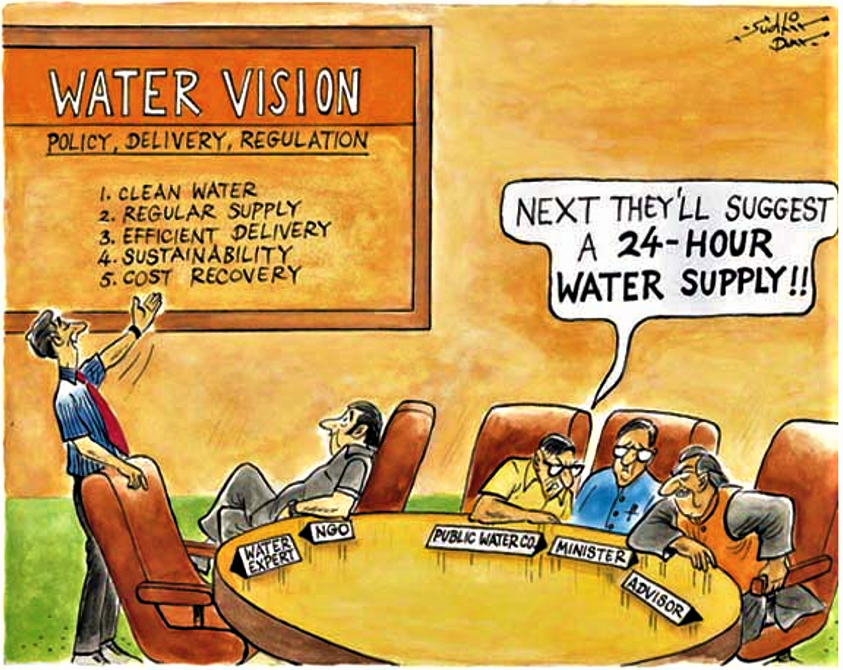
A lack of a sound institutional framework is the root cause of many failures in service delivery — and a major cause of failed water and sanitation provision. Such institutional weakness often results from the lack of a clear institutional “home” for planning and management, together with limited capacity within institutions to coordinate and manage initiatives. The all-too-common outcome is declining services leading to poor cost recovery and ultimately failed investments that do not meet either current or future demand (e.g. water pricing) (SCOTT et al. 2003).
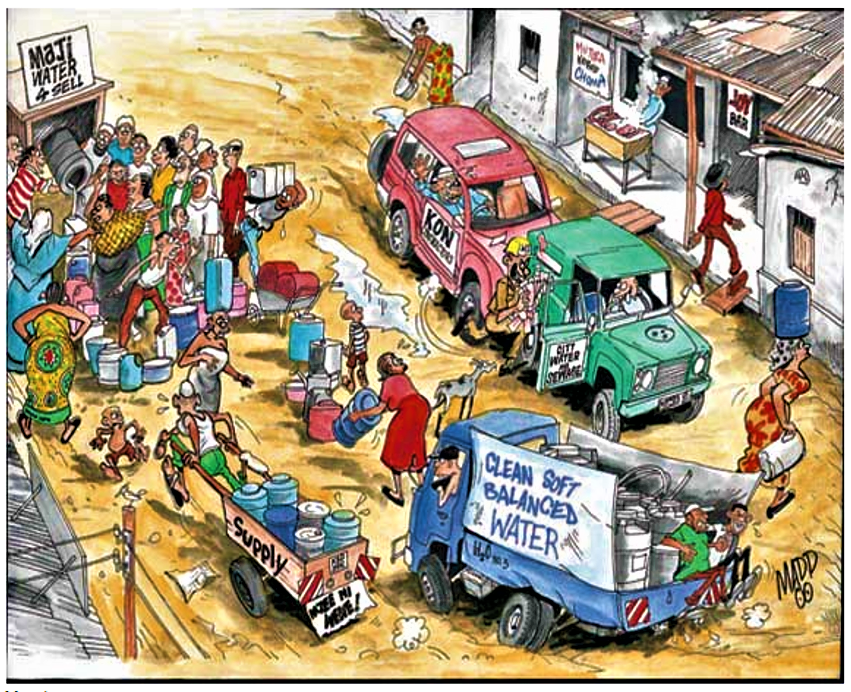
The capacity to provide services effectively and efficiently is critical for the long-term sustainability of service provision, not only in the field of sustainable sanitation and water management, but in general. Most of the constraints to accelerated delivery of service are due to capacity problems at provincial and municipality levels. Appropriate management models are required to ensure that sanitation service delivery is sustained beyond the implementation of infrastructure projects (WRC 2003).
Actors
(Adapted from GWP 2008)
A sound institutional framework for sustainable sanitation and water management on the local level needs a lot of organisations and actors to be in place, such as:
- Service providers range from government departments and municipalities, public corporations, and private sector companies to community-based organisations, and farmers' groups.
- Regulatory and enforcement bodies have a crucial role in establishing and ensuring the effective application of tools for sustainable sanitation and water management.
- The private sector plays an important role in financing sustainable sanitation and water management. Commercial banks and other financial institutions can finance both public and private sector service providers.
- Local authorities can play an important role in overseeing the implementation of activities in sanitation and water management, both within their boundaries and within the local and regional watersheds. They act as regulators and as service providers and have a role in raising finance.
- Civil Society Institutions (CSIs), Non-Governmental Organisations (NGOs) and Community-Based Organisations (CBOs) can play an important role in developing and communicating sanitation and water management policies. Also, they can advocate on behalf of nature and environmental protection, develop and test new models and tools for sanitation and water management, increase awareness of the need for sustainable sanitation and water management and mobilise local communities to get involved.
The most important thing about the actors of an institutional framework is that they need to be co-operative, and have clear definitions of roles and responsibilities. Therefore the organisations and actors need to work transparently and in dialogue with each other. It is possible and sometimes very helpful to build partnerships on the basis of basic policies accepted by all parties.
How to Ensure an Institutional Framework
An institutional framework must be stable, transparent and based on the rule of law, respecting fundamental human needs and ecosystems conservation, and promoting local empowerment and appropriate cost recovery approaches (DWAF 2003). For the new to-be-developed (local) institutional framework, it is advisable to build on and strengthen the existing structure rather than starting from the scratch (IEES 2006). Therefore, promotion of substantial institutional reform may be appropriate in many cases and could include providing support to a variety of initiatives in the SSWM sector, such as:
- Bundling/unbundling of functions, organisational restructuring: The distribution and disposition of functions, activities, processes, roles and responsibilities within an organisation needs to be faced for efficient sanitation and water management (DFID 1998). Also, roles and responsibilities between different spheres of government, community organisations, and the private sector need to be clearly defined, established, recognised and the necessary support needs to be provided. Avoid fragmented and/or overlapping mandates between different organisations and stakeholders (IEES 2006). Wherever possible and practical, the roles of regulation and operation should be clearly separated and preferably fulfilled by separate institutions (DWAF 2003). See also bundling and unbundling of functions.
- Strengthening enforcement bodies: As laws, rules, structures and responsibilities as well as partnership agreements need to be achieved, there must be a sound body monitoring and enforcing them. See also strengthening enforcement bodies.
- Decentralisation will bring government closer to rural communities and is a positive factor for better services and the use of local capacity. However, a phased transition is needed to address several issues (IEES 2006). See also decentralisation.
- Improving cost recovery is crucial to generate the resources for maintaining and improving services, to meet both existing and future demand (DFID 1998).
- Building Public Private Partnerships (PPPs): The government may benefit from the expertise of the private sector in PPPs for SSWM, such as:preparing guidelines, technical assistance, planning, design and contract supervision, construction by large and small contractors, preparation of communications materials, training and capacity building, materials supplies, financing, monitoring (DFID 1998). See also public private partnerships.
- Privatising parts of the water and/or sanitation sector: Introducing private sector incentives and management skills may help to overcome service provision problems and the private sector can act as catalyst for change. See also privatisation.
- Nationalising parts of the water and/or sanitation sector: If there are problems with private service providers, it might help to transfer some responsibilities to the (local) government to make the sector work more efficient and less expensive. See also nationalisation.
- Enhancing participation and involvement of civil society at all levels in consultations, planning, decision-making and operation of sanitation and water management, in research and in other related activities (DWAF 2003). Building an institutional framework is a process that will take its time. Most of the advantages are taking place in the long-term, so in the short-term the process might seem to cost money and efforts for no effect. Motivate the public in forcing the targets, for example through the media. See also awareness raising tools (see PPT).
- Human resources development (HRD) and management development that supports improved capability in all these aspects will be needed (DFID 1998). See also developing human resources.
The applicability of different organisational arrangements (e.g. public-private-partnership) varies from case to case.
The composition of institutions in any given country will depend on the nation’s experience and needs. Institutional structures vary from country to country.
An institutional framework for sustainable sanitation and water management can include organisations of all levels (local, regional, national, international), the political and legal complexity increases with each of the levels.
Decentralisation might be a problem in some nations, when there are no local structures welcome from the (central) government’s side. When there is no decentralisation possible, an institutional framework on the local level is not applicable.
Strategic Framework for Water Services

The DWAF offers information about the institutional structure for service provision, which is very helpful for getting an overview of the topic. Chapter summary available online.
DWAF (2003): Strategic Framework for Water Services. Republic of South Africa: Department of Water Affairs and Forestry (DWAF) URL [Accessed: 11.04.2019]GWP Toolbox. Integrated Water Resources Management
The IWRM ToolBox is a free and open database with a library of case studies and references that can be used by anyone who is interested in implementing better approaches for the management of water or learning more about improving water management on a local, national, regional or global level.
GWP (2008): GWP Toolbox. Integrated Water Resources Management. URL [Accessed: 16.05.2010]Challenges in Developing an Institutional Framework
This paper on institutional frameworks is very helpful for getting more information about the topic. It is offering both detailed information and links to further reading material in each of its sections.
IEES (2006): Challenges in Developing an Institutional Framework. Wolhusen: International Ecological Engineering Society (IEES) URL [Accessed: 11.04.2019]Sanitation and the Poor

This document is on sanitation and the challenges of improving it. It includes some case studies and ideas about building an institutional framework for its cause.
SCOTT, R. COTTON, A. GOVINDAN, B. (2003): Sanitation and the Poor. Leicestershire/London/Delft: Resource Centre for Water, Sanitation and Environmental Health (WELL) URL [Accessed: 11.04.2019]Sanitation Research Strategy
The Sanitation Research Strategy includes a part about institutional and management aspects of sanitation service delivery, helping to identify short-term and long-term objectives.
WRC (2003): Sanitation Research Strategy. Water Research Commission (WRC) URL [Accessed: 11.04.2019]Guidance Manual on Water Supply and Sanitation Programmes
This manual has been prepared as a tool to help improve DFID's (Department for International Developments, United Kingdom) support for water supply and sanitation projects and programmes in developing countries. Its particular focus is on how DFID assistance can best meet the needs of the urban and rural poor for water supply and sanitation services.
DFID (1998): Guidance Manual on Water Supply and Sanitation Programmes. London: Water, Engineering and Development Centre (WEDC) for the Department for International Development (DFID) URL [Accessed: 09.05.2018]A lack of a sound institutional framework is the root cause of many failures in service delivery — and a major cause of failed water and sanitation provision
Strategic Framework for Water Services
The DWAF offers information about the institutional structure for service provision, which is very helpful for getting an overview of the topic. Chapter summary available online.
DWAF (2003): Strategic Framework for Water Services. Republic of South Africa: Department of Water Affairs and Forestry (DWAF) URL [Accessed: 11.04.2019]Challenges in Developing an Institutional Framework
This paper on institutional frameworks is very helpful for getting more information about the topic. It is offering both detailed information and links to further reading material in each of its sections.
IEES (2006): Challenges in Developing an Institutional Framework. Wolhusen: International Ecological Engineering Society (IEES) URL [Accessed: 11.04.2019]Guidance Manual on Water Supply and Sanitation Programmes
This manual has been prepared as a tool to help improve DFID's (Department for International Developments, United Kingdom) support for water supply and sanitation projects and programmes in developing countries. Its particular focus is on how DFID assistance can best meet the needs of the urban and rural poor for water supply and sanitation services.
DFID (1998): Guidance Manual on Water Supply and Sanitation Programmes. London: Water, Engineering and Development Centre (WEDC) for the Department for International Development (DFID) URL [Accessed: 09.05.2018]B1. Creating an organisational framework
The Toolbox by the Global Water Partnership offers a lot of information on institutional roles in the water sector. It offers two main informational sectors in this topic, one sector for creating an organisational framework and one for building institutional capacity.
GWP (2003): B1. Creating an organisational framework. In: Sharing knowledge for equitable, efficient and sustainable water resources management. Global Water Partnership (GWP), pp.35-57 URL [Accessed: 15.04.2019]Strategic Framework for Water Services. Water is life, sanitation is dignity
This document includes a list of the key principles in forming an institutional framework, as well as some graphs to show the roles and responsibilities for such a framework. It is good for getting an overview on the approach.
KASRILS, R. (2003): Strategic Framework for Water Services. Water is life, sanitation is dignity. Republic of South Africa: Department of Water Affairs and Forestry URL [Accessed: 28.07.2010]Sanitation and the Poor
This document is on sanitation and the challenges of improving it. It includes some case studies and ideas about building an institutional framework for its cause.
SCOTT, R. COTTON, A. GOVINDAN, B. (2003): Sanitation and the Poor. Leicestershire/London/Delft: Resource Centre for Water, Sanitation and Environmental Health (WELL) URL [Accessed: 11.04.2019]Guidelines on Municipal Wastewater Management
Sanitation Research Strategy
The Sanitation Research Strategy includes a part about institutional and management aspects of sanitation service delivery, helping to identify short-term and long-term objectives.
WRC (2003): Sanitation Research Strategy. Water Research Commission (WRC) URL [Accessed: 11.04.2019]Groundwater Governance. Synthesis of Thematic Papers/Case Studies. Preparing the ground for Regional Consultations and Global Diagnostic Report

This document synthesizes the 12 thematic papers and case studies prepared by the Groundwater Governance project in an effort to review the global situation of groundwater governance and develop of a Global Groundwater Diagnostic. This diagnostic presents current knowledge and experience concerning key economic, policy, institutional, environmental and technical aspects of groundwater management, and addresses emerging issues and innovative approaches.
FAO GEF IAH IHP World Bank (2012): Groundwater Governance. Synthesis of Thematic Papers/Case Studies. Preparing the ground for Regional Consultations and Global Diagnostic Report. FAO URL [Accessed: 28.03.2013]Groundwater policy and governance

This paper starts by pointing to the large, remaining gaps in our understanding of how water is an integral part of society and its relationship to the planet’s environment. It recognizes that, at their root, all modes of tapping, distributing, and managing water supplies are the result of organized human effort, usually achieved through institutions. The authors address the role of governance of subsurface water, which according to many practitioners and observers remains largely uncharted, incompletely assessed, and notably uncertain and complex
FAO GEF IAH IHP World Bank (2012): Groundwater policy and governance. FAO URL [Accessed: 28.03.2013]Legal and institutional frameworks

Whereas day to day management of groundwater resources takes place within the national sphere, and often at local level, domestic regulatory systems cannot be seen in isolation from international legal frameworks when transboundary aquifers are concerned. In that case international law determines states¿ rights and obligations to which domestic law has to be made compatible. The legal framework for groundwater management should provide answers to key questions such as, who can access groundwater, where, for which purposes and under which conditions? How are aquifers protected against depletion and pollution? According to which criteria are the finite resources of non-recharging aquifers to be allocated and protected? Which kind of monitoring and planning tools have to be used? How will private and public interest be balanced and how get stakeholders involved in decision making and management processes? These are some of the questions this report tries to respond.
FAO GEF IAH IHP World Bank (2012): Legal and institutional frameworks. FAO URL [Accessed: 02.04.2013]Tapping the Market - Opportunities for Domestic Investments in Water for the Poor

To improve access to safe water, particularly by the poor, developing country governments and the international development community are looking to the domestic private sector to play an expanded role. This report examines piped water schemes in rural areas of Bangladesh, Benin, and Cambodia and concludes that in the three study countries, un-served people could increasingly rely on service provision through the domestic private sector as the potential market the domestic private sector could be serving is very large.
THE WORLD BANK ; WSP ; IFC (2013): Tapping the Market - Opportunities for Domestic Investments in Water for the Poor. (= Conference Edition ). Washington: The World Bank, Water and Sanitation Program (wsp), International Finance Corporation (IFC) URL [Accessed: 05.09.2013]Tapping the Market - Opportunities for Domestic Investments in Sanitation for the Poor

To improve access to sanitation, particularly by the poor, developing country governments and the international development community are looking to the domestic private sector to play an expanded role. This report examines private sector provision of on-site sanitation services in Bangladesh, Indonesia, Peru, and Tanzania and concludes that in the study countries, un-served people could increasingly rely on service provision through the domestic private sector as the potential market the domestic private sector could be serving is very large.
THE WORLD BANK ; WSP ; IFC (2013): Tapping the Market - Opportunities for Domestic Investments in Sanitation for the Poor. (= Conference Edition ). Washington: The World Bank, Water and Sanitation Program (wsp), International Finance Corporation (IFC) URL [Accessed: 05.09.2013]Der Nexus Wasser-Energie-Nahrung

Vernetzte Versorgungsrisiken mit sektor- und grenzüberschreitenden Wechselwirkungen stellen für die Politik eine große Herausforderung dar. Ziel der vorliegenden Studie ist, die politische Dimension solcher Probleme zu erfassen und Bearbeitungsoptionen zu diskutieren. Denn häufig ist nicht die Verfügbarkeit einer Ressource oder der Mangel an Lösungsansätzen das zentrale Problem. Stattdessen fehlt es oft am politischen Willen, ein integriertes und langfristig nachhaltiges Management von Ressourcen und Risiken zielstrebig umzusetzen.
BEISHEIM, M (2013): Der Nexus Wasser-Energie-Nahrung. Wie mit vernetzten Versorgungsrisiken umgehen?. Berlin: Stiftung Wissenschaft und Politik (SWP) URL [Accessed: 07.10.2013]Language: German
From Adopt-a-Project to Permanent Services
The dominant paradigm in rural water provision in Bolivia has focused on the provision of infrastructure, whether by government agencies or international cooperation groups. However, the investment in infrastructure has led neither to universal access for all Bolivians nor to consistently high levels of services for those who do have access to a water system. This paper will describe the transition of one international non-profit organisation, Water For People, from supporting dispersed water projects throughout the country towards targeted support of water services at the municipal level, aiming to support permanent universal services.
FOGELBERG, K. (2013): From Adopt-a-Project to Permanent Services. The evolution of Water For People’s Approach to Rural Water Supply in Bolivia. In: Water Alternatives: Volume 6 , 367-383. URL [Accessed: 11.04.2019]Department of Water Affairs of the Republic of South Africa
The official website of the Department of Water Affairs of the Republic of South Africa presents a lot of water related projects and a library of documents.
GWP IWRM ToolBox
The website of GWP contains the toolbox as a web-based learning tool itself and additionally all publications by GWP. Topics of IWRM, Good Water Governance and many more IWRM related issues are discussed in a very comprehensive way. A very extensive collection of high-quality papers are available in English, French, Spanish and Russian. The site also contains a very extensive collection of case studies
Water Research Commission
The Water Research Commission website gives a lot of information about water and wastewater treatment.
National Sanitation Policy White Paper: Draft
The National Sanitation Draft White Paper includes a chapter about institutional and organisational framework for sanitation. On this site, you can find detailed information on how to build such a framework, including stakeholders and responsibilities, financial and economic approaches etc. Only available online.