

Executive Summary
The nationalisation of sanitation and water management is one option for (local) governments to cope with the increasing problem of lacking sanitation and water services. For the public sector, nationalising the utilities means facing the following responsibilities: operational viability, conductive policy environment and legal framework, legitimacy and accountability, financial sustainability and independent, functional regulatory system (MONTEMAYOR 2005).
Introduction
Nationalisation is one option when building an institutional framework for sustainable sanitation and water management. More information about building an institutional framework might help to get an overview of what else can be done. In general, sanitation and water management can be in private hands (see also privatisation), in public hands ― which will be discussed below ― or it is a mixture of both, like with public private partnerships (adapted from THE WORLD BANK 2006).
Problems with Water and Sanitation Management
(Adapted from THE WORLD BANK 2006)
“In many developing countries, the delivery of water services is unsatisfactory. Many households do not receive water from the main utility, even though they would be prepared to pay for the service. Others are connected, but get water for only a few hours a day. Even fewer are connected to a sewer network. Often the water is not safe to drink and the wastewateris not properly treated” (THE WORLD BANK 2006).
The most serious obstacles ― under both public and private operation ― to achieving a local government’s goals in water and sanitation management are:
- Water and sanitation services are critical to all consumers.
- They are often provided under conditions of natural monopoly; one well-run firm can supply the services at a lower cost than two or more well-run firms.
- The investments required to provide the services are often long-lived and irreversible; once made, they cannot be reversed should the returns to the investment prove less than expected.
The biggest challenge for local governments is to address these problems. One possibility to do so might be the (re-)nationalisation of parts (or all parts) of the sanitation and water management sector or the improvement of the status quo of state-run water and sanitation utilities. Also, nationalisation might be an answer when privatisation has shown to be ineffective in the specific region. Therefore, the key question needs to be: How to improve and expand the public sanitation and water service delivery (adapted from HALL 2005)?
Possible (Positive) Outcomes of Nationalisation
A (re-)nationalisation of the water and sanitation sector has the following four main benefits:
- Operating performance: The incentive to act in the public interest (e.g. through future elections or public protest) might motivate the public provider to operate more efficiently than its private counterpart, which might be stronger led by profit incentives.
- Investment decisions:As the public provider is not profit driven, investment decisions in sanitation and water management are usually made in the public interest (e.g. serving the unconnected poor, not focusing on areas that promise high profit margins).
- Participation: Participation of community members (e.g. their integration in decisions about sanitation and water management issues like investment decisions) leads to higher accountability and transparency of the whole water and sanitation sector, and also to a better self-esteem of the community members.
- Policies and legal framework: The responsibility of the local government/ authorities for the water and sanitation sector puts the issue directly on the political agenda, which leads to a positive change in sanitation and water management policies and the legal framework.
Models of Nationalisation
(Adapted from BALANYA et al. n.y.)
There are many different models of nationalisation in sanitation and water management, of which the most important are listed below:
- People-centred, participatory public models(see down below Porto Alegre in Brazil): improved public water supply through increased citizen and user participation as well as other democratic reforms.
- Worker’s co-operatives(water workers): co-operatives organised by workers, including the self-employed, who are at the same time the members and owners of the water and sanitation enterprise. Principal purpose of worker's co-operatives is to provide employment and business opportunities to its members and manage it in accordance with cooperative principles.
- Community control: mobilising the community's own capacities and local resources for improved sanitation and water services.
- Public-Public Partnerships (PUPs): see down below.
A Public-Public Partnership (in opposition to a public private partnership) is the “collaboration between two or more public authorities or organisations, based on solidarity, to improve the capacity and effectiveness of one partner in providing public water or sanitation services. […] Neither partner expects a commercial profit, directly or indirectly” (HALL et al. 2009). The partners may come from within the same country or from different countries. In PUPs, the aim is to address common causes of public service failure and secure affordable water and sanitation services for all.
In general, the objectives of PUPs are to improve the capacity of the assisted partner. There are a range of specific objectives involved in PUPs. These can be divided into five broad categories (HALL et al. 2009):
- training and developing human resources (workforce)
- technical support on a wide range of issues
- improving efficiency and building institutional capacity
- financing water services
- improving participation/ democratisation
PUPs have a number of advantages over other partnerships based on commercial objectives (HALL et al. 2009):
- Mutual understanding of public sector objectives and ethos
- Non-commercial relationship, low risk to municipality/community
- Transparency and accountability
- Many public partners to choose from, north and south
- Possibility of reinvesting 100% of available financial resources into the system
- Long-term gain in capacity-building
- Local control over objectives,methods
- Can involve local civil society, workforce
- Partners which have benefited from a PUP can become supporting partners to other cities
Anti-Privatisation and Re-Nationalisation
Some complaints against the progressive privatisation of the water and sanitation sector have arisen during the last decade, because the privatisation wave induced by the World Bank and the Asian Development Bank in the 1990s was in some cases not as successful as it was first hoped to be. Privatisation was expected to bring greater efficiency and lower prices, attract greater volumes of investment, especially in developing countries, and extend water and sanitation to the unconnected poor. Nowadays,failures of privatisation are ample evidence to some experts, that the water needs of the poor should not be left in the hands of profit-driven, trans-national water corporations (adapted from HALL 2005). This is why a growing anti-privatisation movement is fighting for the re-nationalisation of water and sanitation utilities where privatisation failed.
One example of a failing privatisation is Metro Manila (adapted from MONTEMAYOR 2005): Seven years after the utility was privatised in 1997 in Metro Manila, coverage, pricing, service obligations, non-revenue water, water quality and other targets stipulated in the Concession Agreement remained unmet. The two private concessionaires, Maynilad Water Services, Inc. and Manila Water Company Inc. did not reach their targets, both companies place unconnected individuals at an estimated one million and inflation of water prices was very high. This development lead to protests (see picture below).
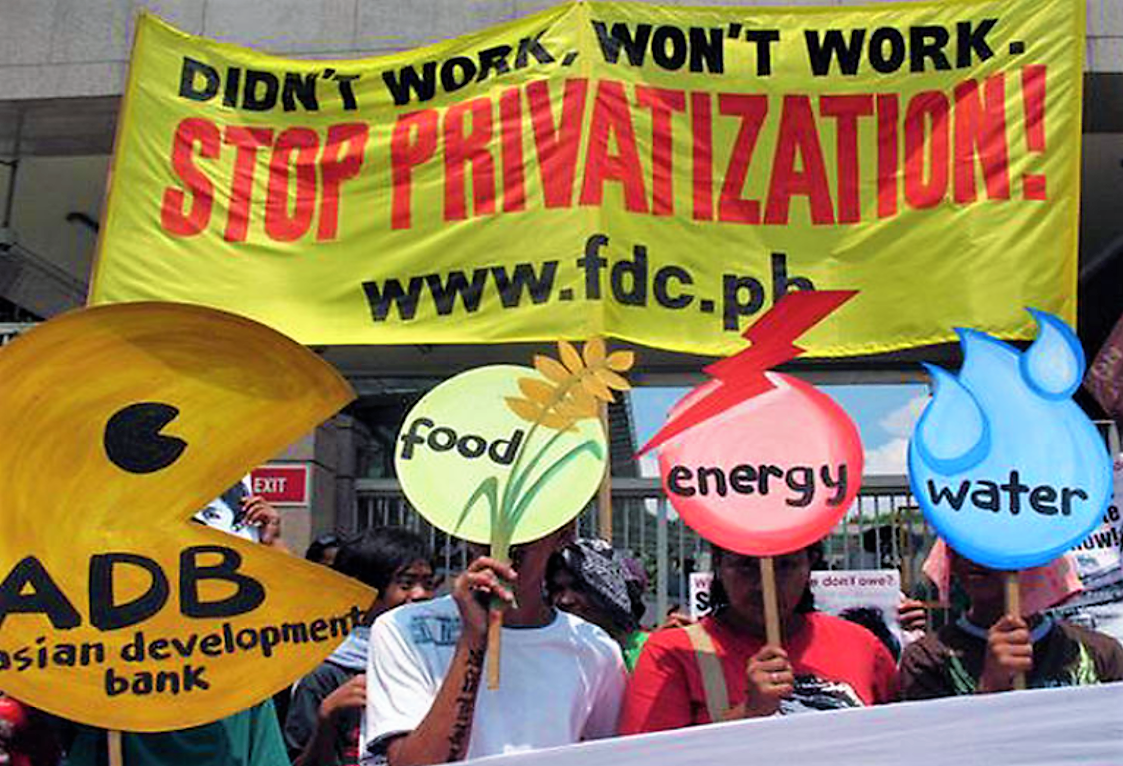
In some cases, where privatisation failures are leading to wide public protest and huge problems in water and sanitation service delivery, a re-nationalisation might be a possible solution to improve it. Therefore, the next chapter lists key steps to enable the environment for nationalisation.
Key Steps to Enable the Environment for Nationalisation
(Adapted from MONTEMAYOR 2005)
Any public entity that seeks to replace private concessionaires must meet several requirements:
Operational Viability
- Need of financial resources to fund a clear-cut capital expenditure programme that especially targets poorest areas for expansion and most vulnerable sections of the pipe network for rehabilitation.
- Need of institutional capacity to implement service obligation targets.It must be demonstrated that a public agency/ corporation can provide skilled, service-oriented and accountable personnel (see also building an institutional framework).
- A system of incentives for good performance and clear punitive measures for unmet performance targets must be institutionalised (see also strengthening enforcement bodies).
Conducive Policy Environment and Legal Framework
- A broad national policy to provide universal water coverage aligned with the MDGs and general poverty reduction targets.
- Individual water agencies, government departments and local government units need to be motivated by a clear, co-ordinated push towards water provision, especially for the poor.
- Legislation for the rules and regulations that will govern a public water utility, including performance standards and penalties for the non-fulfilment of such.There is likewise a need for legislation creating a new, independent regulatory system (see also creating policies and a legal framework).
Legitimacy and Accountability
- Social preparation, continuing education and dialogue to develop consensus and commitment towards responsibilities, rights and obligations concerning water (see also school campaigns and SSWM in school curriculums).
- Community participation in water resource management, prevention of leakages and illegal connexions and even collective maintenance of a water system can be encouraged through field personnel who can interact with, dispense and collect information from residents concerning water issues.
- Higher tariffs may be needed to invest in improvements for the many unserved and badly served areas (see also water pricing). People must become confident that the money they will infuse into a public company (via taxes and via cross-subsidisation) will not be stolen by corrupt officials and equally corrupt public works contractors (see also water corruption).
- Transparency in the technical and financial processes of the utility.Public access to the utility’s books, capital expenditures maps, price indexes, audits, regulatory procedures, etc. should be ensured. This transparency will enable greater and more meaningful participation of communities, organisations, local government officials, and other stakeholders in policy and decision-making.
- A clear responsibility and accountability chain.An alternative structure should indicate the responsible personnel for specific areas of water administration such as coverage issues, service issues, repairs, metering and billing, etc. Ideally, there should be locally assigned personnel to respond to communities’ queries and concerns.
Financial Sustainability
- Financing remains a problematic issue for public alternatives. The following have been suggested as sources of alternative financing: co-financing between national and local governments; the corporatisation of water authorities, securitisation (floating municipal/city bonds for water system projects), etc.
- Cross subsidies and tariff adjustments.A form of socialised billing can be implemented by private concessionaires, where the first ten cubic metres of water is charged at the lowest rate, with prices increasing progressively after certain volume levels are breached (see also water pricing and financing (see PPT)).
Independent, Functional Regulatory System
- The need for regulation cannot be over-emphasised, even within a public setting. Regulation is necessary to ensure the consistent delivery of service obligations, to determine “efficient” pricing, to conserve water, to extract professionalism from managerial staff, and to ensure the financial viability of the utility (especially when public subsidies are involved).
- Regulators of public water utilities should have equity as an additional and explicit objective that might conflict with the regulatory function of devising “efficient” pricing patterns.
- Subsidies for water connexions and even usage can have a significant impact on poverty reduction. Regulators of a public utility can be guided by such a principle and enforce a universal service obligation on connexion, while balancing usage-related and other fixed charges.
Example: Porto Alegre in Brazil
(Adapted from HALL 2005; VIERO 2003; HALL et al. 2002)
Porto Alegre in Brazil is one example for a well working people-centred, participatory public model for water supply and sanitation. The comparatively low rate of infant death (Porto Alegre: 13.8 deaths per thousand births, national: 65 deaths per thousand births) stands in direct correlation with improvements in the levels of water and sanitation demonstrated in the following.
- DMAE as an autonomous municipal organisation:The Departamento Municipal de Água e Esgoto (DMAE – Municipal Department of Water and Sanitary Sewage) is wholly owned by the municipality of Porto Alegre. Despite this, DMAE enjoys separate legal personality from the city council, operational autonomy and financial independence.
- Participatory Budgeting:The Participatory Budget process is a form of direct democracy, allowing citizens to participate in the neighbourhood they live in or within a particular thematic area and choose which of their priorities the municipality should implement.
- Participatory Budgeting in water and sanitation:The Participatory Budget takes place in the 16 neighbourhoods in which the city is divided. Citizens meet to vote on what of their priorities the available resources should be invested.
- Transparency and participation:All decision-making processes are effectively open, the weekly and the investment planning process of the Participatory Budget system itself.
- Performance, efficiency and service delivery: Positive outcomes range from an increase of service coverage and sewerage services to an increase of wastewater treatment. The DMAE employs over 2.000 workers, runs an educational program for illiterate workers and training courses for technical, administrative and operational issues.
Nationalisation is only applicable if the local government has the capacity and capability to lead the water and sanitation sector properly. Therefore, the government should be clearly structured, or accept help from a partner within a PUP.
Reclaiming Public Water. Achievements, Struggles and Visions from Around the World
This publication takes a different perception and presents case studies on different forms of public water management — be they successful examples of publicly managed water provision or also cases where the public water provision needs to be improved. Furthermore, it also presents the struggle for people-centred public water and ways forward for improving public water services.
BALANYA, B. ; BRENNAN, B. ; HOEDEMAN, O. ; KISHIMOTO, S. (2005): Reclaiming Public Water. Achievements, Struggles and Visions from Around the World. Amsterdam: Transnational Institute (TNI) and Corporate Europe Observatory (CEO) URL [Accessed: 27.10.2010]Introduction
Public Public Partnerships (PUPs) in Water
This publication describes how public-public partnerships in the water sector can be a valid method to improve efficiency, accountability and service quality. Most of the water utilities worldwide are public – i.e., also most of the skills and knowledge is public. Utilities can thus complement lacking competences of one another and thus improve service quality.
HALL, D. LOBINA, E. CORRAL, V. HOEDEMAN, O. TERHORST, P. PIGEON, M. KISHIMOTO, S. (2009): Public Public Partnerships (PUPs) in Water. Public Services International (PSI), Transnational Institute (TNI) and Public Services International Research Unit (PSIRU) URL [Accessed: 11.01.2010]Water in Porto Alegre, Brazil – Accountable, Effective, Sustainable and Democratic

This case study describes the successful example of public water operation in Porto Alegre, Brazil.
HALL, D. LOBINA, E. VIERO, O.M. MALTZ, H. (2002): Water in Porto Alegre, Brazil – Accountable, Effective, Sustainable and Democratic. Public Services International Research Unit (PSIRU) and Municipal Department of Water and Sanitary Sewage (DMAE) URL [Accessed: 11.01.2010]Possibilities for Public Water in Manila
Manila Anti Privatisation
Approaches to Private Participation in Water Services. A Toolkit
This toolkit by the World Bank leads through the whole planning and implementation phase. It offers both theoretical background material and practical guidelines for the process in a very detailed way, including stakeholder analysis and institutional and legal framework conditions.
THE WORLD BANK (2006): Approaches to Private Participation in Water Services. A Toolkit. Washington, DC: The International Bank for Reconstruction and Development/ The World Bank URL [Accessed: 15.04.2019]Water Supply and Sanitation in Porto Alegre/Brazil
Public Public Partnerships (PUPs) in Water
This publication describes how public-public partnerships in the water sector can be a valid method to improve efficiency, accountability and service quality. Most of the water utilities worldwide are public – i.e., also most of the skills and knowledge is public. Utilities can thus complement lacking competences of one another and thus improve service quality.
HALL, D. LOBINA, E. CORRAL, V. HOEDEMAN, O. TERHORST, P. PIGEON, M. KISHIMOTO, S. (2009): Public Public Partnerships (PUPs) in Water. Public Services International (PSI), Transnational Institute (TNI) and Public Services International Research Unit (PSIRU) URL [Accessed: 11.01.2010]Approaches to Private Participation in Water Services. A Toolkit
This toolkit by the World Bank leads through the whole planning and implementation phase. It offers both theoretical background material and practical guidelines for the process in a very detailed way, including stakeholder analysis and institutional and legal framework conditions.
THE WORLD BANK (2006): Approaches to Private Participation in Water Services. A Toolkit. Washington, DC: The International Bank for Reconstruction and Development/ The World Bank URL [Accessed: 15.04.2019]Reclaiming Public Water. Achievements, Struggles and Visions from Around the World
This publication takes a different perception and presents case studies on different forms of public water management — be they successful examples of publicly managed water provision or also cases where the public water provision needs to be improved. Furthermore, it also presents the struggle for people-centred public water and ways forward for improving public water services.
BALANYA, B. ; BRENNAN, B. ; HOEDEMAN, O. ; KISHIMOTO, S. (2005): Reclaiming Public Water. Achievements, Struggles and Visions from Around the World. Amsterdam: Transnational Institute (TNI) and Corporate Europe Observatory (CEO) URL [Accessed: 27.10.2010]Water in Porto Alegre, Brazil – Accountable, Effective, Sustainable and Democratic
This case study describes the successful example of public water operation in Porto Alegre, Brazil.
HALL, D. LOBINA, E. VIERO, O.M. MALTZ, H. (2002): Water in Porto Alegre, Brazil – Accountable, Effective, Sustainable and Democratic. Public Services International Research Unit (PSIRU) and Municipal Department of Water and Sanitary Sewage (DMAE) URL [Accessed: 11.01.2010]Water Supply and Sanitation in Porto Alegre/Brazil
Water Justice - resource center on alternatives to privatisation
The site of water justice is a resource centre on alternatives to (water) privatisation.