


Executive Summary
Enforcement bodies have a very important role in establishing and ensuring the effective application of other software tools in sustainable sanitation and water management (adapted from GWP 2003). Especially economic and command and control tools are based on laws that have been enacted. As laws, rules, structures and responsibilities as well as partnership agreements need to be adhered to, and there must be a sound body monitoring and enforcing them. The actual function of enforcement bodies should be set out in a clear legal framework reflecting water and sanitation policies. Here, we will explain the importance of enforcement bodies, focusing on their needs and principles and showing the negative effect of corruption. Some concluding tips help to strengthen institutional (enforcement) bodies.
Policies and Laws: Framework for Compliance and Enforcement
Formulating and/or changing policies and legal frameworks is an important step when creating an enabling environment for sustainable sanitation and water management. Especially economic and command and control are based on laws that have been enacted.But those laws for the assertion of economic and command and control tools are not working independently. Their enforcement is as important as their formulation itself. Laws can therefore be seen as the framework for compliance and enforcement,as well as for all economic and command and control tools. None of those tools will work without the implementation of the others: On the one hand, economic and command and control tools are based on laws and need a sound institution enforcing them, because otherwise these tools are worthless. On the other hand, enforcement bodies need economic and command and control tools based on laws as statutes for their work, because otherwise they might be misled to act corruptly and arbitrarily.
The specific functions of enforcement bodies are determined by local government policy and the legal framework of sanitation and water management (see also bundling and unbundling of functions. Those functions include the assertion of command and control tools based on laws. Usually, they are in the local government sector, but they may subcontract specific activities (e.g. monitoring and testing of samples) to NGOs or private companies (see also privatisation). It is important that they can act without day-to-day political interference (adapted from GWP 2003).
Enforcement is a regulatory role, which may be brought out through a legal notice, a direction, or a court order. It also includes the regulation of activities beneficial to sustainable sanitation and water management. Enforcement functions may include responsibilities to identify particular types of offences, e.g. the non-compliance of certain agreements by a partnership contractor. The functions also include to investigate certain matters, gather evidence, take direct remedial actions, confiscate certain things (e.g. licences) and initiate proceedings for prosecution. The legislation sets out the range and limits of monetary penalties for specified offences, and provisions for appeal. (adapted from HANNAM n.y.)
Enforcement bodies may be financed through central government or other funds, or by user fees or fines for non-compliance. If the latter, the terms need to be very clear to avoid a potential risk of conflict of interest (adapted from GWP 2003) (see also financing, and water pricing).

Compliance and Enforcement Actors
(Adapted from U.S. EPA 2006)
Different actors can be included in compliance and enforcement:
- Offender: This might be a company from a partnership not acting in the way the contract says, or a single person, a part of the local government, or even a police officer/official inspector violating a law concerning sanitation and water management.
- Local government: Local councils have the ability to investigate and take enforcement action on certain sustainable sanitation and water management issues. In some cases, the same body, e.g. the local government, undertakes regulation and enforcement, in others there is a separation.
- Police are normally the executive of the government. They have the power to take action over complaints about non-compliance of laws.
- Private agencies/inspectors can be subcontracted to enforce compliance in specific areas of sanitation and water management. They might just be responsible for the monitoring or promotion of compliance, or have more responsibilities like tools to regulate or enforce compliance, or to penalise non-compliance.
- Community: While the community does not directly enforce the provisions, it plays a crucial role in providing key information to the enforcement actor, for example details of potential offences. Also, the community can be a supporter of enforcement through social control and participatory monitoring and evaluation. For example, sanitation and water management laws can allow citizens to sue offenders for failing to comply with the law, and/or the government/private agency for failing to fulfil its duties under the law. Such provisions are an important means of enlisting citizen participation. (adapted from HANNAM n.y.)
- NGOs can report non-compliance to the enforcement actors. They might also play a role in monitoring and reporting incorrect behaviour of enforcement bodies. They can also put pressure on potential offenders.
Principles of Enforcement Bodies
Enforcement bodies have to (adapted from NSW 2006):
- act in the public interest
- act consistently, impartially and fairly according to law
- promote consistency through effective liaison with field staff and the adherence to policies and procedures
- ensure not to discriminate on the basis of race, religion, sex, national origin or political association
- ensure that enforcement action is taken against the right person for the right offence
- ensure that all relevant evidence is placed before courts or appeal tribunals
- make sanitation and water businesses aware of their legal obligations through the widest possible dissemination of information
- make legislation available to industry
- explain the benefits of compliance in sustainable sanitation and water management issues and discuss specific compliance failures or problems
- provide advice on mechanisms that can be used to improve compliance
- advise regulated parties of their right of appeal where provided by law; provide alleged offenders with an opportunity to discuss the circumstances of their case
What Enforcement Bodies Need
(Adapted from GWP 2003)
All the aspects shown below need to be considered before water and sanitation laws are enacted. Otherwise, the enforcement body might suffer from missing transparency, finances or statutes, which leads to water corruption and arbitrariness.
- Sufficient staff of adequate capability in enforcement agencies to enforce regulations. The staff needs to be paid well to avoid corruption.
- Statutes which are practical, enforceable and based on accurate knowledge of sustainable sanitation and water management.
- Staff who are knowledgeable about good sustainable sanitation and water management practices and have appropriate scientific knowledge.
- A sense of ownership on the part of stakeholders so that they accept the monitoring, enforcement and regulation procedures.
- Adequate financial resources to support the staff, their education and operations, and transparency in financial management, to minimise regulatory capture.
- Meaningful indicators for technical, economic and social issues and appropriate benchmarks.
- Good leadership.
- A programme of legal education and awareness building for the enforcement bodies and the general public.
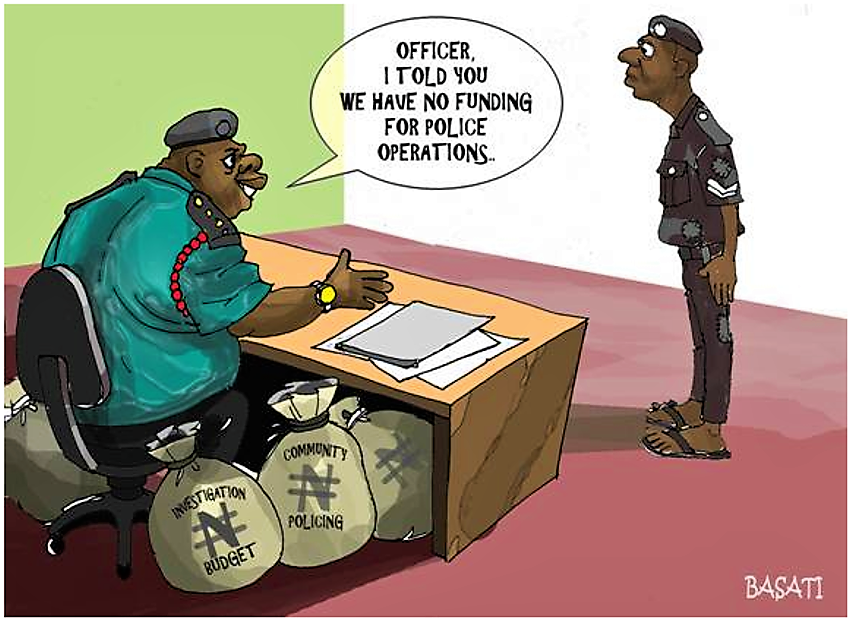
Enforcement & Corruption
(Adapted from KLITGAART et al. 1996)
Enforcement actors are especially prone to corruption that will lead to inefficiency, injustice and inequity. Development processes like sustainable sanitation and water management are hampered by corruption, especially when enforcement officials are corrupt, so that nobody assures the implementation of intervention tools. Therefore, it is crucial for local (and national) governments to fight corruption. Some tips on how to do this are listed below:
- Improve the positive incentives facing municipal officials. In many areas, pay levels have fallen so low that officials literally cannot feed their families without moonlighting or accepting side payments. Even more important is to strengthen the linkages between pay and performance, and promotion and performance, which in many cases have badly eroded.
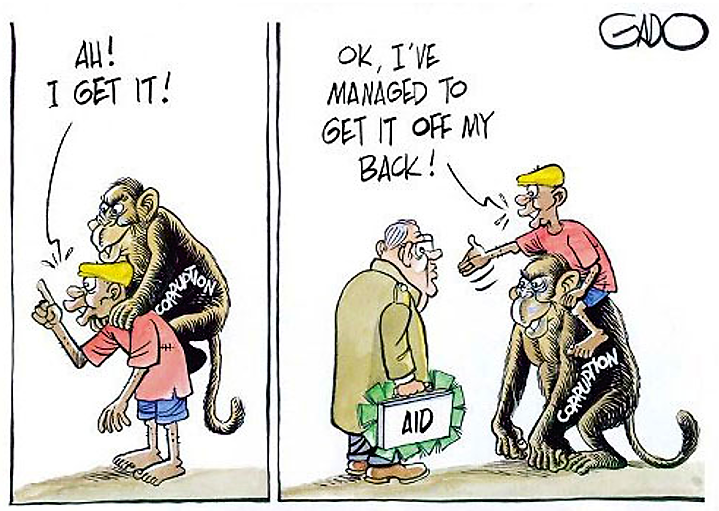
For the progress of any processes, it is important to fight corruption. Source: WSP (2006)
- Increase the effective penalties for corruption. Because of weak or corrupt investigatory, persecutory, and judicial systems, accusations of corruption seldom stick. If they do, the penalties are often minimal in practice (for example, the official is fired). As a result, the expected penalty for corruption does not deter. A key step is to strengthen the capacity and improve the incentives of the police, prosecutors, and judges. Local leaders can be creative in devising disincentives, such as firing or suspending employees, using the press to create publicity, inviting the denunciation of corrupt officials by professional groups, personnel transfers to less desirable jobs, and so forth.
- Limit monopoly. Promote competition in the public and private sectors. Avoid monopoly granting regulations when possible.
- Clarify official discretion. Simplify rules and regulations. Create “bright lines” that circumscribe duties and discretion. Help citizens learn how public systems are supposed to work (through brochures and manuals, help desks,and rules in ordinary language, publicity/media campaigns, the use of citizen-service-providers, etc.). Improve citizens’ oversight of what the local government is doing. Social control and pressure are helpful means against corruption.
- Enhance accountability and transparency. Clear standards of conduct and rules of the game make accountability easier. So does openness in bidding, grant-giving, and aid projects. Accountability depends on internal auditors, accounting, ombudsmen, inspectorates, specialised elements of the police, and specialised prosecutors. But it also should involve citizens, unions, NGOs, the media, and business in a variety of ways, including citizen oversight boards, hot lines, external audits, inquiry commissions, and so forth. Local governments can help external actors by generating and disseminating more information about public service effectiveness. Finally, local governments should encourage the private sector to police its own participation in corrupt schemes of procurement, contracting, regulating, and so forth.
Effective capacity in regulation and enforcement is essential and this applies whether traditional regulatory instruments or innovative pricing and economic instruments are used. However, capacity in regulatory and enforcement bodies varies widely from region to region and stress on capacity building and support is essential (GWP 2003).
The legitimacy of the regulatory and enforcement body is critical in ensuring compliance of policies and laws (GWP 2003).
Corruption in Nigeria
Enforcement Policy
This enforcement policy was published to provide clarity and certainty to individuals, companies and government agencies about the approach adopted by EPA in the enforcement of the Environment Protection Act. As it outlines the principles for fair and consistent enforcement, it is helpful to see what enforcement and its legislation should be like.
U.S. EPA (2006): Enforcement Policy. Victoria: Environment Protection Authority (EPA)Introduction to IWRM. Presentation by D. Thalmeinerova, based on GWP Toolbox Resources
A Method to Identify and Evaluate the Legal and Institutional Framework for the Management of Water and Land in Asia
A Practical Approach to Dealing With Municipal Malfeasance. Urban Management Programme
As malfeasance or wrongdoing by public officials operates as a critical impediment to developing accountable and transparent urban management systems, which is essential for the efficient and equitable use and distribution of resources at local level, this paper has been prepared to help officials diagnose, investigate, and prevent various kinds of corrupt and illicit behaviour. It emphasises preventive measures rather than purely punitive or moralistic campaigns.
KLITGAART, R. MACLEAN-ABAROA, R. PARRIS, H.L. (1996): A Practical Approach to Dealing With Municipal Malfeasance. Urban Management Programme. (= Working Paper No. 7 ). Marrakech: UNDP/UNCHS/WORLD BANK URL [Accessed: 22.10.2010]Compliance and Enforcement Policy
Water and Sanitation 2006 Calendar
B1. Creating an organisational framework
The Toolbox by the Global Water Partnership offers a lot of information on institutional roles in the water sector. It offers two main informational sectors in this topic, one sector for creating an organisational framework and one for building institutional capacity.
GWP (2003): B1. Creating an organisational framework. In: Sharing knowledge for equitable, efficient and sustainable water resources management. Global Water Partnership (GWP), pp.35-57 URL [Accessed: 15.04.2019]Enforcement Policy
This enforcement policy was published to provide clarity and certainty to individuals, companies and government agencies about the approach adopted by EPA in the enforcement of the Environment Protection Act. As it outlines the principles for fair and consistent enforcement, it is helpful to see what enforcement and its legislation should be like.
U.S. EPA (2006): Enforcement Policy. Victoria: Environment Protection Authority (EPA)GWP Toolbox. Integrated Water Resources Management

The IWRM ToolBox is a free and open database with a library of case studies and references that can be used by anyone who is interested in implementing better approaches for the management of water or learning more about improving water management on a local, national, regional or global level.
GWP (2008): GWP Toolbox. Integrated Water Resources Management. URL [Accessed: 16.05.2010]A Practical Approach to Dealing With Municipal Malfeasance. Urban Management Programme
As malfeasance or wrongdoing by public officials operates as a critical impediment to developing accountable and transparent urban management systems, which is essential for the efficient and equitable use and distribution of resources at local level, this paper has been prepared to help officials diagnose, investigate, and prevent various kinds of corrupt and illicit behaviour. It emphasises preventive measures rather than purely punitive or moralistic campaigns.
KLITGAART, R. MACLEAN-ABAROA, R. PARRIS, H.L. (1996): A Practical Approach to Dealing With Municipal Malfeasance. Urban Management Programme. (= Working Paper No. 7 ). Marrakech: UNDP/UNCHS/WORLD BANK URL [Accessed: 22.10.2010]Tools to Support Transparency in Local Governance
The tools in this document focus on how to gain more transparency in local governments, to fight corruption and malfeasance in an effective and participatory way.
TRANSPARENCY INTERNATIONAL ; UNHABITAT (2004): Tools to Support Transparency in Local Governance. (= Urban Government Toolkit Series ). Nairobi: Transparency International and UN-Habitat URL [Accessed: 15.04.2019]Colombia: Legislative Efforts to Prevent Corruption in Large Scale Water Projects
Corruption: Your NO Counts

This poster raises awareness about the worldwide problem with corruption.
UNODC (n.y): Corruption: Your NO Counts. United Nations Office on Drugs and Crime (UNODC) URL [Accessed: 28.10.2010]Corruption - Act Against Corruption
As part of its two-year anti-corruption communications campaign "Your NO Counts", UNODC has produced a Public Service Announcement video spot to illustrate that people are not simply at the mercy of corruption, and often have the power to say NO.
Prevention and Fight against Corruption
This webpage from the UNDP and the UNODC provides a lot of information about corruption and the fight against it.
Fighting corruption in water worldwide
The Water Integrity Network (WIN) was formed to respond to increasing concerns among water and anti-corruption stakeholders over corruption in the water sector. It combines global advocacy, regional networks and local action, to promote increased transparency and integrity, bringing together partners and members from the public and private sectors, civil society and academia, to drive change that will improve the lives of people who need it most.