
Executive Summary
In July 2010, the UN general assembly proclaimed access to safe drinking water and sanitation as a human right. At the same time, water and sanitation are also economic goods. There is a need to get a balance of these two aspects of water. Pricing water fairly and equally is important to sustain and extend the water and sanitation system. In many countries, consumers pay too little for water services. Revenue from water charges does not even cover operation and maintenance of water utilities, let alone (re)investment for the infrastructure. Water and wastewater tariffs determine the level of revenues that service providers receive from users in centralised or semi-centralised systems for the appropriate treatment, purification and distribution of freshwater, and the subsequent collection, treatment and discharge of wastewater. Here, we will introduce water pricing as an important economic instrument for improving water use efficiency, enhancing social equity and securing financial sustainability of water utilities and operators.
Water and Wastewater Tariffs
A water tariff is the price assigned to water supplied by a public utility generally for both freshwater supply and wastewater treatment. The term is also often applied to wastewater tariffs. Water and wastewater tariffs determine the conditions of service and the monthly bills for water users in various categories and classes. Tariffs are often set by a regulatory agency for the appropriate catchment, purification and distribution of freshwater, and the subsequent collection, treatment and discharge of wastewater.
Wastewater tariffs can be a fixed percentage of water tariffs, or can be set separately.Water charges often contain some elements to address poverty. Connexion fees to a network, or installation costs for pumps are generally charged separately (CARDONE & FONSECA 2004).
Tariff setting practises vary widely around the world, and there is no consensus on which tariff structure best balances the objectives of the utility, consumers, and society (WHITTINGTON 2002).
Why Setting a Tariff on Water?
(Adapted from ROGERS et al. 2001)
Often, consumers pay too little for the water and sanitation services they get. People are not aware of the real costs of providing water and sanitation services because these have been historically heavily subsidised from governments. This is because water is a social good and it was considered a cheap and abundant resource. However, with population growth and much larger communities requiring access to water services, the availability of freshwater is decreasing dramatically in many regions of the world.
Water tariffs are economic instruments that help tackling both challenges of providing water and sanitation services to all citizens at an affordable price and the conservation of water resources.
Proper water tariffs provide incentives to improve sustainable water and sanitation services and to use water resources more efficiently:
- Tariffs generate revenues to recover specific costs (e.g. operation and maintenance costs)
- Tariffs generate funds for necessary infrastructure development and expansion as well as for wastewater treatment, hence assuring water quality protection.
- Charges send appropriate price signals to users about the relationship between water use and water scarcity
- Having to pay for water can encourage people to reduce wasting water
- Subsidising tariffs for low-income groups ensure that poor households also have sufficient and affordable water services.
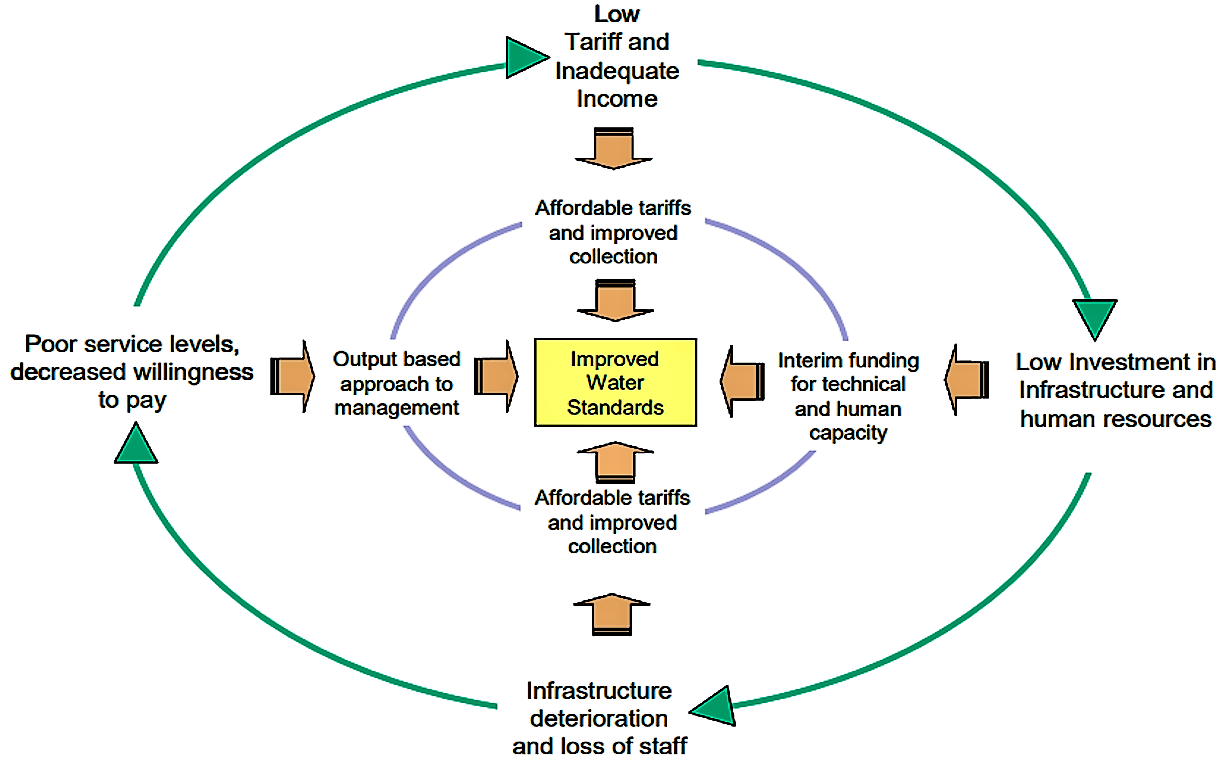
Adequate water tariffs allow cost recovery, which is very important to assure well functioning water and sanitation systems. “The figure shows the downward spiral resulting from poor cost recovery. In essence, low levels of cost recovery from users and other sources, lead to insufficient income for the effective and efficient operation and management of the service. This implies a poor ability to invest in the sector, whether through human investment or capital investment. As a result, poor service ensues, leading to the dissatisfaction of users thus decreasing to pay, which, on top of already poor cost recovery levels, further exacerbates the system” (CARDONE & FONSECA 2004).
Water Tariffs - a Controversial Topic
(Adapted from CARDONE & FONSECA 2004)
Pricing water is a very controversial topic and there is plenty of disagreement about the “right” way of pricing it. Some of the most discussed topics are:
- Water tariffs are a powerful management tool to achieve various objectives in the water and sanitation sector. However setting tariffs is a political process that is rife with controversy. Research has shown that low tariffs are set largely for political, rather than practical, purposes. Free water is often used as a campaign promise, for political gain. In India for example, this has lead to the situation that the agricultural sector, which uses approx. 90% of all water, receives a large share of it for free. This political interference has been found to be a significant barrier to effective cost recovery (see also policies and legal framework).
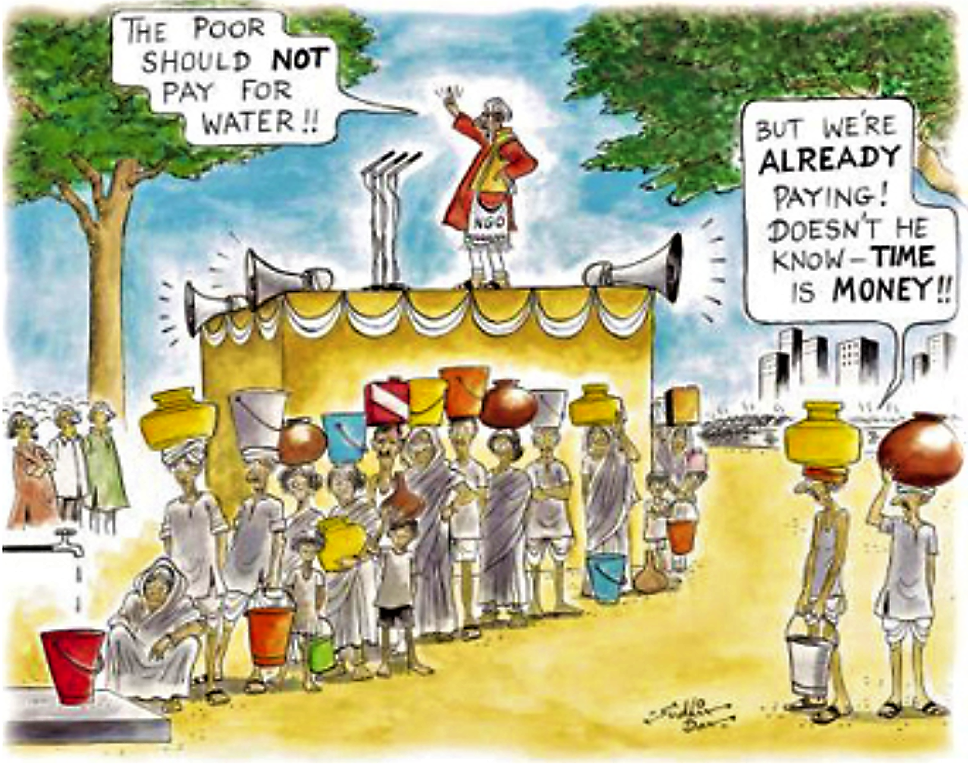
- Tariff structures are often complex and difficult to understand for consumers. People are not generally aware about the costs of providing water and sanitation services, it is difficult for them to judge what a “fair” or appropriate price to pay is. Moreover, it must be considered that poor without access to public water network are already paying a high proportion of their incomes either in excessive charges for poor quality water from water vendors, or in lost productivity through time taken by women to collect water from distant sources. Many poor would be willing and able to pay for appropriate low-cost services, if they were shown to be convenient and reliable (CARDONE & FONSECA 2004).
- There is disagreement over the objectives of water pricing and tariff design. Tariff setting practises affects the goals of different stakeholders in conflicting ways: consumers need affordable and equal water services whereas utilities require stable revenues for cost recovery and economic efficiency. A tariff structure alone cannot cover all the needs.
- Often, there is a lack of empirical data about how the application of different tariff structures affects water use for different consumer classes and whether or not price changes would affect customers' decisions to connect (or stay connected) to the water distribution system.
- There are no market tests for different water tariff structures.Consumers are usually not involved in the design and setting of tariff structures and they cannot reject inappropriate tariff structures because these are typically set by the regulatory agency (WHITTINGTON 2006).
Regulatory Environment and Main Stakeholders
(Adapted from LE BLANC 2008)
Water and wastewater tariffs need to be set, and from time to time, revisited and adapted. The process is often complex and can involve some or all the stakeholders mentioned below. Outside consulting firms, lending institutions and political leaders may be involved as well. The tariff may be determined by a formula embodied in national legislation (e.g. Ukraine), which may also be administered and regulated by a national regulatory body (e.g. Colombia).
At the national level, the following entities usually have a say in defining the environment in which water and sanitation management take place:
- The state, through ministries in charge of water and sanitation, and sometimes through ministries in charge of social programmes (mostly for the subsidy aspect),
- The regulating agency, which may be part of the sector ministry or independent,
- Intermediate levels of government, which may intervene for example in the implementation of water subsidies,
- Municipalities, which are typically responsible for basic service provision in their jurisdictions, and may own local utility companies.
- Water utility companies (public or private);
- Alternative providers (communities, private sector entities);
- Consumers (households, agricultural, commercial and industrial), directly or through intermediaries, e.g. community representatives.
Water and Wastewater Tariff Design
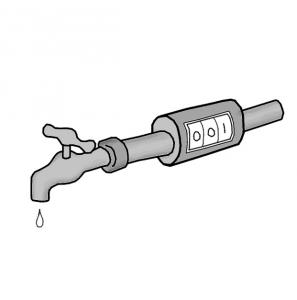
Water and wastewater tariffs are usually designed as a single part tariff or as a combination of two tariff structures. Charges can be set depending or not from the volume of water consumed. In the first case water metering is needed. A briefly overview of water and wastewater tariffs generally adopted by water utilities is given below:
- Fixed charge: the monthly water bill is independent of the volume consumed.
- Uniform volumetric tariff: is a volumetric charge with a rate proportional to water consumption (metering is needed). All units (cubic meters) are priced the same rate, independently of total consumption.
- Increasing block tariff: is a step-wise volumetric charge (metering is needed). With this tariff the unit charge is constant over a specific range of water use block) and then increases as the consume increases.
- Decreasing block tariff: is the opposite of the increasing block tariff: the rate per unit of water is high for the initial (lower) block of consumption and decreases as the volume of consumption increases.
- Two parts tariffs: have a fixed charge component plus a variable charge depending on the volume of water consumed (e.g. increasing block or uniform tariff). Two parts tariffs are widely promoted by the World Bank, aim at recovering costs and achieving economic efficiency. The fixed part usually corresponds to the fixed costs of production and administration and the proportional part can be adjusted to the marginal cost (OLIVER 2006).
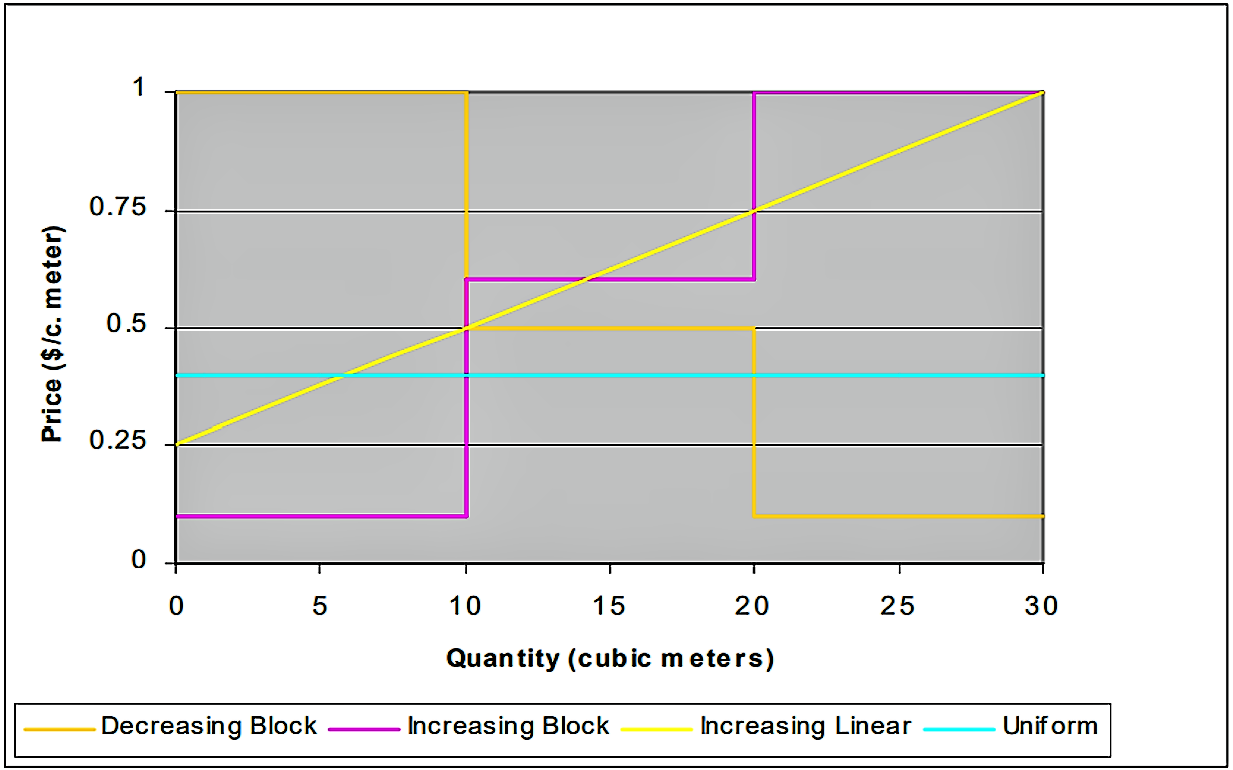
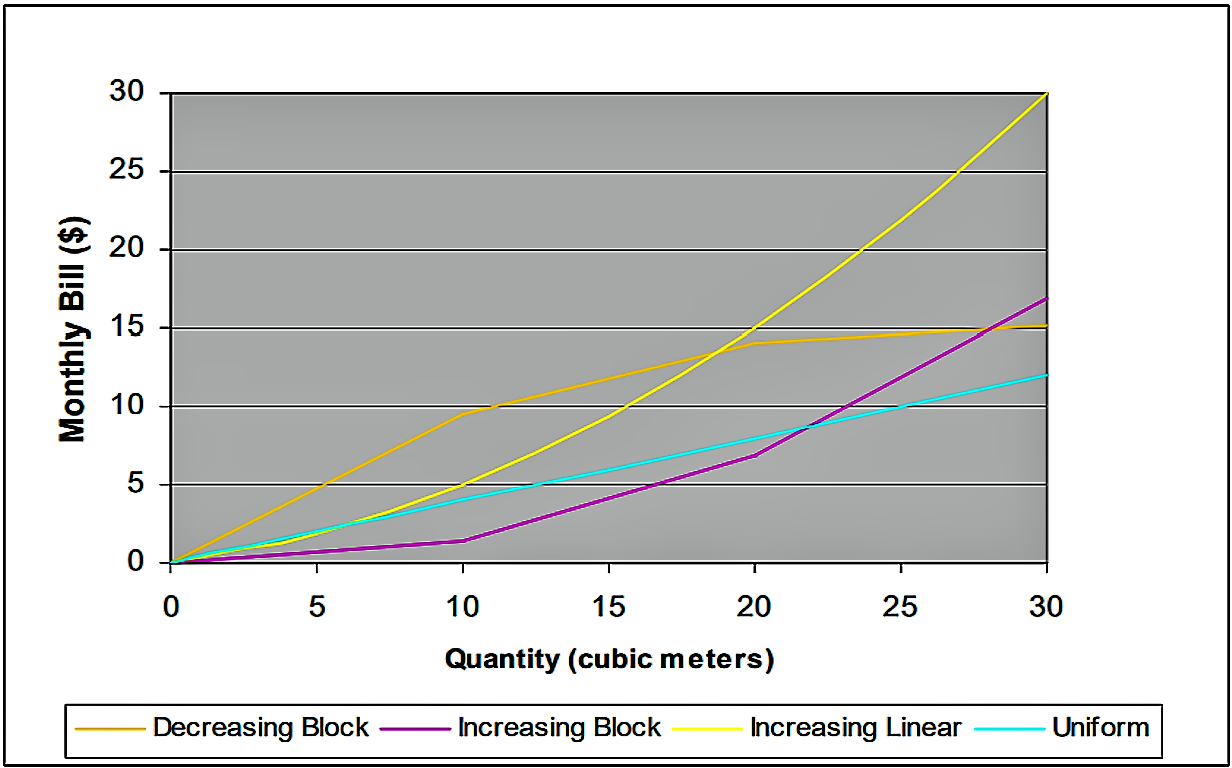
Water tariffs are applicable at different levels: they can be set either at the service provider level or by national (or local) governments.Tariffs can be categorised in consumer categories and classes and they can be designed within a policy framework that addresses the needs of the poor (CARDONE & FONSECA 2004). Policy makers need to decide which objectives have the highest priority, and where possible, use a range of instruments. Involvement of local communities in the tariff setting process is important to identify the real local needs, the costs of providing a good quality service, and the best ways to recover the costs incurred (CARDONE & FONSECA 2004).
Water Tariff Design in Developing Countries: Disadvantages of Increasing Block Tariffs and Advantages of Uniform Price with Rebate Designs
Financing and Cost Recovery
This paper provides an excellent overview on financing and cost recovery for the water supply and sanitation services sector in rural and low-income urban areas of developing countries. The document contains also case studies and mini reviews of best publications on financing and cost recovery.
CARDONE, R. FONSECA, C. (2003): Financing and Cost Recovery. Delft (The Netherlands): IRC (International Water and Sanitation Centre). Thematic Overview Paper 7. URL [Accessed: 03.05.2019]A Framework for Analyzing Tariffs and Subsidies in Water Provision to Urban Households
This paper aims to present a basic conceptual framework for understanding the main practical issues and challenges relating to tariffs and subsidies in the water sector in developing countries. The paper introduces the basic economic notions relevant to the water sector; presents an analytical framework for assessing the need for and evaluating subsidies; and discusses the recent evidence on the features and performance of water tariffs and subsidies in various regions, with a special focus on Africa. The discussion is limited to the provision of drinking water to urban households in developing countries.
BLANC, D. le (2008): A Framework for Analyzing Tariffs and Subsidies in Water Provision to Urban Households . New York: DESA Working Paper n°63 URL [Accessed: 20.07.2010]Water Tariff Increase in Manaus (Brazil): An Evaluation Of The Impact On Households
Water is an Economic Good: How to use Prices to Promote Equity, Efficiency, and Sustainability
This paper focuses on the role of prices in the water sector and how they can be used to promote equity, efficiency, and sustainability.
ROGERS, P. ; SILVA, R. de ; BATHIA, R. (2001): Water is an Economic Good: How to use Prices to Promote Equity, Efficiency, and Sustainability. In: Water Policy : Volume 4 , 1–17. URL [Accessed: 03.05.2019]Review of Current Practices in Determining User Charges and Incorporation of Economic Principles of Pricing of Urban Water Supply
This report reviews current practices in determining user charges and researches how economic principles of pricing of urban water supply can be incorporates. It researches international practices in the UK, Australia and the Philippines and several cases in India.
TERI (2010): Review of Current Practices in Determining User Charges and Incorporation of Economic Principles of Pricing of Urban Water Supply. New Delhi: TERI URL [Accessed: 03.05.2019]Municipal Water Pricing and Tariff Design: a Reform Agenda for South Asia
This paper describes the major elements of a package of pricing and tariff reforms that are needed in the municipal water supply sector in many South Asian cities. Keywords: Increasing block tariffs; Pro-poor policies; Seasonal tariffs; Subsidies; Tariff designs; Water pricing.
WHITTINGTON, D. (2003): Municipal Water Pricing and Tariff Design: a Reform Agenda for South Asia. In: Water Policy 5 : , 61–76. URL [Accessed: 20.07.2010]Tariffs and Subsidies in South Asia: Understanding the Basics
Pricing Water and Sanitation Services. Human Development Report 2006. Human development office-occasional paper
The purpose of this paper is to provide the reader with a better understanding of the main issues involved in the design of W&S tariffs. Keywords: Costs of W&S services, objectives of tariff design, tariff options, subsidies, development paths of W&S services.
WHITTINGTON, D. (2006): Pricing Water and Sanitation Services. Human Development Report 2006. Human development office-occasional paper. New York: UNDP URL [Accessed: 03.05.2019]WSP Water Calendar
Pricing Water and Sanitation Services. Human Development Report 2006. Human development office-occasional paper
The purpose of this paper is to provide the reader with a better understanding of the main issues involved in the design of W&S tariffs. Keywords: Costs of W&S services, objectives of tariff design, tariff options, subsidies, development paths of W&S services.
WHITTINGTON, D. (2006): Pricing Water and Sanitation Services. Human Development Report 2006. Human development office-occasional paper. New York: UNDP URL [Accessed: 03.05.2019]Financing and Cost Recovery
This paper provides an excellent overview on financing and cost recovery for the water supply and sanitation services sector in rural and low-income urban areas of developing countries. The document contains also case studies and mini reviews of best publications on financing and cost recovery.
CARDONE, R. FONSECA, C. (2003): Financing and Cost Recovery. Delft (The Netherlands): IRC (International Water and Sanitation Centre). Thematic Overview Paper 7. URL [Accessed: 03.05.2019]Providing Water to the Urban Poor in Developing Countries: The Role of Tariffs and Subsidies
This brief explores the role of water tariffs and subsidies as key instrument to achieve the objective of providing safe and affordable drinking water to residents of growing urban areas in developing countries.
BLANC, D. le (2007): Providing Water to the Urban Poor in Developing Countries: The Role of Tariffs and Subsidies. In: Sustainable Development Innovation Brief: Volume 4 URL [Accessed: 03.05.2019]A Framework for Analyzing Tariffs and Subsidies in Water Provision to Urban Households
This paper aims to present a basic conceptual framework for understanding the main practical issues and challenges relating to tariffs and subsidies in the water sector in developing countries. The paper introduces the basic economic notions relevant to the water sector; presents an analytical framework for assessing the need for and evaluating subsidies; and discusses the recent evidence on the features and performance of water tariffs and subsidies in various regions, with a special focus on Africa. The discussion is limited to the provision of drinking water to urban households in developing countries.
BLANC, D. le (2008): A Framework for Analyzing Tariffs and Subsidies in Water Provision to Urban Households . New York: DESA Working Paper n°63 URL [Accessed: 20.07.2010]International Statistics for Water Services
This short leaflet presents water international statistics for water services, e.g. major cities’ water bills, abstraction sources for drinking water supplies, or a large comparison of water cycle charges.
IWA SPECIALIST GROUP STATISTICS AND ECONOMICS (2010): International Statistics for Water Services. The Hague: International Water Association (IWA). [Accessed: 22.04.2012] PDFSocial Issues in the Provision and Pricing of Water Services. Executive Summary.
The main focus of the report (here: executive summary) is the affordability of water services in OECD countries, as well as the social measures currently in place aimed at resolving these affordability problems. The report also examines the potential role of the private sector in incorporating the social dimension into water pricing decisions, as well as issues related to making the transition towards higher levels of access to water services.
OECD (2002): Social Issues in the Provision and Pricing of Water Services. Executive Summary.. URL [Accessed: 20.07.2010]Water is an Economic Good: How to use Prices to Promote Equity, Efficiency, and Sustainability
This paper focuses on the role of prices in the water sector and how they can be used to promote equity, efficiency, and sustainability.
ROGERS, P. ; SILVA, R. de ; BATHIA, R. (2001): Water is an Economic Good: How to use Prices to Promote Equity, Efficiency, and Sustainability. In: Water Policy : Volume 4 , 1–17. URL [Accessed: 03.05.2019]Municipal Water Pricing and Tariff Design: a Reform Agenda for South Asia
This paper describes the major elements of a package of pricing and tariff reforms that are needed in the municipal water supply sector in many South Asian cities. Keywords: Increasing block tariffs; Pro-poor policies; Seasonal tariffs; Subsidies; Tariff designs; Water pricing.
WHITTINGTON, D. (2003): Municipal Water Pricing and Tariff Design: a Reform Agenda for South Asia. In: Water Policy 5 : , 61–76. URL [Accessed: 20.07.2010]Sanitation surcharges collected through water bills: a way forward for financing pro-poor sanitation?
This discussion paper is a situation review of sanitation surcharge systems in African cities, focusing on systems designed to raise revenues for improving sanitation in low-income districts. The review considers existing pro-poor surcharge systems in Lusaka and Ouagadougou; systems that cannot currently be considered pro-poor, in Dakar, Beira, and Antananarivo; and the special case of Maputo, where there is ongoing debate about how a surcharge might be introduced.
WSUP (2012): Sanitation surcharges collected through water bills: a way forward for financing pro-poor sanitation?. Discussion paper. London: Water & Sanitation for the Urban Poor (WSUP) URL [Accessed: 22.04.2019]Review of Current Practices in Determining User Charges and Incorporation of Economic Principles of Pricing of Urban Water Supply
This report reviews current practices in determining user charges and researches how economic principles of pricing of urban water supply can be incorporates. It researches international practices in the UK, Australia and the Philippines and several cases in India.
TERI (2010): Review of Current Practices in Determining User Charges and Incorporation of Economic Principles of Pricing of Urban Water Supply. New Delhi: TERI URL [Accessed: 03.05.2019]International Statistics for Water Services
This short leaflet presents water international statistics for water services, e.g. major cities’ water bills, abstraction sources for drinking water supplies, or a large comparison of water cycle charges.
IWA SPECIALIST GROUP STATISTICS AND ECONOMICS (2010): International Statistics for Water Services. The Hague: International Water Association (IWA). [Accessed: 22.04.2012] PDFSelf-Supply as a Complementary Water Services Delivery Model in Ethiopia
Self-supply, where households invest to develop their own easily-accessible water supplies, is identified as an alternative service delivery model that is potentially complementary to more highly subsidised community-level provision. The approach is widespread in Ethiopia with family wells bringing additional benefits that are in line with wider government objectives, such as supporting small-scale irrigation. However, two recent studies show the current performance of traditional or family wells to be far below potential with most sources providing unsafe water in the absence of adequate protection.
BUTTERWORTH, J. ; SUTTON, S. ; MEKONTA, L. (2013): Self-Supply as a Complementary Water Services Delivery Model in Ethiopia. In: Water Alternatives: Volume 6 , 405-423. URL [Accessed: 08.03.2019] PDFParticipatory Monitoring and Evaluation (PM & E)
This web page contains several links and documents related to PM&E.
World Water Assessment Programme (UNESCO WWAP)
The website of the World Water Assessment Program (WWAP) serves as a thematic entry point to the current UNESCO and UNESCO-led programmes on freshwater. It offers a review of case studies to highlight the challenges that need to be addressed in the water resources sector including water-pricing issues.