


Executive Summary
Participatory planning requires the involvement of concerned stakeholders. This includes identifying public concerns and values and developing a broad consensus on planned initiatives. It is also about utilising the vast amount of information and knowledge that stakeholders hold to find workable, efficient and sustainable solutions (CAP-NET 2008). The stakeholder analysis is the process of identifying and analysing stakeholders, and plan for their participation (RIETBERGEN-McCRACKEN et al. 1998). There are a great number of methodologies concerning stakeholder analysis with a wide range of complexity (see e.g. RIETBERGEN-McCRACKEN et al. 1998; NETSSAF 2008; CAP-NET 2005). Here, we present a four-step methodology, that can be done fully or shortened according to one’s needs: (1) Stakeholder identification, (2) Stakeholders’ importance and influence (3) Stakeholder interests and (4) Stakeholder strategy plan. Based on stakeholder identification, the analysis of their importance and influence, and stakeholders interests a stakeholder strategy plan can be developed. In this final step, potential roles and responsibilities are assigned preliminarily to different stakeholders (WORLD AGROFORESTRY CENTER 2003). The stakeholder strategy plan aims at structuring the findings of the preceding steps through the development of a stakeholder participation matrix. This structure helps to know about the roles and characteristics of the stakeholders, and how and when to involve them. The objective of a stakeholder strategy plan is to avoid project failures and to use their capacities to make a contribution as effective as possible.
Introduction
A stakeholder strategy plan can guide one on how to interact, communicate and involve with each identified stakeholder during different phases of a project. The stakeholder strategy provides approaches for building and maintaining positive relationships with stakeholders. It also helps you to define who should participate, in what ways and at what stage of the project cycle stakeholders should be involved. This will contribute to realise a well-designed project and to be successful with your initiative!
A Stakeholder Strategy Should Incorporate the Following Elements:
(Adapted from ELLIOT 2003)
- Best approaches to involve stakeholders in key decision
- Ways to meet stakeholders’ expectations
- Ways to create buy-in and ownership
- Ways to use the influence of stakeholders to the project’s advantage
- Bests methods for communicating with stakeholders
- Ways to neutralize or eliminate negative impact of stakeholders
How to Convert the Previously Gained Information into a Strategy Plan?
In the previous steps, you gained a lot of information about the stakeholders. Now, the aim of a stakeholder strategy plan is to use this information and to convert it into a preliminary strategy plan showing HOW to involve the identified stakeholders and WHEN (at which stage) to involve them to help the project to succeed. The stakeholder participation matrix is an effective way to convert the existing information into an overview of stakeholder participation.
The Stakeholder Participation Matrix
The stakeholder participation matrix contains two axes: The horizontal axe (rows) is about the participation level, and the vertical axe (columns) is about implementation level:
Participation Level (rows)
Participation can be seen as a continuous scale, or continuum, ranging from a low level of stakeholder participation to a high level of participation. It depends on how interested the stakeholders are (e.g., in regards to what they hope to get out of the project), and also on how much participation YOU want to involve them (WATER AND FORESTRY 2005). There are the four (general) levels:
- Inform: To provide the stakeholder(s) with balanced and objective information to enable people to understand the problem, alternatives and/or solution.
- Consult: To obtain stakeholder feedback on analysis, alternatives and/or decisions. It involves acknowledging concerns and providing feedback on how stakeholder input has influenced the decision.
- Collaborate/Partnership: To work as a partner with the stakeholder(s) on each aspect of the decision, including the development of alternatives and the identification of the preferred solution.
- Empower/Control: A process of capacitating the stakeholder(s) through involvement and collaboration so that they are able to make informed decisions and to take responsibility for final decision-making.
In each of the cells, write which stakeholders you need to inform, to consult, with which you want to collaborate, and which are controlling the process.
Implementation Level (columns)
(Adapted from WATER AND FORESTRY 2005)
This level helps to identify which stakeholders are involved in which stage of the project, e.g. during the exploring phase the planning phase, the implementation phase and the monitoring and evaluation phase.
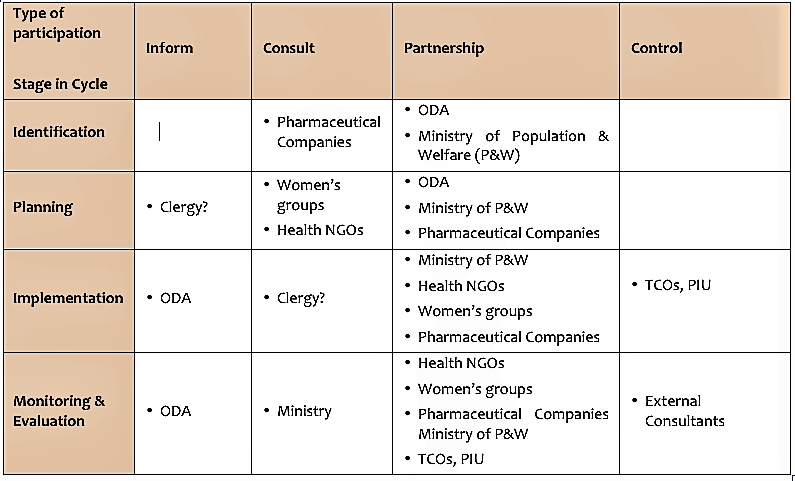
The below table is adapted from ODA 1995. It presents a project in Pakistan about the collection and growing of medicinal plants in a rural region. Important stakeholders are e.g. the Islamic clergy, Pharmaceutical companies as the buyers of the plants, women’s groups (who collect them), the Ministry of Population and Welfare, and local Health NGO. The table shows which stakeholders are involved at which stage, and how much they participate in the project.
Subscribe here to the new Sanitation and Water Entrepreneurship Pact (SWEP) newsletter. SWEP is a network of organizations joining hands to help entrepreneurs design and develop lasting water and sanitation businesses.
Stakeholder Analysis Steps
<----- Go back to Step 3: stakeholder interests
Or see also:
-----> Step 1: Stakeholder identification
-----> Step 2: Stakeholder importance and influence
The participation matrix should be seen as a dynamic tool to find an appropriate way how and when to involve stakeholders into the planning process of SSWM. It is a viable tool for the preliminary planning of stakeholder involvement and serves as a base for the following SSWM planning process and implementation.
Integrated Water Resources Management Plans. Training Manual and Operational Guide
The Cap-Net manual is an introduction to essential parts of integrated water resource management (IWRM). Chapter 2 consists of management planning for IWRM, which provides good information about stakeholder process as well.
CAP-NET (2005): Integrated Water Resources Management Plans. Training Manual and Operational Guide. Pretoria: Cap-Net URL [Accessed: 30.06.2019]Integrated Water Resource Management for River Basin Organisations. Training Manual
Capacity Building for Ecological Sanitation

This publication deals with the educational aspects linked to ecologically sustainable sanitation, and contains extensive chapters on capacity building and knowledge management in the field of ecological sanitation.
UNESCO/IHP ; GTZ (2006): Capacity Building for Ecological Sanitation. Paris & Eschborn: German Agency for Technical Cooperation (GTZ) & International Hydrological Programme of UNESCO (UNESCO/IHP) URL [Accessed: 15.04.2019]NETSSAF Participatory Planning-Approach

This is the actual tutorial of the participative planning approach developed by NETSSAF, containing all the steps, sub-steps and case studies. It is freely available on the internet in French and English.
NETSSAF (2008): NETSSAF Participatory Planning-Approach. A tutorial for sustainable sanitation planning. Network for the Development of Sustainable Approaches for Large Scale Implementation of Sanitation in Africa (NETSSAF). [Accessed: 29.03.2010] PDFGuidance Note on how to do Stakeholder Analysis of Aid Projects and Programmes
This guidance note provides a step-by-step manual on how to do a stakeholder analysis. Effective strategies for stakeholder participation must be based on good analysis of individuals, groups, and institutions with an interest in a project.
ODA (1995): Guidance Note on how to do Stakeholder Analysis of Aid Projects and Programmes. London: Overseas Development Department (ODA) URL [Accessed: 30.06.2019]Stakeholder Participation
Participation and Social Assessment: Tools and Techniques

This resource kit aims to share information and experiences on participatory methods in the context of development cooperation. The primary focus concentrates on providing practical guidance and case examples.
RIETBERGEN-McCRACKEN, J. NARAYAN, D. WORLD BANK (1998): Participation and Social Assessment: Tools and Techniques. Washington: World Bank URL [Accessed: 10.05.2010]Carrying Out a Stakeholder Analysis
Good Practices in Participatory Mapping
This report explores the power of participatory mapping. Covering a range of techniques, intermediaries, tools and impacts, it is shown how a systematic approach could contribute to addressing conflict-related issues and improving community ownership in sustainable environmental and natural resource management.
IFAD (2009): Good Practices in Participatory Mapping. Rome: International Fund for Agricultural Development (IFAD) URL [Accessed: 04.05.2010]Guidance Note on how to do Stakeholder Analysis of Aid Projects and Programmes
This guidance note provides a step-by-step manual on how to do a stakeholder analysis. Effective strategies for stakeholder participation must be based on good analysis of individuals, groups, and institutions with an interest in a project.
ODA (1995): Guidance Note on how to do Stakeholder Analysis of Aid Projects and Programmes. London: Overseas Development Department (ODA) URL [Accessed: 30.06.2019]Integrated Water Resources Management Plans. Training Manual and Operational Guide
The Cap-Net manual is an introduction to essential parts of integrated water resource management (IWRM). Chapter 2 consists of management planning for IWRM, which provides good information about stakeholder process as well.
CAP-NET (2005): Integrated Water Resources Management Plans. Training Manual and Operational Guide. Pretoria: Cap-Net URL [Accessed: 30.06.2019]Capacity Building for Ecological Sanitation
This publication deals with the educational aspects linked to ecologically sustainable sanitation, and contains extensive chapters on capacity building and knowledge management in the field of ecological sanitation.
UNESCO/IHP ; GTZ (2006): Capacity Building for Ecological Sanitation. Paris & Eschborn: German Agency for Technical Cooperation (GTZ) & International Hydrological Programme of UNESCO (UNESCO/IHP) URL [Accessed: 15.04.2019]NETSSAF Participatory Planning-Approach
This is the actual tutorial of the participative planning approach developed by NETSSAF, containing all the steps, sub-steps and case studies. It is freely available on the internet in French and English.
NETSSAF (2008): NETSSAF Participatory Planning-Approach. A tutorial for sustainable sanitation planning. Network for the Development of Sustainable Approaches for Large Scale Implementation of Sanitation in Africa (NETSSAF). [Accessed: 29.03.2010] PDFParticipation and Social Assessment: Tools and Techniques
This resource kit aims to share information and experiences on participatory methods in the context of development cooperation. The primary focus concentrates on providing practical guidance and case examples.
RIETBERGEN-McCRACKEN, J. NARAYAN, D. WORLD BANK (1998): Participation and Social Assessment: Tools and Techniques. Washington: World Bank URL [Accessed: 10.05.2010]Strategy Development for Successful Implementation of Ecological Sanitation Approaches in Sri Lanka using Stakeholder Analysis. Report 3 of 3 from "Evaluation of the Appropriateness of Ecological Sanitation in Relation to the Social, Cultural and Economic
The presented stakeholder analysis provides the necessary information to develop strategies for the successful implementation of ecological sanitation approaches in Sri Lanka.
WINDBERG (2009): Strategy Development for Successful Implementation of Ecological Sanitation Approaches in Sri Lanka using Stakeholder Analysis. Report 3 of 3 from "Evaluation of the Appropriateness of Ecological Sanitation in Relation to the Social, Cultural and Economic. Paris: UNICEF URL [Accessed: 18.08.2010]Stakeholder Analysis
This short PowerPoint presentation explains in a brief way how to do a stakeholder analysis and also contains empty tables that can be directly used for analysing stakeholders.
PUBLIC SECTOR IMPROVEMENT FACILITY (n.y): Stakeholder Analysis. URL [Accessed: 30.06.2019]Carrying out a stakeholder analysis
This is a very practical, concise and easy to understand set of online guidelines for planning and running training courses. Although the training approaches and techniques described here are based soundly on the sciences of pedagogy and education, they also reflect the practical side of field work in the developing world.