


Executive Summary
Whenever individuals meet, it is helpful to develop guidelines for positive interaction. Meaningful guidelines, often called "ground rules", provide a framework to ensure an “open, respectful dialogue, and maximum participation”. Using ground rules to build a safe learning climate is especially important in the field of education, where many teaching practices are strongly linked to personal values and experiences. A completely safe learning environment can provide a cushion for the shifts in thinking and practice that new knowledge and skills may require (HARPER-WHALEN and MORRIS 2007).
Introduction
Whether you facilitate a short half-day workshop on Sustainable Sanitation and Water Management or preparing a two-week course, a vital first step is the development of guidelines for participation. These guidelines, often referred to as "ground rules" or "community norms", should provide the community within a workshop or class a framework to ensure open, respectful dialogue and maximum participation.
How to Create Ground Rules
(Adapted from HARPER-WHALEN and MORRIS 2007)
Ground rules are best shaped by group discussion and consensus resulting in a mutually agreed upon list of guidelines unique to each community of learners. While this list of shared expectations provides a powerful guide for shaping the teaching/learning experience, the process of collaboration to create these rules is just as powerful. When learners are given a voice and engaged as active participants from the onset, their ownership of the learning process throughout the training session is inaugurated and promoted.
There are several effective ways to create ground rules or norms.
- If time is an issue, as it tends to be in short workshops, it may be necessary for you to list the ground rules for the group. Be sure to inquire whether the ground rules are agreeable and mention that if you had more time together, you would have preferred the group to generate the list.
- A second way to create ground rules is to list those rules you commonly use, and then ask for additional ground rules from the participants. When somebody proposes a ground rule, ask the other participants if they agree to it. If most do, add it to the list.
- The best way to create ground rules, if you have the time, is to allow the participants to generate the entire list. Ask them to think about what they, as individuals, need to ensure a safe environment to discuss difficult and controversial issues. If the participants are having difficulty coming up with ground rules, or if they do not come up with a particular ground rule you feel is important to the success of your facilitation, try to prompt them toward it. If they still do not mention it, you can add it to the list.
Planning for the development of ground rules begins with reflection on the training context. First, consider the length of the session. When a training session is two hours or less, come prepared with a short list of important ground rules and briefly introduce them to the group. To help build participant engagement, you can ask: “Are there other ground rules you would like to add?” To seek consensus for implementing the ground rules, you can say: “Give me a “thumbs up” if you agree to use these guidelines during our session today.” You can also include feedback regarding the effectiveness of the ground rules on the session evaluation form.
In longer training sessions, it is still helpful to set the process of generating ground rules in motion by introducing a few commonly used ground rules. These are more easily remembered when they are listed in categories such as comfort, safety, and productivity. Within each category, encourage a brief discussion inviting participants to contribute their own ideas. When somebody proposes an idea/ground rule, ask the other participants if they agree to it. If most do, add it to the list in the proper category (BENS 2005).
In all cases, ground rules should be posted – on the wall or at each table– and referred to throughout the session. Once developed, ground rules should be posted each time the same group meets together. Be ready to call attention to the ground rules when the opportunity presents itself to congratulate or remind the group of the guidelines they agreed to follow.
If a particular ground rule is routinely broken, offer participants a chance to discuss why they are not following that guideline and make changes if needed. If there is time, occasionally revisit the ground rules list and encourage participants to add new items when issues or challenges arise.
Examples of Common Ground Rules
(Adapted from GORSKI 2009)
Ground rules should be developed and adapted for every unique context. Appropriate ground rules may depend partially on age, region, and other contextual factors. The following list of common ground rules from equity, diversity, and social justice related classes and workshops should serve only as a starting point for your process of creating a similar list suitable to your own situation:
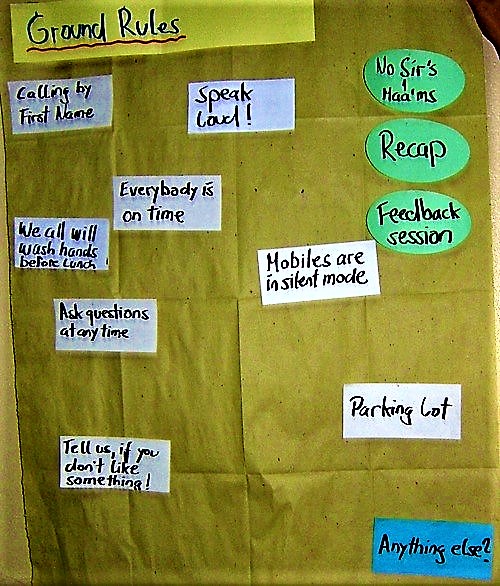
- You will have a full and equal opportunity to speak up on every issue presented for discussion - there is no need to rush or interrupt.
- You are encouraged to ask genuine "questions of clarification." Please avoid asking "questions of attack."
- Use each other's first names, not the pronouns "he" or "she."
- Speak for yourself only.
- You agree to work for your perceived most constructive and fairest agreement.
- Appeals and attempts to convince should be made to each other and not to the mediator.
- If something is not working for you, speak up.
- Speak from your own experience instead of generalising ("I" instead of "they," "we," and "you").
- Please keep your mobiles on silent mode.
- Be on time every time!
- Respect other's cultural and religious traditions, beliefs, values and languages.
- Etc….
When a group of learners knows what behaviour is expected, they are more likely to work together to create an effective learning environment (see also adult learning principles). When participants are involved in the process of setting ground rules as much as possible (or, at the very least, agreeing to follow them), their active role in the learning process is confirmed. Participants in training are sometimes described as “difficult” when, in fact, they may simply be confused about appropriate expectations. Setting ground rules helps participants monitor their own behaviour and gives the trainer a place to go whenever challenges arise.
See also facilitation or facilitators role.
Facilitating with ease! Core skills for facilitators, team leaders and members, managers, consultants and trainers
A tutor’s guide to teaching and learning at UQ

Tutors guide made for teaching and learning at the university for adult students By University of Queens land explains various methods the tutors has to adopt in training adult students. It’s a self study guide for the tutors in the University.
BATH, D. SMITH, C. (2004): A tutor’s guide to teaching and learning at UQ. The university of Queensland: TEDI Educational Technologies URL [Accessed: 08.05.2012]Guide for Setting Ground Rules: EdChange
Setting Ground Rules for Training Sessions
This document provides brief overlook on setting up ground rules. It includes ideas or even a list of suggestions for maintaining a safe and productive learning climate.
HARPER-WHALEN, S. MORRIS, S. (2007): Setting Ground Rules for Training Sessions. Montana Early Childhood Project URL [Accessed: 23.04.2010]A tutor’s guide to teaching and learning at UQ
Tutors guide made for teaching and learning at the university for adult students By University of Queens land explains various methods the tutors has to adopt in training adult students. It’s a self study guide for the tutors in the University.
BATH, D. SMITH, C. (2004): A tutor’s guide to teaching and learning at UQ. The university of Queensland: TEDI Educational Technologies URL [Accessed: 08.05.2012]Setting Ground Rules for Training Sessions
This document provides brief overlook on setting up ground rules. It includes ideas or even a list of suggestions for maintaining a safe and productive learning climate.
HARPER-WHALEN, S. MORRIS, S. (2007): Setting Ground Rules for Training Sessions. Montana Early Childhood Project URL [Accessed: 23.04.2010]Train the Trainer: Basic Training Guidelines
An excellent training is nothing without an excellent trainer. This publication covers basic guidelines and tips to help improve your training skills. The following areas are covered: Preparation, Establishing Confidence, Setting the Tone, Facilitating Discussion, and Ending.
ALAMEDA COUNTY PUBLIC HEALTH DEPARTMENT (2007): Train the Trainer: Basic Training Guidelines. Alameda: Alameda County Public Health DepartmentFacilitation Handbook

The Facilitation Handbook uses a particular approach to change processes, that builds on the idea of looking at social groups and institutions as complex systems. It contains various sections: starting with a brief general outline of how we believe we can deal with complex systems in a change context, it then draws practical conclusions on designing and delivering change events (such as workshops, meetings, conferences, …) – in particular in terms of the architecture of such events; it then creates an overview over methods and tools which allow to select and assemble them into a meaningful order that directs the event towards results.
STEINLIN, M. WIDRIG JENKINS, C. (2010): Facilitation Handbook. Knowledge Sharing for Change. Designing and Facilitating Learning with a Transformational Impact. Cape Town: Ingenious Peoples Knowledge URL [Accessed: 07.05.2012]http://www.edchange.org/
A guide for setting ground rules can be found on this website.
http://www.ehow.com/
This website provides some ideas about how to establish ground rules in adult education.
http://www.oncourseworkshop.com/
Various aspects on establishing group rules are posted in this link.
http://www.helium.com/
This site gives ideas about how to encourage positive discipline and effective classroom rules.