


Executive Summary
A sizable portion of the work involved in a training course takes place well before the first day of classes. It is important to plan the sessions ahead to avoid confusions during facilitation (PATRICK 2009). Preparation is the key to successful presentation. A good lecturer can range far and wide from their plan, just because they know their session is well planned and because they can hence integrate upcoming issues well. While the degree of preparation will of course vary, that it should always take place is a fundamental rule.
Introduction
Planning a good training session is very important for the effective learning experience of its participants. What goals do you have for the participants? How will the session effectively engage the participants and ensure that the goals for them are met? How will you assess whether the participants have benefited from the session?
Preparation of Sessions
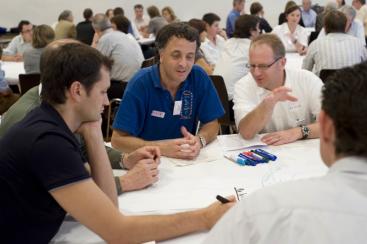
Planning sessions well results in a better learning environment. Source: REGIOSUISSE (2008)
Careful preparation for a session helps to build the confidence of the facilitator and ensures that participants have the best possible learning experience. Each session is like a mini-workshop in itself and requires thought and planning (USAID 2001). This includes the following actions:
- Decide the subject and aim.
- Identify the two or three key points to be discussed.
- Decide on the different parts of the session: a) Include an introduction to the subject of the activity and how it links with previous sessions. b) Select a teaching methodology to be used; consider the relative importance of having time for sharing and discussion. c) Decide how the activity will be concluded. Also consider whether energisers or icebreakers will be necessary.
- Allocate time for each part of the session. To ensure that learning is achieved in the best way for the subject of the session, some subjects need a lot more practice and others need more time for discussion.
- Prepare materials. Make and organise the materials that the participants and facilitators will need during activities.
- Rehearsing sessions. Read (very carefully) the chapters and sections those are designated for the sessions.
- Conduct research (as needed) in order to be appropriately informed about the topic. Make any additional notes, including supplemental information from your own research, in the training outline.
- If you are working with groups, make sure that the instructions for small group work are clear. Decide on the size and composition of the groups. Use different activities to divide people into groups (BENS 2005). Depending on the objective of the activity it may be necessary for people to work on their own, with people from the same organisation, or in mixed groupings (see also group works).
- Organise materials according to their order of use in the session. Well before the session starts, organise all prepared flip charts, posting those to be used during the session, hiding those to be introduced later.
- Make sure the seating arrangements are appropriate for the planned activities and exercises (e.g. small-group seating arrangements or adequate moving space).
During the Session: Session Plans
It is good to keep “session plans" when you plan for the sessions. So called “learning logs” help trainers to know what participants have learned and how they can apply it back to their work. This supports you in creating the session plans and delivering them effectively (TSHIULA and MARYANNE 2005). Session Plans can be developed taking into consideration the following aspects (adapted from SINGH et al. n.y.).
- Who: The learners (think about their skills, needs and resources) and the trainer(s).
- Why: Overall purpose of the training and why it is needed.
- When: The time frame should include a precise estimate of the number of learning hours and breaks and starting and finishing times each day.
- Where: The location with details of available resources and equipment and how the venue will be arranged.
- What: The skills, knowledge and attitudes that learners are expected to learn;the content of the learning event (keep in mind the length of the training when deciding on the amount of content).
- What for: The achievement-based objectives;what participants will be able to do after completing the training.
- How: The learning tasks or activities that will enable participants to accomplish the “what for” (SING et al. n.y.).
Conclusion
When the session comes to an end, make sure that you have either covered all points that you wanted to, or that you make clear that you will take them up in the next session. Try to summarise the most important points. Allow some time for questions, and be clear about possible assignments.
Planning of sessions is crucial to accomplishing workshop aims. Set workshop goals early in the planning process and use them to plan workshop sessions and pre-workshop activities. Adult learners want to learn things that are directly relevant to what they personally need to know. So, planning the sessions, it is essential to keep the needs of the participants in mind.
Facilitating with ease! Core skills for facilitators, team leaders and members, managers, consultants and trainers
Improve Your Coaching & Training Skills
Training Methodologies and Principles of Adult Learning
A Training-of-Trainers manual to strengthen the capacity of a team of trainers by applying different training methodologies and principles of adult learning to the trainings of health service personnel, NGO staff and community-based health workers.
TSHIULA, J. MARYANNE, S. J. (2005): Training Methodologies and Principles of Adult Learning. United States: United States Agency for International Development (USAID) URL [Accessed: 29.04.2010]A Facilitators Guide to Participatory Workshops with NGOs/CBOs Responding to HIV/AIDS
This guide aims to support people who facilitate participatory workshops with non-governmental organisations (NGOs) and community-based organisations (CBOs) responding to HIV/AIDS in developing countries. It contains also some general information on workshop facilitation.
USAID (2001): A Facilitators Guide to Participatory Workshops with NGOs/CBOs Responding to HIV/AIDS. United Kingdom: International HIV/AIDS Alliance URL [Accessed: 07.05.2012]Training Presentation
A Trainers Guide for Participatory Learning and Action

This trainers guide provides guidelines for participatory learning and action, which can be applied for any training or workshop.
GUIJT, I. PRETTY, J. SCOONES, I. THOMPSON, J. (1995): A Trainers Guide for Participatory Learning and Action. London: International Institute for Environment and DevelopmentParticipation and Social Assessment: Tools and Techniques

This resource kit aims to share information and experiences on participatory methods in the context of development cooperation. The primary focus concentrates on providing practical guidance and case examples.
RIETBERGEN-McCRACKEN, J. NARAYAN, D. WORLD BANK (1998): Participation and Social Assessment: Tools and Techniques. Washington: World Bank URL [Accessed: 10.05.2010]Tools for Community Participation. A Manual for Training Trainers in Participatory Techniques
This manual focuses on one approach to participatory training which PROWESS has applied in numerous projects and workshops. Intended primarily for the training of trainers in participatory techniques, it describes these techniques in a "how to" step-by-step fashion. This manual is also intended to be a "discussion starter" and delves into some of the political issues underlying participation and the often conflicting priorities of communities and development practitioners.
SRINIVASAN, L. (1990): Tools for Community Participation. A Manual for Training Trainers in Participatory Techniques. New York: PROWESS/UNDP Technical SeriesFacilitation Handbook
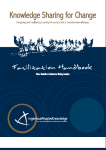
The Facilitation Handbook uses a particular approach to change processes, that builds on the idea of looking at social groups and institutions as complex systems. It contains various sections: starting with a brief general outline of how we believe we can deal with complex systems in a change context, it then draws practical conclusions on designing and delivering change events (such as workshops, meetings, conferences, …) – in particular in terms of the architecture of such events; it then creates an overview over methods and tools which allow to select and assemble them into a meaningful order that directs the event towards results.
STEINLIN, M. WIDRIG JENKINS, C. (2010): Facilitation Handbook. Knowledge Sharing for Change. Designing and Facilitating Learning with a Transformational Impact. Cape Town: Ingenious Peoples Knowledge URL [Accessed: 07.05.2012]Training Methodologies and Principles of Adult Learning
A Training-of-Trainers manual to strengthen the capacity of a team of trainers by applying different training methodologies and principles of adult learning to the trainings of health service personnel, NGO staff and community-based health workers.
TSHIULA, J. MARYANNE, S. J. (2005): Training Methodologies and Principles of Adult Learning. United States: United States Agency for International Development (USAID) URL [Accessed: 29.04.2010]A Facilitators Guide to Participatory Workshops with NGOs/CBOs Responding to HIV/AIDS
This guide aims to support people who facilitate participatory workshops with non-governmental organisations (NGOs) and community-based organisations (CBOs) responding to HIV/AIDS in developing countries. It contains also some general information on workshop facilitation.
USAID (2001): A Facilitators Guide to Participatory Workshops with NGOs/CBOs Responding to HIV/AIDS. United Kingdom: International HIV/AIDS Alliance URL [Accessed: 07.05.2012]Sample Format of Training Plan Template

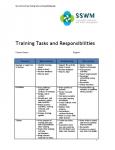
Sample Format of Training Tasks Plan
http://teaching.berkeley.edu/
This site provides you with many tools for teaching. This specific site gives information on how to prepare a large lecture course.
http://serc.carleton.edu/
Provides Tools for Teaching, training techniques and adult training strategies.