

Executive Summary
Group work can lead to a spirit of cooperation, coordination. Groups can - under optimal conditions – achieve more than the same number of individual workers, as each member’s performance is enhanced by their mutual support. However, group works are not always adapted, and need good preparation, instruction, management and evaluation in order to be successful.
Introduction
(Adapted from LINCOLN UNIVERSITY 2000)
There are many benefits to be gained through these experiences, but we must remember that there is nothing magical about putting students together in small groups. Group activities will only realise their potential for enhancing learning insofar instructors are able to design realistic goals, assist trainees to develop the necessary teamwork and interpersonal skills and encourage the sort of environment in which trainees will share ideas and learn from each other.
The benefits of group work in terms of both cognitive and social development have been widely documented in the literature. During group work, trainees have the opportunity to discuss issues, to listen to what others are saying, to analyse their arguments, and compare them with their own experiences. This process has been shown to enhance both the amount and depth of learning, to promote the development of communication and thinking skills, and to foster positive social skills and attitudes towards learning.
Workshop participants working in teams can achieve products of greater complexity and/or size than they would be able to achieve as individuals. Through group work students can also develop:
- a sense of responsibility and accountability
- time management and planning skills
- teamwork skills
- better interpersonal communication
- leadership
- tolerance and sensitivity towards others’ viewpoints
- the ability to negotiate and resolve conflict
Types of Group Work
(Adapted from LINCOLN UNIVERSITY 2000)
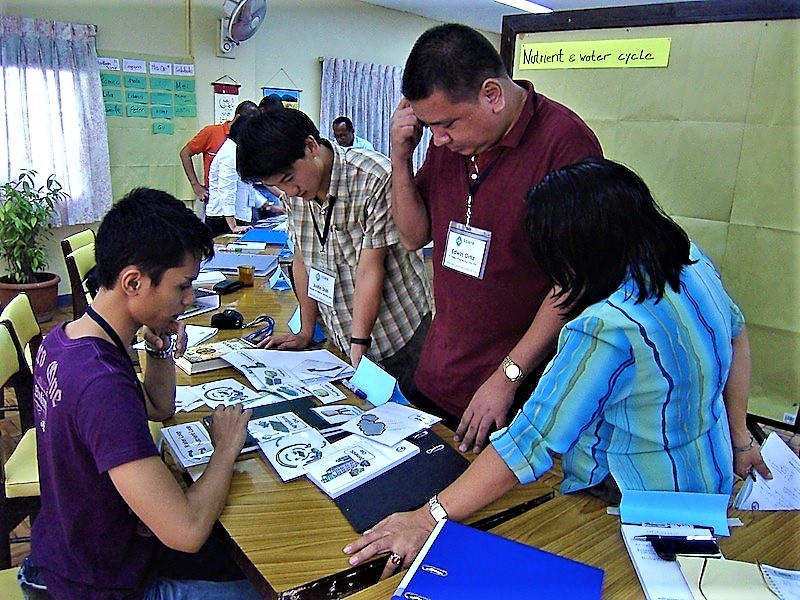
There are different types of groups:
Informal learning groups are temporary, ad hoc groups that last for a class or even simply one discussion point. These groups can be created for tasks that take as little as a few minutes, are a useful way of breaking up the traditional lecture slot (preferably before the students’ eyes glaze over), and can be achieved easily even with very large classes. They serve to focus student attention and give students the opportunity to cognitively process the material. By comparing ideas with their peers, students are also able to identify misconceptions or gaps in understanding. Finally, these opportunities can provide useful social interaction within a class and can begin to form a basis for the open communication skills necessary for successful interaction when they come to work in Formal Groups.
Formal learning groups are teams established to complete a specific task, such as perform a detailed situation analysis (e.g. the understand your system-Exercise over a certain period of time. These groups may complete over a longer period of time. Typically, students work together until the task is finished.
When to Do Group Works in Your Training
(Adapted from LINCOLN UNIVERSITY 2000 and MEYERS & JONES 1993)
Informal learning groups are particularly useful for simple activities such as:
- Gathering ideas in preparation for a lecture, film etc. (e.g. in the Intro session to a SSWM course – depending on the knowledge participants already bring with them – what are the most pressing problems we face today in regards to water and sanitation?
- Summarising or reviewing main points in a lecture
- Assessing levels of skills and understanding, or processing learning outcomes at the end of class (helpful for the trainers to see if they got their point across, e.g. at the end of a day).
- Re-examining ideas presented in previous classes
- Comparing and contrasting key theories, issues and interpretations
- Brainstorming applications of theory to everyday life
Formal learning groups are particularly apt for larger tasks that benefit from the inputs of different kinds of people, e.g. completing a situation analysis, developing a solution approach for a specific water management/sanitation problem, etc:
- Completing a specific task that requires conceptual thinking
- Developing solution approaches (incorporating different people’s viewpoints)
- Developing action plans and strategies
- Solving complex problems
When Do Group Works Work Well?
(Adapted from LINCOLN UNIVERSITY 2000)
Groups are working to their full potential when collaborative learning takes place. But collaborative learning is more than just students sitting together and talking. There needs to be something that holds the group together - the ‘glue’.
JOHNSON & JOHNSON (1991) have identified five key factors that make up this ‘glue’:
- Positive interdependence: This means that the group cannot succeed unless every member contributes (sink or swim together). Although the individual members may fulfil different roles or tasks, they must depend on each other to reach a common goal. When positive interdependence is working students are sharing resources, providing mutual support and celebrating their common achievement.
- Individual accountability: Group members need to be accountable for what they do; those who just don’t do anything in a group can be a real problem. By carefully setting goals and responsibilities, members must realise that every contribution is needed. Peer assessment can help in evaluating a group.
- Face-to-face interactions: While group meetings are crucial, it does not mean that all the work has to be done jointly. Withdrawing and working individually for some time can benefit the outcome.
- Interpersonal and small-group skills, including DISCUSSION (sharing and clarifying information) PROBLEM-SOLVING (putting information into new configurations relevant to the solution of a specified problem) DECISION-MAKING reaching group consensus, and COMMUNICATION of the product.
- Group processing: Groups need to assess their success and failure by learning to evaluate what they are doing. Again, early opportunities for evaluating the group process can be useful.
Most importantly, groups work best together when they have shared expectations and a common goal, supported by the necessary group work skills to ‘oil the wheels’ of the process as they work towards that goal.
Your challenge as a trainer then is to design tasks that demand interdependence of group members, to ensure sufficient opportunities for face-to-face interaction, to facilitate the development of the necessary teamwork skills through initial training and subsequent reflection on the group process, and to design an appropriate assessment regime so that individual accountability is maintained.
What Makes Groups Fail?
Simply putting individuals into groups and telling them to work together does not in itself promote co-operative learning and productivity. There are many ways in which group efforts can be derailed.
First off, not all trainees will want to work in groups – an often heard argument is: “I have paid for this course to work with experts – now I have to work with peers who don’t know more than I do!”. It is important to spend time explaining your rationale for doing group work and to get a feel for what the expectations of the experience are. Finally, if there is still resistance, you should consider whether you are prepared to let them choose to work on their own.
When a group is not working well, avoid breaking it up if you possibly can. Adding floundering group members to ongoing groups may throw off their group processes and the bailed-out, troubled group will not learn how to cope with its unproductive interactions.
How to Do Group Works
A good group work requires good preparation:
Preparing
- Develop a clear task. Consider the section “When to do group works” when designing your activity.
- Clearly describe the activity on a handout. Put a special effort into describing the goals clearly. Don’t forget to mention the timeline.
- Prepare all the necessary material: Are handouts needed? Do the groups need additional material such as pens, managing flipcharts, markers, or even computers?
- Think about how you are going to divide the whole class into groups: is it necessary that people from the same organisation work together (e.g. when analysing their situation or water management problems?). Or would it be better to mix people up? What about gender balance?
Instructing and Starting
- Make sure that the instructions for small group work are clear. Allow enough time for questions. Agree on clear goals.
- Decide on the size and composition of the groups. You can use different activities to divide people into groups. Depending on the objective of the activity it may be better to create groups randomly (e.g. by letting people count 1, 2, 3, 1 ,2 ,3), put together people from the same organisation, or form interest groups.
- Provide time and space (see also: logistics) for group work.
Management
When your trainees are engaged in group work, you cannot just “lean back”. Your main task during this time is to be there if questions arise, to step by each group and get a feeling of how the group work is going, to take corrective action if the group misunderstands its task, or if tension arises between individual group members. There are various approaches at managing groups – from ‘total freedom’ to ‘guided discovery’ – it is up to you to decide how much involvement of you as a trainer makes sense.
Evaluation / Results Sharing
When the group work is completed, it can be presented in plenary. For informal work groups, it may become repetitive to prepare findings in plenary, as they normally don’t go too deep. Think of different methods than just reporting back in plenary.
- you could for instance give each informal group two coloured cards with the most important findings that can be put on a pin board
- or you can have each group present main findings for a strictly limited time
In formal group works, it makes sense to plan sufficient time for the results to be presented. This enables other groups (who may have worked on the same issue) to provide feedback, and to compare their own work with the one of their peers.
Group Size
(Adapted from LINCOLN UNIVERSITY 2000)
The appropriate size of the group really depends on the context - How big is the class? What are the learning outcomes desired? How much work is involved in the associated task? What are your resources? What meeting facilities are available? And so on.
Some Guidelines could be:
- Pairs are good for small scale tasks: Difficulties arise when one student is absent, or lazy or domineering. It is normally unwise to use the same pairs for long term tasks.
- Threes can work well, as communication is easy and work can often be shared out in manageable ways. However, threes can be difficult if two pair up and exclude the other, or if one doesn’t do anything.
- Fours can be very effective, having a good critical mass for sharing out large projects, with opportunities for delegation and collaboration. However, fours do have a tendency, however, to split into two pairs and tensions can arise.
- Fives have many of the advantages of fours, and are a favoured group size for many tasks. There are sufficient people to provide a range of perspectives, but the group is not of unmanageable proportions. In a group this size, however, a determined slacker may be able to hide, unless suitable precautions are taken.
- Above five, groups generally get more difficult to manage.
| In smaller groups | In larger groups |
|
|
Group works can be applied in any course and are particularly adapted in longer trainings to break up the day, and to provide an alternative form of teaching than just lectures. Informal groups are particularly useful for simple activities such as generating ideas, summarising or reviewing points in a lecture, re-examining ideas presented, comparing and contrasting ideas or brainstorming. Formal group works are particularly apt for larger tasks that benefit from the inputs of different kinds of people with a different knowledge, e.g. completing a situation analysis, developing a solution approach for a specific water management/sanitation problem, etc. Be aware that any group work is just as good as its preparation – be specific, set clear goals, a clear timeline, and be sure to be there to help when assistance is needed.
Learning Together and Alone: Cooperative, competitive and individualistic learning, 3rd Edition
Guide to best practice: Group work
Promoting Active Learning
Groups that work
This article looks at the basics of group work and suggests ways to accelerate development. Normally, in a group, there are two main issues involved. The first issue includes the task. The second one concerns the process of the group work itself the mechanisms by which the group acts as a unit. This process is rarely addressed and is often forgotten, which can impede the success of group works.
BLAIR, G.M. (n.y): Groups that work. URL [Accessed: 20.12.2010]Group work – training the trainers
This article is written for trainers and aims to improve practical skills. Since group works is not free of problems, the focus lies on dealing with problem incidents.
MORTENSON, R. (2004): Group work – training the trainers. NGRF URL [Accessed: 20.12.2010]What is group work?

The author of this article gives an elaborate summary about how to do group works. He elaborates some definitions of key aspects and suggests areas which are held open for exploration.
SMITH, M.K. (2008): What is group work? . INFED URL [Accessed: 20.12.2010]Training Evaluation Form
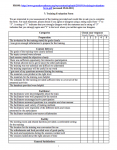
This training evaluation form, developed by ISPCAN within their international training programme ITPI can easily be adapted for own trainings and allow to conduct a comprehensive evaluation of a training, allowing trainers to improve their trainings continuously.
ISPCAN (2008): Training Evaluation Form. Chicago: ISPCAN International Society for the Prevention of Child Abuse and Negelect URL [Accessed: 24.04.2011]Evaluation Questionnaire
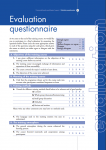
This comprehensive evaluation questionnaire can be used after the end of a training course in order to rate the training course. It allows trainers to collect feedback and improve their trainings.
NCDO (2008): Evaluation Questionnaire. Toolkit Sport for Development URL [Accessed: 16.11.2010]http://www.onlineteachingdegree.com
This website gives an overview and useful hints on collaborative learning, group work and study teams. Collaborative, or cooperative, learning is a strategy for learning material in a social setting.
http://sydney.edu.au/
This website shares sample sheets with which an evaluation for a finished group work can be done. This includes also a group feedback to estimate the performance and well-doing of the group.
http://www.guidance-research.org/
The material presented on this website emphasises on developing and supporting group works. Skills and a basic understanding which are necessary to perform a good group work are also described.