

Executive Summary
Role playing is a useful technique for developing a broad understanding of a situation or approach, and to prepare oneself for different eventualities. Role playing can be used to analyse problems from various perspectives, to spark brainstorming sessions, to experiment with different solutions to a problem, to develop team work, and help group problem-solving.
Introduction
A role play is a vivid way of learning how to handle different situations (KROEHNERT 2007). Role plays also effectively incorporate the principles of Adult Learning Theory. They can clearly show the relevance of the training and enable the trainees to apply the skills they are learning. Trainees share the learning experiences with each other in a supportive environment (BLANCHARD 2007). Furthermore, adults learn more effectively through participative techniques such as role plays.
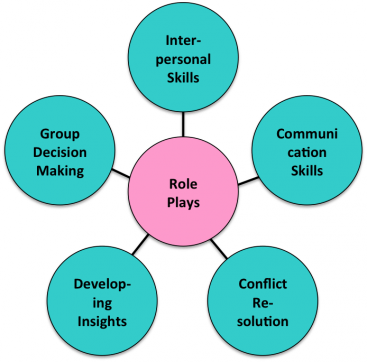
Role play – a good and many-sided method of Instruction. Source: NAUKRIHUB (2007)
A role play is a simulation in which each participant is given a role to play. Trainees are given some information related to description of the role, concerns, objectives, responsibilities, emotions, etc. Then, a general description of the situation, and the problem that each one of them faces, is given. For instance, situation could be to propose a new water management system to the beverage industry, managing conflict, bringing different water users to talk to each other, etc. Once the participants read their role descriptions, they act out their roles by interacting with one another.
There are various types of role plays, such as:
Multiple role play – In this type of role play, all trainees are in groups, with each group acting out the role play simultaneously. After the role play, each group analyses the interactions and identifies the learning points.
Single role play – One group of participants plays the role for the rest, providing demonstrations of situation. Other participants observe the role play, analyse their interactions with one another and learn from the play.
Role rotation – It starts as a single role play. After the interaction of participants, the trainer will stop the role play and discuss what happened so far. Then the participants are asked to exchange characters. This method allows a variety of ways to approach the roles.
Spontaneous role play – In this kind of role play, one of the trainees plays herself while the other trainees play people with whom the first participant interacted before.
Purpose of Role Plays
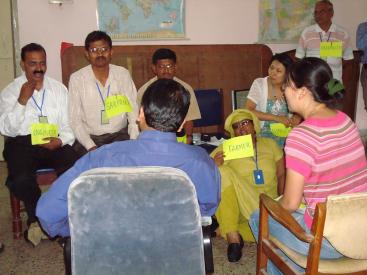
A vivid role play in an ecosan course in India. Role plays are especially useful to round up a week of learning and force participants to put their acquired knowledge into practise. Furthermore, role plays can break monotonous lecture sessions as they are a lot of fun. Source: KROPAC (2007)
(Adapted from WOODROW n.y.)
Role plays are used to help examine real problems on the level of philosophy, emotional response, and physical response. Participants get a chance to analyse situations and try out different theories and tactics in a relatively safe setting. Role plays also enable trainees to understand different people and their roles and to develop insights into the thoughts and feelings of "opponents". Through role plays, participants can identify and anticipate possible problems and reveal fears and anxieties people have about an event or action. Role plays develop group and individual confidence and competence.
See also setting ground rules.
Steps in a Role play
(Adapted from WOODROW n.y.)
In the following, several steps to set up and perform a role play are described. Of course, the set up of role plays can vary.
- Select a situation. Either (a) use a scenario developed by the trainers (see also handouts preparation), or (b) ask the participants to identify the problems they expect might occur or they fear will occur. If drawing scenarios from the group, one possible process is to ask participants to meet together in groups of three people for about five minutes to talk about the kinds of problem situations they think will come up. Then, call the participants back to the large group and ask someone from each group to call out situations "headline" style while you or a colleague write them up on newsprint. Once you have a list of situations, you as trainer pick a situation to start with usually a fairly simple scenario to get people warmed up and engaged. Save more complex or difficult problems until later in the session. Be sure to leave time to cover situations that were mentioned by several small groups.
- Explain the situation: What groups/individuals are involved, what their roles are, what is the physical setting. If the scenario was drawn from the group, ask for the help of a participant who raised the situation to set the scene and players. Explain enough of background to make the situation clear, so roles will not be played solely from stereotypes. Since a role play is used to learn how to handle a particular situation, it is usually best to define carefully either the situation or the role to the players, but not both. Leave room for creative response by the participants.
- Cast roles. Ask for volunteers among participants. If no one comes forward, ask specific people to play roles. If possible, cast people in roles with which they do not identify strongly. Ask role players to take fictitious names, whether they will be used or not.
- Prepare the role players. Allow a few minutes for people to get into their roles and to plan their strategy in the role play. Ask people to think about other aspects of the character they are playing (job, family, motivation...) to make the roles realistic. If the role is unfamiliar, the trainer can help. Limit the time for this, however, in order to keep things moving and make sure the role play is spontaneous. If the trainer wants to give special or secret instructions to a role player, they can be given at this time.
- Prepare the observers. Observation is as important as playing a role. Prepare observers by suggesting specific things they should watch for, such as the effects of different physical actions, words, gestures, tone, etc. Ask them not to say or do anything which might distract the role players. If the role play causes emotional reactions in participants, ask them to share their feelings early in the debriefing.
- Set the scene. You establish the scene, the physical layout and any other relevant details.
- Run the role play. Give a clear signal to begin the role play once the players are ready. Tell them from the start what signal you will use to stop the role play.
- Cut the role play. Stop the role play when enough issues have been uncovered, or the action seems to come to an end, or when people want to stop. Keep the learning goals in mind when deciding. Stop the action if someone is about to get hurt, or the role play dissolves into laughter. If role players did not get "into" their roles, start again. If someone over-identifies with a role (indicated by showing great tension), stop and assist the person to step out of role.
- Debrief. Debriefing allows people to examine what took place; it is essential for learning. Set a tone of exploration rather than judgement; draw the learning’s from the participants rather than provide answers yourself. Some trainers divide the evaluation into three sections: a) feelings, reactions, tensions; b) tactics, approaches, motivations/goals; c) general lessons or theoretical connexions. We recommend starting by asking the players how they felt in their roles. If practical, give each person a chance to speak.
Role playing is when a group of people act out roles for a particular scenario. As an example, you might train water and sanitation experts by having two people act out a real scenario. One acts as the marketing person for sustainable sanitation. The other acts as the customer. This allows trainee people to practice their marketing techniques. A trainer and/or other trainees may watch the role play and critique it afterwards. Do not forget to plan time for this when designing the sessions.Role plays can be invaluable. They can also be a dreadful torment and waste of time. How you set them up and handle can often make the difference.
Team Role Play
This article copied from the above link leads to a short overview which explains how a role play can be applied and how a role play works.
BAUMGARTNER, J. (2001): Team Role Play. URL [Accessed: 14.12.2010]Effective Training Systems, Strategies, and Practices
Basic Training for Trainers
How to lead Roleplays
This article describes the purpose of roleplays, as well as how to lead them in ten very illustrative steps.
WOODROW, P. (n.y): How to lead Roleplays. Minneapolis: Training for change URL [Accessed: 14.12.2010]Team Role Play
This article copied from the above link leads to a short overview which explains how a role play can be applied and how a role play works.
BAUMGARTNER, J. (2001): Team Role Play. URL [Accessed: 14.12.2010]How to lead Roleplays
This article describes the purpose of roleplays, as well as how to lead them in ten very illustrative steps.
WOODROW, P. (n.y): How to lead Roleplays. Minneapolis: Training for change URL [Accessed: 14.12.2010]From Knowing to Doing: How to Implement!
This article gives some ideas on how to organise a role play well, and provides the reader with many good tips and tricks.
FINKEL, S. (n.y): From Knowing to Doing: How to Implement!. URL [Accessed: 14.12.2010]http://www.jpb.com/
This site presents many useful tools that can be used in trainings, such as role plays, brainstorming techniques, evaluation methods etc.
http://trainingforchange.org/
This site, entitled Training for Change presents an array of tools that can be used for training. The organisation is dedicated to inducing change, which requires a strong team spirit. Hence, there are also some tools on teambuilding.
http://www.stevefinkel.com/
The author of this article, Steve Finkel, regards role play as a good way to take the step from “knowing to doing”. It can help to implement new techniques and to teach new methodology. The article also highlights the advantages of a role play.
http://www.thetrainingworld.com/
This website of the training, learning and development resources presents an overview of the advantages and disadvantages of roleplays, and includes also other training tools.
http://www.salescreators.com/
This website considers role play as an effective training method for staff and gives reasons for this conclusion. As an example, a role play allows to assess new scenarios in a realistic manner, and enables participants to reflect.