Use of Compost

Compiled by:
Analiza Miso (Xavier University)

Executive Summary

Composting products (compost, vermicompost, terra preta or humanure) derive from composting or vermicomposting processes of raw organic matter coming from biodegradable solid waste and excreta. Due to their high nutrient and organic matter content compost products are a valuable soil amendment and fertiliser source. Furthermore, they provide a positive environment for beneficial soil organisms by serving as an energy source, support microbial activity in the soil, moderate the soil temperature and improve the water and nutrient holding capacity of the soil. Composting products can be applied in small scale or larger scale agriculture as a soil conditioner prior to planting giving substantial yield increase particularly if compared with poor soils.

In Out

Compost/Biosolids

Food Products

Introduction

 ROUSE et al. (2008)

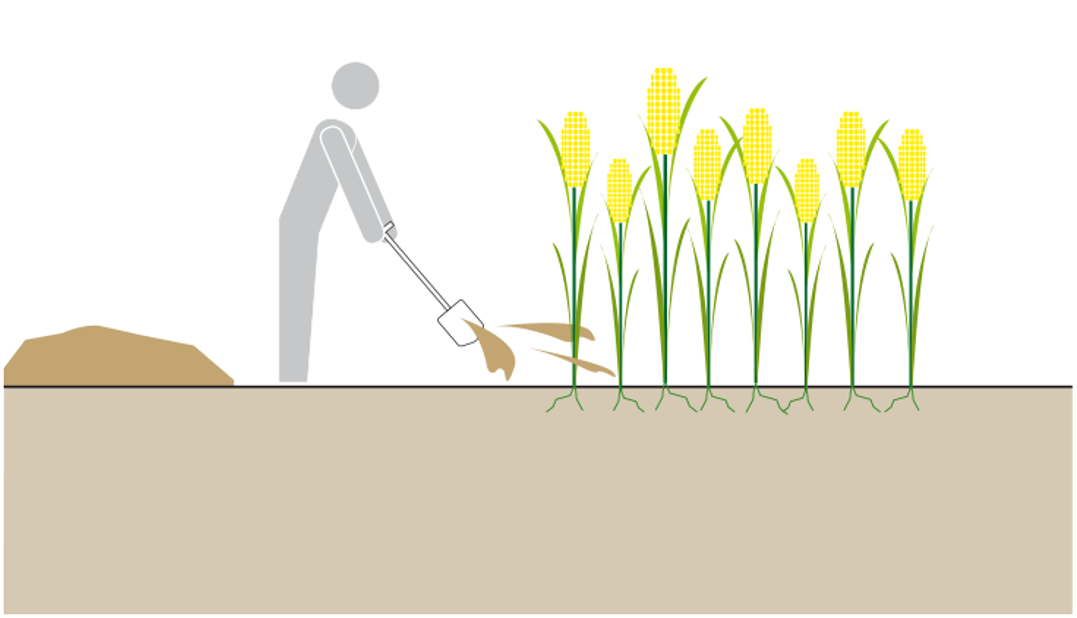
Compost is a valuable soil amendment. It improves soil structure and helps plant to grow. Source: ROUSE et al. (2008)

Compost, vermicompost, terra preta and ecohumus are all products of the degradation of organic wastes. Even though they vary somehow regarding composition and structure,they function similarly when applied to the soil. They can be mixed in the soil before crops are planted, used to start seedlings in the nursery or as soil media for container gardening. They primarily function is as soil conditioner and soil fertiliser by the addition of humus, nutrients and beneficial soil bacteria, with a wide range of specific applications.

   GREEN PARENTHOOD (2010)

Compost helps to bring back the nutrients contained in household waste to the filed for food production. Source: GREEN PARENTHOOD (2010)  

The quality of composting products varies according to the type of materials used in composting. Variety of materials can be composted or vermicomposted such as kitchen waste, garden waste, animal manure (cow dung, chicken dung, etc.) and human urine and faeces (see also small and large-scale composting, composting toilets, the arborloo, fossa alterna, terra preta toilets or terra preta sanitation. These products are very important resources as fertiliser and soil supplement when properly utilised for producing compost.

The most important thing to consider in determining the quality of compost are: pH level, soluble salts, moisture, organic matter content, total nitrogen, carbon to nitrogen ratio (C:N), and other physical properties of the compost (e.g. structure).

In order to decide, which type of compost product is better for which type of soil, one must first know what set of organisms is needed in the soil (lacking in the soil); second, what set of carbon compounds are needed around the roots of the plants to grow the beneficial bacteria and fungi; and third, what organisms and kinds of carbons are in the different types of compost products.

        ROUSE et al. (2008)

Different types of composts are commercially available. The commercialisation of compost allows getting sustainable market driven solution for the treatment organic waste products. Source: ROUSE et al. (2008)       

Use of Compost

The general term of compost describes the product of the aerobic degradation of organic waste, mostly kitchen waste (see also small and large-scale composting). The basic use is conditioning and fertilising soil by the addition of humus, nutrients and beneficial soil bacteria, with a wide range of specific applications.It can be used beneficially to improve the quality of soils by adding nutrients and organics, which help improving the physical and chemical properties and contribute to enhance the capacity of the soil to store air and water.

           MORGAN (2007)

Pumpkin grown with compost in Ethiopia. Source: MORGAN (2007)

Around the house, compost can be used on the lawns, for potted plants, trees and shrub plants, in the vegetable garden, as mulch, starter mixes. The application technique varies according to what and where it is to be sed. For instance, when compost is applied in the garden, simply add compost to your garden each year in spring or early summer before planting. Till the soil to a depth of 15 to 25 cm then, apply 10 cm of compost on top of the soil, and then till it again to mix it. If the soil is very poor, you can add some more compost (don’t worry about adding too much compost). Compost releases nutrients slowly and continuously and will not damage plants. Throughout the growing season you can add a sprinkle of compost mixed with soil as a top dressing. You can also apply a couple inches of unfinished compost (COMPOST CENTRE n.y.).

When using compost for the potted plants, potting soil can be made with 1/4 to 1/3 finished compost and the rest sterile soil or sand. You can also sprinkle a thin layer of compost over the house plant soil to add nutrients. This is also excellent to correct drainage problems in soils that have cracked or pulled away from the container. But do not put plants in pure compost. Plants need coarser particles such as sand and soil in order to root properly (COMPOST CENTRE n.y.).

Use of Vermicompost

Vermicompost (also called worm compost, vermicast, worm castings, worm humus or worm manure) is similar to compost, but as earth worms are used during the composting process, the resulting soil is particularly rich in nutrients, humic acids and as a fertiliser, improves the structure of the soil (see also small and large-scale composting). Earthworm castings in the home garden often contain 5 to 11 times more nitrogen, phosphorous, and potassium as the surrounding soil. Secretions in the intestinal tracts of earthworms, along with soil passing through the earthworms, make nutrients more concentrated and available for plant uptake, including micronutrients (AALOK et al. 2008, DICKERSON 2004). Moreover, the tunnels formed by the worms aid in the passage of water, which also washes the nutrients from the drilosphere to the roots that extend quite rapidly along these channels (AALOK et al. 2008, DICKERSON 2004).

Vermicompost can be used in many ways, such as a good germinator, potting mix, soil conditioner, tree planting media, seed inoculation, and fertiliser replacement. It can be applied as pure cast or it can also be mixed with the garden soil. In pure form, castings provide a superior rate of germination. The seedlings produced from 100% vermicompost will be unusually healthy. Vermicompost is also an excellent potting media, suggested good mixture formula can be 5 to 10% vermicompost, mixed with any other potting medium that does not have a nitrogen demand. It will provide sufficient nutrition to sustain vigorous, healthy growth for up to six months. Vermicompost is also a very good soil conditioner, even in quite barren soils good sprinkling of vermicompost (around 2 to 3mm thick) dug in and watered well will awaken quite amazing results for the first season's plants. Another option to use vermicompost is for tree planting. A hand-spade of castings in the bottom of the hole dug for the tree will help ensure healthy growth right from the start (DWF 2009).

Another very important role of vermicompost is during the initial stage of planting. It can be good for seed inoculation as well. Take the seed and shake it together with vermicompost before you spread it. Vermicompost is also a good fertiliser due to its high C:N ratio: sprinkle vermicompost around the base of plants (spread it broadcast by hand or use a seed spreader) and dig it in. Do this at the end of the day - preferably in the twilight, as this reduces the damage that can be done by direct sunlight - and always water well (DWF 2009).

Ecohumus (Humanure)

                MORGAN (2007)

Toilet compost dug out of a fossa alterna.  Source: MORGAN (2007)               

Ecohumus or humanure is a term used for composted human faeces, in particular the one from composting toilets,fossa alterna and the arborloo toilets because it is produced passively underground and has a slightly different composition (MORGAN 2007; TILLEY et al. 2008). Ecohumus can be mixed into the soil before crops are planted, used to start seedlings or indoor plants or simply mixed into an existing compost pile for further treatment. For poor soils, equal parts of compost and topsoil have shown to improve productivity. The output from one fossa alterna, for instance, should be sufficient for two 1.5 m by 3.5 m beds (MORGAN 2007).


Terra Preta

                       MORGAN (2007)

Tomatoes growing in pit filled with compost from an arborloo. Source: MORGAN (2007) 

Terra preta (literally “black earth”) is a manmade soil recently discovered in the Amazon region that was produced by pre-Columbian cultures through the conversion of biowaste and faecal matter via lacto-fermentation and vermicomposting into long-term fertile soils (see also terra preta toilets and terra preta sanitation). Terra preta soils have a high organic carbon content that allows for a long lasting fixation of essential nutrients, water retention and reduced leaching of nutrients from the rhizosphere. The nutrient rich humus in combination with the black carbon acts like a “microbial reef” that promotes and sustains the growth of mycorrhizae and other beneficial microbes, and it has been shown to retain its fertility for thousands of years (adapted from FACTURA et al. 2010). Terra preta products can be used or applied similar with the ordinary compost and vermicompost.


Applicability

Composting products can be mixed into the soil before crops are planted, used to start seedlings or indoor plants or simply mixed into an existing compost pile for further treatment. For poor soils, the incorporation of the compost into the soil by tillage or the simple spreading on the top soil can improve the quality of soils by adding nutrients and organics, which help improving the physical and chemical properties and contribute to enhance the capacity of the soil to store air and water. Especially vermicompost improves the soil structure because of the wholes that earthworms have dug.

Advantages

  • Livelihood and income generation opportunity (selling of composting products, improved yield and productivity of plants)
  • Low risk of pathogen transmission if well applied
  • Improving the structure and water-holding capacity of soil
  • Simple technique for all users
  • Low cost
  • Requires time for maturation
  • Does only partly replace fertiliser (N, P, K)

Disadvantages

References Library

AALOK, A.; TRIPATHI, A. K.; SONI, P. (2008): Vermicomposting: A Better Option for Organic Solid Waste Management. In: Journal of Human Ecology 24, 59-64.

COMPOST CENTRE (Editor) (n.y.): Compost Uses Every Homeowner Should Know. The New England Environmental Internship Program (NEBHE). URL [Accessed: 25.03.2011].

DICKERSON, G. (2004): Vermicomposting. Guide H-164. New Mexico: New Mexico State University, Cooperative Extension Service, College of Agriculture and, Home Economics. URL [Accessed: 11.08.2010]. PDF

DWF (Editor) (2009): Vermicast. Davo's Worm Farms (DWF). URL [Accessed: 24.03.2010].

FACTURA, H.; BETTENDORF, T.; BUZIE, C.; PIEPLOW, H.; RECKIN, J.; OTTERPOHL, R. (2010): Terra Preta Sanitation: re-discovered from an ancient Amazonian civilisation - integrating sanitation, bio-waste management and agriculture. In: Water Science and Technology, accepted for publication. PDF

GREEN PARENTHOOD (Editor) (2010): 11 Green New Years Resolutions For 2011. URL [Accessed: 30.03.2011].

MORGAN, P.; EcoSanRes (Editor) (2007): Toilets That Make Compost . Stockholm: Stockholm Environment Institute. PDF

ROUSE; ROTHENBERGER, S.; ZURBRUEGG, C. (2008): Marketing Compost. A Guide for Compost Producers in Low and Middle-Income Countries. Duebendorf: Water and Sanitation in Developing Countries (SANDEC), Swiss Federal Institute for Environmental Science (EAWAG). URL [Accessed: 05.05.2010]. PDF

TILLEY, E.; LUETHI, C.; MOREL, A.; ZURBRUEGG, C.; SCHERTENLEIB, R. (2008): Compendium of Sanitation Systems and Technologies. Duebendorf and Geneva: Swiss Federal Institute of Aquatic Science and Technology (EAWAG). URL [Accessed: 15.02.2010]. PDF

Further Readings Library

Reference icon

HOLMER, R.J. (n.y.): Basic Principles for Composting of Biodegradable . PDF

This publication discusses the basic principles that need to be considered in composting household wastes.


Reference icon

BAFU (Editor); BLW (Editor) (2012): Nährstoffe und Verwendung von Düngern in der Landwirtschaft. Ein Modul der Vollzugshilfe Umweltschutz in der Landwirtschaft. Bern: Bundesamt für Umwelt (BAFU) / Bundesamt für Landwirtschaft (BLW). URL [Accessed: 15.01.2013]. PDF

These terms of references define the legal regulations in Switzerland concerning the water protection and air pollution control for the use of nutrients and fertilisers in agriculture.


Reference icon

BALLIETT, A. (2007): Terra Preta. Magic Soil of the Lost Amazon. In: Acres U.S.A. The Voice of Eco-Agriculture 37, 16-18. URL [Accessed: 13.05.2010]. PDF

This article provides detailed information on terra preta, the historical background and the latest ideas and theories of creating a synthetic terra preta.


Reference icon

JENKINS, J. (2005): The Humanure Handbook. A Guide to Composting Human Manure. Grove City: Joseph Jenkins Inc. . URL [Accessed: 16.08.2010].

A comprehensive book on recycling human excrement without chemicals, high technology or pollution. Well written, practical, and thoroughly researched, this self-published book is built on nearly twenty years of experience by the author, who tells us about every aspect of dealing with excrement on the home-scale level. Only available for free as web book.


Reference icon

JOENSSON, H.; RICHERT, A.; VINNERAAS, B.; SALOMON, E. (2004): Guidelines on the Use of Urine and Faeces in Crop Production . Stockholm: EcoSanRes. URL [Accessed: 17.04.2012]. PDF

These guidelines provide a thorough background on the use of urine (and faeces) for agricultural purposes. Aspects discussed are requirements for plant growth, nutrients in excreta, hygiene aspects, and recommendations for cultivation. It provides detailed guidance on the use of urine for purposes.


Reference icon

LEKAMMUDIYANSE, L.M.M.U.; GUNATILAKE, S.K. (2009): Efficiency of the Household Compost bin as a Waste Management Technique in Sri Lanka . In: International Journal of Basic & Applied Sciences IJBAS-IJENS 10, 89-94. URL [Accessed: 05.08.2010]. PDF

The paper presents the findings of a survey of 70 households using compost bins in Gampaha Municipality. During the study two compost samples from each of the bins were also tested.


Reference icon

MANGAN, F.; BARKER, A.; BODINE, S. ; BORTEN, P. (n.y.): Compost Use and Soil Fertility. PDF

This paper gives information on compost maturity and compost quality.


Reference icon

EcoSanRes (Editor) (2008): Toilets That Make Compost. Factsheet. (pdf presentation). Stockholm: Stockholm Environment Institute. PDF

This information sheet summarises the Peter Morgan publication under the same name on two pages. It describes three types of simple and affordable composting toilets: Two types of shallow pit toilets (arborloo) and the urine diverting toilet.


Reference icon

MORGAN, P.; EcoSanRes (Editor) (2007): Toilets That Make Compost . Stockholm: Stockholm Environment Institute. PDF

This book describes in an easy-to-understand and picture-based way how to construct three different low cost sanitation solutions, namely arborloos, fossa alterna and urine diversion toilets.


Reference icon

PREMAKUJMARA, D.G.H. (2000): Compost Bins as an Alternative Solution to the Problem of Household Waste Problem in Urban Areas. URL [Accessed: 05.08.2010]. PDF

This paper describes a household composting project implemented by SEVENATHA in Dehiwala Mt. Levenia Municipal Council near Colombo in Sri Lanka with support from UNDP.


Reference icon

ROUSE; ROTHENBERGER, S.; ZURBRUEGG, C. (2008): Marketing Compost. A Guide for Compost Producers in Low and Middle-Income Countries. Duebendorf: Water and Sanitation in Developing Countries (SANDEC), Swiss Federal Institute for Environmental Science (EAWAG). URL [Accessed: 05.05.2010]. PDF

This guide describes a marketing approach to composting, and is intended to help compost producers run more viable initiatives by unlocking the value of their product. The handbook does not cover everything there is to know about marketing, but starts with the basics and introduces the key principles and techniques. These include understanding the ‘marketing environment’, identifying appropriate target customer groups, and developing and promoting products to suit the market.


Reference icon

SCHOENNING, C.; STENSTROEM, T. A. (Editor) (2004): Guidelines for the Safe Use of Urine and Faeces in Ecological Sanitation Systems. Stockholm: Stockholm Environment Institute. PDF

These guidelines provide a thorough background on the safe use of urine and faeces for agricultural purposes. Aspects like the health risk associated we the use of human excreta in agriculture and how to limit them are discussed.


Reference icon

TILLEY, E.; LUETHI, C.; MOREL, A.; ZURBRUEGG, C.; SCHERTENLEIB, R. (2008): Compendium of Sanitation Systems and Technologies. Duebendorf and Geneva: Swiss Federal Institute of Aquatic Science and Technology (EAWAG). URL [Accessed: 15.02.2010]. PDF

This compendium gives a systematic overview on different sanitation systems and technologies and describes a wide range of available low-cost sanitation technologies.


Reference icon

TULADHAR, B. (2003): Home Compost Bins. In: ENPHO Magazine. URL [Accessed: 05.08.2010]. PDF

This article describes the home compost bins that were promoted in Kathmandu.


Reference icon

VALLEY VIEW UNIVERSITY (Editor) (2008): Small scale composting of human faeces - in a Nutshell. Hohenheim: University of Hohenheim (Germany), Berger Biotechnik, Valley View University Ghana. URL [Accessed: 11.08.2010]. PDF

This leaflet provides a summary on why and how to compost faeces.


Reference icon

WHO (Editor) (2006): Guidelines for the safe use of wastewater excreta and greywater. Volume IV. Excreta and Greywater Use in Agriculture. Geneva: World Health Organisation. URL [Accessed: 26.02.2010]. PDF

Volume IV of the Guidelines for the Safe Use of Wastewater, Excreta and Greywater recognizes the reuse potential of wastewater and excreta (including urine) in agriculture and describes the present state of knowledge as regards potential health risks associated with the reuse as well as measures to manage these health risks following a multi-barrier approach.


Case Studies Library

Reference icon

ALI, M. (Editor) (2004): Sustainable Composting Case Studies and Guidelines for Developing Countries. Leicestershire: Water Engineering and Development Centre, Loughborough University. URL [Accessed: 05.08.2010]. PDF

This publication presents the findings of a research on “Promoting Composting as a Business for the Urban Poor” in the form of guidelines based on case studies from India, Bangladesh, Sri Lanka, Pakistan and Ethiopia.


Reference icon

ARANCON, N.Q.; EDWARDS, C.A.; DICK, R.; DICK, L. (2007): Vermicompost Tea Production and Plant Growth Impacts. Ohio State University. PDF

This is part one of the research study of Ohio State University on the impact of vermicompost on tea production and plant growth where the research study found out that aerating vermicompost tea during brewing results in significant growth responses, even at the concentration tested.


Reference icon

KINOBE, J.; OLWENY, S.; NIWAGABA, C. (2010): Composting at Households in Kitgum Town, Uganda - Draft. Eschborn: Susana. URL [Accessed: 16.08.2010]. PDF

A case study on household-level composition in Kitgum, Uganda. The project aims at using composting to develop practical operation and management strategies for peri-urban areas and to demonstrate the safe reuse of faces by co-composting them.


Reference icon

LAPID, D.G.; ANCHEPA, C.C.; VILLAREAL, T.J. (1996): Composting in the Philippines. Gouda: WASTE. PDF

This report analyzes the technical and financial aspects of Santa Maria Compost Plant operated by AWARE Inc.


Reference icon

OLUFUNKE, C.; DOULAYE, K. (2009): Co-composting faecal sludge & organic solid waste, Kumasi, Ghana. Eschborn: Sustainable Sanitation Alliance (SuSanA). URL [Accessed: 22.05.2012]. PDF

This project aimed to gain scientific knowledge on the technical, socio-economical and operational aspects of co-composting (organic solid waste and faecal material). Dried faecal sludge (drying bed) is co-composted with the organic fraction of solid waste. The final product is used as compost for urban and periurban agriculture.


Reference icon

SHEWA, W.A.; SuSanA (Editor) (2009): Fossa Alterna for Household Sanitation. Arba Minch, Ethiopia: Sustainable Sanitation Alliance (SuSanA). URL [Accessed: 25.11.2010]. PDF

Case study about fossa alterna toilets for household sanitation in Arba Minch, Ethiopia.


Reference icon

STRAUSS, M.; DRESCHER, S.; ZURBRUEGG, C.; MONTANGERO, A.; OLUFUNKE, C.; DRECHSEL, P. (2003): Co-composting of Faecal Sludge and Municipal Organic Waste. Swiss Federal Institute of Aquatic Science (EAWAG), Department of Water and Sanitation in Developing Countries (SANDEC) and International Water Management Institute (IWMI). URL [Accessed: 23.06.2010]. PDF

The document gives an overview on the combined composting of (faecal) sludges and organic solid waste based on a pilot project in Kumasi, Ghana. Results of the investigation should help the city’s waste management department to develop its biosolids management strategy and enable the project team to develop guidelines for planners and engineers on the option of co-composting.


Reference icon

TRAVIS, J.W.; HALBRENDT, N.; HED, B.; RYTTER, J.; ANDERSON, E.; JARJOUR, B.; GRIGGS, J. (2003): A Practical Guide to the Application of Compost in Vineyards. Penn State University in Cooperation with Cornell University. PDF

This document provides growers very practical information on the use of compost in vineyards. It focused on determining the correct rate of compost to use based on the nitrogen contained in the compost and the nitrogen needs of the vineyards.


Reference icon

ZURBRUGG, C.; DRESCHER, S.; PATEL, A.H.; SHARATCHANDRA S.C. (2002): Decentralised Composting in India – Lessons Learnt. Leicestershire: Water Engineering and Development Centre, Loughborough University. URL [Accessed: 05.08.2010]. PDF

The paper discusses the findings of a study of 20 compost plants, ranging in size from household composting to large centralised composting facilities, in Bangalore, Chennai, Pune and Mumbai.


Reference icon

SOIL (Editor) (2011): Can We Sell EcoSan Compost in Haiti?: A Market Analysis Report . Sherburne: Sustainable Organic Integrated Livelihoods (SOIL). URL [Accessed: 22.02.2012]. PDF

With the support of Oxfam Great Britain, SOIL conducted a market assessment of compost and fertilizer sales in Haiti with a specific focus on identifying possible markets for the sale of compost generated by Ecosan projects.


Training Material Library

Reference icon

AME FOUNDATION (Editor) (2007): Vermi-Composting brings better yields and returns – A farmer shows the way. Bangalore: AME Foundation. URL [Accessed: 05.08.2010]. PDF

This is the case of a small farmer who chose to be different from the typical resource-poor farmers struggling to make a living in the degraded drylands. His deep ‘love for life’ has not only earned him a decent living, but more importantly, it has inspired many other farmers to emulate him.


Reference icon

CORNELL UNVIERSITY (Editor) (n.y.): Home Composting Brochure. URL [Accessed: 05.08.2010]. PDF

The four-page brochure explains the basic of composting and how yard waste and food waste can be composted at home.


Reference icon

HRDA (Editor) (1998): Composting in the Tropics II. The Organic Organisation. URL [Accessed: 11.08.2010]. PDF

This booklet follows on from ‘Composting in the Tropics’, which concentrated especially the heap method. This second booklet looks at other methods of producing compost, including variations on the heap method and also describes practices suitable for different climates in the tropics, for example arid areas.


Reference icon

HDRA (Editor) (1998): Composting in the Tropics. The Organic Organisation. URL [Accessed: 11.08.2010]. PDF

This booklet describes the principles of composting with focus on the heap method.


Reference icon

LAOIS COUNTY COUNCIL (Editor) (n.y.): Turn Spoil into Soil – A guide to Household Composting. URL [Accessed: 05.08.2010]. PDF

This 8-page guide-book consists of information on need of composting and how to start composting at household level.


Reference icon

NYACHHYON, B.L.; MALLA, G. (2005): Manual for Composting at Domestic Level. Kathmandu: Zero Waste Nepal and Rotary Club of Mt. Everest. PDF

This booklet describes the process of composting at the household level and provides instructions for building and operating a compost bin made from a 200-litre water tank.


Reference icon

DRESCHER, S.; ZURBRUEGG, C.; ENAYETULLAH, I.; SINGHA, M.A.D. (2006): Decentralised Composting for Cities of Low- and Middle-Income Countries – A User’s Manual. Dhaka: Swiss Federal Institute of Aquatic Science (EAWAG), Department of Water and Sanitation in Developing Countries (SANDEC) and Waste Concern. URL [Accessed: 16.08.2010]. PDF

This book describes approaches and methods of composting on neighbourhood level in small-and middle-scale plants. It considers issues of waste collection, composting technologies, management systems, occupational health concerns, product quality, marketing and end-user demands.


Reference icon

NETWAS (n.y.): Proper Use and Safe Handling of Ecosan By-Products. Kampala: Network for Water and Sanitation (NETWAS). URL [Accessed: 29.09.2011]. PDF

This poster illustrates how to use Ecosan toilets and handle faecal compost in a safe way.


Reference icon

NETWAS (n.y.): Primary and Secondary Processing of Ecosan By-Products. Kampala: Network for Water and Sanitation (NETWAS). URL [Accessed: 29.09.2011]. PDF

This poster illustrates how to transform faecal waste to usable compost.


Important Weblinks

http://web.extension.illinois.edu/ [Accessed: 22.02.2011]

This weblink of the University Illinois Extension providing information about the use and benefits of compost for the homeowners.

http://www.anr.state.vt.us/ [Accessed: 25.03.2011]

This weblink providing information as to why use compost and how to use compost.