
Executive Summary
The media (television, radio, print media, internet and email) play a significant part in spreading information on Sustainable Sanitation and Water Management and in awareness raising. They enable to influence and change public opinion and behaviour on an issue. This can lead to public pressure on the local policy actors, and can indirectly influence decision makers as well. Furthermore, the media can play a role as an advocacy tool (WATERAID & WSSCC 2003). Here, we will focus on print media, especially on posters and flyers. Being placed and handed out at public places and prepared with an eye-catching and strong visualisation, they are an efficient tool to raise awareness of SSWM and to focus discussions about it.
Media Campaigns as a Tool to Influence Both the Public Opinion and Policy Makers
As the media are part of the lives of many people (BURKE 1999), they can give a basis for public discussion and the reconsidering of norms. Case studies show that the media can have an immense educating impact on the public opinion and behaviour (BURKE 1999). Also, the media can influence the decision makers indirectly, when the public gets aware of a topic and applies pressure (WATERAID 2007). The media play also an important role in advocacy work.
Summarised, the media are useful for the following reasons (WATERAID 2007):
- Change public attitudes and behaviour
- Inform the public about your issue and proposed solutions
- Recruit allies among the public and decision-makers
- Raise money for your cause
- Get your issue onto the political public agenda
- Make your issue visible and credible in policy debate
- Influence decision makers and opinion leaders
Main Stakeholders & Target Groups
As the central aim is to spread information and raise awareness of SSWM and so change people’s attitudes, your target group are people in rural and urban areas who have no or few information about the topic.
Posters and flyers can be produced by almost everyone. Even the smallest NGO might have a printer or somebody who can draw well and thus has the capacity to produce posters, as they are easy to develop and a cheap method to spread information.
Therefore, the main stakeholders of producing posters and flyers can come from a local level: For example, in the Water Awareness Campaign in Palestine, a local artist was involved to give the campaign an artistic and professional touch (SCHAAP & VAN STEENBERGEN 2002).
It is also possible to offer workshops to make posters and flyers a participatory media: The government of Pakistan and the Regional Water Supply Group in South Asia train artists in the development of promotional and educational material. Development agencies can draw from this pool of skilled artists (SCHAAP & VAN STEENBERGEN 2001).
Why to Choose Posters and Flyers as Medium to Reach Your Targets?
- Posters and flyers are an efficient tool to influence the public opinion because they can reach wide and specific audiences (children, women), and they are accessible to people who are otherwise isolated by illiteracy or poverty.
- The involvement of the public will increase the decision makers’ attention to the water and sanitation topic and it will also influence social norms directly. According to this, posters and flyers can have a direct effect on the public attitude and behaviour.
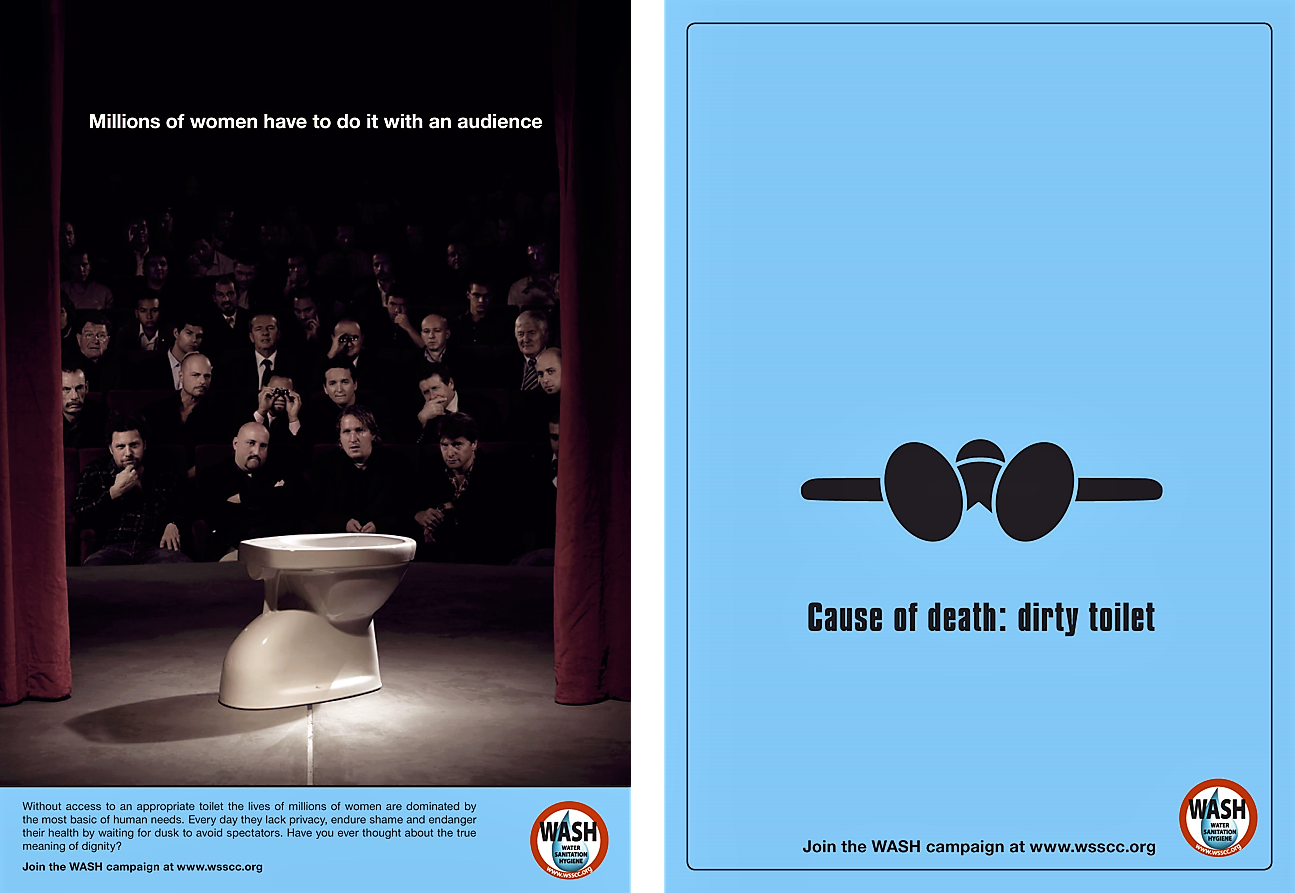
- An eye-catching poster or flyer with strong visualisation does not necessarily need words on it. They can hence also reach illiterates or deaf.
- Posters or flyers can contain an address of a website or an email-address where people can find more information or ask questions about the campaign and SSWM related topics.
- A series of posters can help making the topic familiar and heighten the educational impact. Different audiences can be attracted within the series, which leads to a wider circulation of SSWM related topics.
- Posters and flyers can also give written information in areas where there are few illiterates. This enables to emphasise main messages and to give educational information.

How to Plan a Media Campaign
The following six steps are the main ones for developing a media campaign in general. The questions posed will guide you through your planning (adapted from FOCUS 2006):
Step 1: Define Your Audience: Whom do you want to reach with your message? Can you reach this audience within available resources? Do you know enough about your audience to select effective messages and channels of communication?
Step 2: Set Clear Objectives: What is your overall goal? Do your plans fit with other activities and plans in the community? Have you identified your objectives?
Step 3: Define Channels and Vehicles for Communication: Which channel is the best to use for your targets?
- Raise awareness (see PPT)/spread information: accessible media with broad reach (radio/ posters and flyers)
- Change attitudes: channels with emotional impact (television, radio)
- Model specific skills: television works best because of sound, sight, and motion
- Change public opinion: look for news coverage via editorials, news interviews
- Complex message: print presentations
Step 4: Identify Effective Messages: Have you chosen a message for your audience that has the right message content (or theme)? Does the message have the right tone (light or heavy) and the right appeal (rational or emotional)? Would using humour or fear be appropriate and effective?
Any message you choose should pass the “What?” ”So What?” “Now What?” Test:
- “What?” refers to the basic information being conveyed
- “So What?” addresses the reasons or benefits for action
- “Now What?” clearly defines some desirable and productive action
Step 5: Implement Your Campaign: What work needs to be done? Have you made a timeline? When and how long will you run your campaign, and with what intensity? When will you contact the media channels you have selected, obtain the messages you selected in the format required? Have you set out a work plan that defines required tasks, the people responsible and the timing.
Step 6: Evaluate Your Campaign: Does your campaign track coverage (process indicators)? Does it generate additional media coverage? Can you see changes in knowledge or attitudes (outcome indicators)? Are there any letters or phone calls with questions on the topic?
Things to Consider Before Applying Posters and Flyers
- Find out if posters and flyers are the right media to reach your targets. If you can not express your message in pictures, radio might be better in some areas for reaching illiterates.
- Posters usually work best with short slogans that emphasise the main message.
- If the posters and flyers are part of an overall media campaign, it could be beneficial to use a corporate slogan or figure that is recognisable within all kinds of used media. Make sure you use identical information in all media.
- Most material uses drawings and symbols. The correct understanding of those depends on existing cultural conventions. This can become a problem when producers of material are from a different cultural background than the target audience (SCHAAP & VAN STEENBERGEN 2001). Avoid this by employing a local artist (see also: sociocultural issues).
- The flyer/ poster should be designed to have maximum impact on your audience. It should be eye-catching while avoiding being sensational (WATERAID 2007).
- If you produce educational material, the content should include a simple presentation of the facts relating to your issue, and a clear statement of what you want your audience to do (WATERAID 2007).
- Posters and flyers are usually a one-way medium and most people can not ask for further information. To avoid this, the public can be involved in their production (e.g. in workshops) to make them a two-way medium.
- Consider how the posters and flyers will be reproduced (e.g. photocopying, printing). It is important to know how many colours can be used and if there are photographs, images or logos that you must include (WATERAID & WSSCC 2003).
- Make sure people will know who is talking to them: Include contact details like phone numbers and web addresses (WATERAID & WSSCC 2003).
- How you distribute the leaflets or where you place the posters will depend on your target audience and the resources you have available. If you have very limited resources, you may decide to target the distribution very specifically to key audiences (WATERAID 2007). Make sure you are allowed to place posters and hand out flyers in your target area.Posters and flyers should be a part of a wider communication process that encompasses other awareness raising (see PPT)] instruments. They can achieve your objectives even better combined with other media, awareness raising and communication tools in the SSWM Toolbox.
- Posters and flyers are printed on paper and being littered after their use. This means that there will be a lot of waste produced by choosing posters and flyers as media
Design Principles and Ideas for Posters and Flyers
(Adapted from WATERAID 2007)
Posters and flyers can be used as part of your public campaigning to raise public awareness among large numbers of people. They should be tailored, with particular messages and approaches, depending on who your intended target audience is. The following ideas and tips help you to get an idea of how to produce posters and flyers (adapted from SCHAAP & VAN STEENBERGEN 2001):
- The main message needs to be seen on the first sight: Use big letters, symbols or figures and few background.
- For texts it is important to answer the questions Who? What? When? Where? Why? and How? at the beginning.
- Keep the information given short and interesting.
- Emphasise benefits of your issue.
- Do not put to much information on it, just key points.
- If you want to use a slogan make it short and memorable.
- Use uniformity in layout and logos in campaign material.
- Posters in a participatory setting should be open for interpretation, in order to invoke discussion and lead to creative thinking.
- Promotional/ awareness posters are clear to the viewer at a glance and usually have one main slogan and few details. They say a lot with just one picture or slogan and should be very eye-catching and memorable.
- Visualising the result of behaviour change can help encourage the adoption of this behaviour change. A good example is a poster where a pile of bathtubs is used to demonstrate how much water could be saved each week.
- Cartoon figures are often used to target children.
- Often, educational posters have a lot of information and interesting details meant for a closer look. They can be used at schools as teaching material, but usually they are not very useful for raising awareness because on the streets people might not stop and do not necessarily look at them for long.
- The organisation SAWA in Cambodia has provided durable metal posters to schools, to be placed on latrine doors, with messages on the correct use of the latrines. As schools have a limited budget and there often is not even money for chalk, it is necessary to provide schools with an adequate supply of durable educational material.
To learn more about other media campaigns, see also internet and email, radio or video.
The benefit of posters and flyers is their wide applicability. They can be used at schools, at universities, in training courses, and in the streets in rural as well as in urban areas.
As posters and flyers use visualisation, the illiterates can be reached. Also, the poor do not have to buy them (like a radio or TV), as they can see them placed on walls in the streets or get a flyer for free.
Communications & Development. A practical guide
This document includes a guide to using different media (drama, broadcast media and other media). In the internet section, it focuses on networking. You can get detailed information on networking, especially combined with gender questions. As there are some case studies, the document is not just theoretical but close to reality.
BURKE, A. (1999): Communications & Development. A practical guide. London: Social Development Division. Department for International Development. [Accessed: 14.07.2010]Community Based Media Campaign Action Pack
This planner takes you through a 6-step process to develop a community-based media campaign. Although it is written for a campaign on alcohol risks, it offers clear step-by step information on how to plan a media campaign that are useful for any kind of a media campaign. It includes many useful tips and tricks.
FOCUS (2006): Community Based Media Campaign Action Pack. Kingston: Ontario Stroke Strategy URL [Accessed: 17.04.2012]Ideas for Water Awareness Campaigns
This document includes a section for advocacy, presenting an overview of many ideas and initiatives with emphasis on practical suggestions and clues. It is not a guidebook for planning your advocacy work but it might be a great knowledge source and starting point for your activities.
SCHAAP, W. STEENBERGEN, F. van (2001): Ideas for Water Awareness Campaigns. Stockholm: The Global Water Partnership URL [Accessed: 24.06.2019]The Advocacy Sourcebook

This book provides detailed information about drawing up advocacy action plans that aim to improve the water supply and sanitation situation. The document presents concrete examples of advocacy work in practice and it provides many tools, tables and diagrams, which advocacy workers may like to reproduce, adapt or distribute for their own advocacy campaign.
WATERAID (2007): The Advocacy Sourcebook. London: WaterAid URL [Accessed: 21.04.2019]Advocacy Sourcebook. A Guide to Advocacy for WSSCC co-ordinators working on the WASH campaign
This guide for the Water, Sanitation and Hygiene for all (WASH) campaign offers practical guidance on advocacy work related to water and sanitation. It aims to explain the different advocacy tools, provide practical examples of advocacy work, and provide information on key policy actors and processes and how to influence them at local, national and international levels.
WATERAID & WSSCC (2003): Advocacy Sourcebook. A Guide to Advocacy for WSSCC co-ordinators working on the WASH campaign. WATERAID & WSSCC URL [Accessed: 21.04.2019]Newsletter April 2008
WSSCC is pleased to announce the launch of the Global Sanitation Fund! Plus updates on AfricaSan and Sanitation and Hygiene in South Asia workshop. News from the Secretariat: The Global Sanitation Fund is launched! World Water Day 2008 Central Celebrations in Geneva AfricaSan - Sanitation moving up the Priority Ladder WSSCC Members & Partners: Sanitation & Hygiene in South Asia a Practitioners’ View Zura Mendikulova, WSSCC National Coordinator for Kyrgyzstan, speaks about the International Year of Sanitation
WSSCC (2008): Newsletter April 2008 . Genf : Water Supply and Sanitation Collaborative Council (WSSCC). [Accessed: 20.03.2012]Hurry Up!
The Water Supply and Sanitation Collaborative Council (WSSCC) is a global multi-stakeholder partnership and membership organisation that works to save lives and improve livelihoods. It does so by enhancing collaboration among sector agencies and professionals who are working to improve access for the 2.5 billion people without safe sanitation and the 884 million people without clean drinking water. Through its work, WSSCC contributes to the broader goals of poverty eradication, health and environmental improvement, gender equality and long-term social and economic development. WSSCC has coalitions in 35 countries, members in more than 160 countries, and a Geneva-based Secretariat hosted by the United Nations Office for Project Services (UNOPS).
WSSCC (2008): Hurry Up!. Postcard. Genf: WSSCC URL [Accessed: 20.03.2012]Communications & Development. A practical guide
This document includes a guide to using different media (drama, broadcast media and other media). In the internet section, it focuses on networking. You can get detailed information on networking, especially combined with gender questions. As there are some case studies, the document is not just theoretical but close to reality.
BURKE, A. (1999): Communications & Development. A practical guide. London: Social Development Division. Department for International Development. [Accessed: 14.07.2010]Community Based Media Campaign Action Pack
This planner takes you through a 6-step process to develop a community-based media campaign. Although it is written for a campaign on alcohol risks, it offers clear step-by step information on how to plan a media campaign that are useful for any kind of a media campaign. It includes many useful tips and tricks.
FOCUS (2006): Community Based Media Campaign Action Pack. Kingston: Ontario Stroke Strategy URL [Accessed: 17.04.2012]Newsletters and Booklets
In this document, instructions on how to produce newsletters and booklets can be found as well as their advantages and disadvantages. The technical brief ends with a real life story from Kenya.
PRACTICAL ACTION (2007): Newsletters and Booklets. Bourton on Dunsmore, Rugby, Warwickshire: The Schumacher Centre for Technology and Development URL [Accessed: 26.08.2010]Posters
This technical brief about posters offers a short summary about advantages and disadvantages of posters. Also, it gives some tips for poster production and motivates through a real life story from Kenya.
PRACTICAL ACTION (2003): Posters. Bourton on Dunsmore, Rugby, Warwickshire: The Schumacher Centre for Technology and Development URL [Accessed: 26.08.2010]Producing Printed Material
A lot of helpful information about the steps to take and things to consider when producing printed material is given in this technical brief. It includes sections about the budget, the designer, paper, the printer e.g.
PRACTICAL ACTION (1998): Producing Printed Material. Bourton on Dunsmore, Rugby, Warwickshire: The Schumacher Centre for Technology and Development URL [Accessed: 26.08.2010]Wall Newspapers
This document is about wall newspapers, which combine newspapers’ content with posters’ advantages (anyone can see them for no money). It gives some tips about the production of wall newspapers, lists advantages and disadvantages and ends with a real life story from Nepal.
PRACTICAL ACTION (2007): Wall Newspapers. Bourton on Dunsmore, Rugby, Warwickshire: The Schumacher Centre for Technology and Development URL [Accessed: 26.08.2010]Ideas for Water Awareness Campaigns
This document includes a section for advocacy, presenting an overview of many ideas and initiatives with emphasis on practical suggestions and clues. It is not a guidebook for planning your advocacy work but it might be a great knowledge source and starting point for your activities.
SCHAAP, W. STEENBERGEN, F. van (2001): Ideas for Water Awareness Campaigns. Stockholm: The Global Water Partnership URL [Accessed: 24.06.2019]The Advocacy Sourcebook
This book provides detailed information about drawing up advocacy action plans that aim to improve the water supply and sanitation situation. The document presents concrete examples of advocacy work in practice and it provides many tools, tables and diagrams, which advocacy workers may like to reproduce, adapt or distribute for their own advocacy campaign.
WATERAID (2007): The Advocacy Sourcebook. London: WaterAid URL [Accessed: 21.04.2019]Advocacy Sourcebook. A Guide to Advocacy for WSSCC co-ordinators working on the WASH campaign
This guide for the Water, Sanitation and Hygiene for all (WASH) campaign offers practical guidance on advocacy work related to water and sanitation. It aims to explain the different advocacy tools, provide practical examples of advocacy work, and provide information on key policy actors and processes and how to influence them at local, national and international levels.
WATERAID & WSSCC (2003): Advocacy Sourcebook. A Guide to Advocacy for WSSCC co-ordinators working on the WASH campaign. WATERAID & WSSCC URL [Accessed: 21.04.2019]Ideas for Water Awareness Campaigns
This document includes a section for advocacy, presenting an overview of many ideas and initiatives with emphasis on practical suggestions and clues. It is not a guidebook for planning your advocacy work but it might be a great knowledge source and starting point for your activities.
SCHAAP, W. STEENBERGEN, F. van (2001): Ideas for Water Awareness Campaigns. Stockholm: The Global Water Partnership URL [Accessed: 24.06.2019]Image Library - Posters
On this homepage you can find some examples of posters that are not as professional as the ones from the Wash-Campaign of the WSSCC. They can help get an idea of what posters can be like.