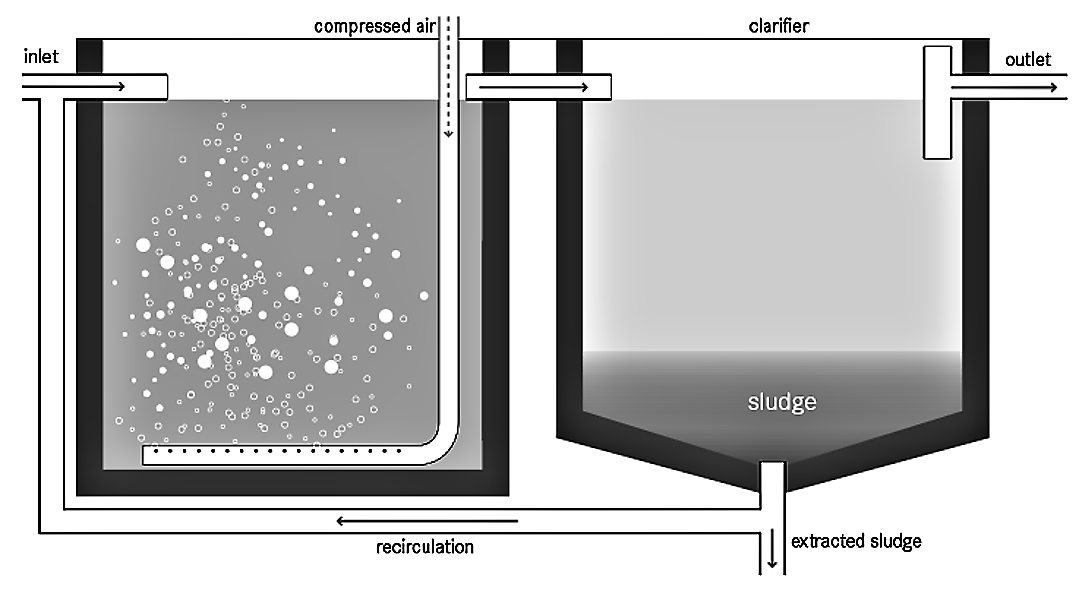
Activated sludge consists of flocs of bacteria, which are suspended and mixed with wastewater in an aerated tank. The bacteria use the organic pollutants to grow and transform it to energy, water, CO2 and new cell material. Activated sludge systems are suspended-growth type and are used in conventional high-tech wastewater treatment plants to treat almost every wastewater influent as long as it is biodegradable. A physical pre-treatment unit, a post-settling unit (a clarifier) from which active sludge is re-circulated to the aerated tank, and excess sludge treatment, are necessary. The process is highly mechanised and thus mainly adapted for centralized systems where energy, mechanical spare parts and skilled labour are available. Provided the reactor is well operated, a very good removal of organics and suspended solids can be achieved, though pathogen removal is low.
| In | Out |
|---|---|
| Blackwater, Brownwater, Greywater, Non-biodegradable Wastewater, Energy |
The term activated sludge refers to suspended aerobic sludge consisting of flocs of active bacteria, which consume and remove aerobically biodegradable organic substances from screened or screened and pre-settled wastewater. Activated sludge systems can treat blackwater, brownwater, greywater, faecal sludge and industrial wastewater as long as the pollutants to be treated are biodegradable.
An activated sludge pond with a surface mechanical aeration / oxygen supply. Source: Stickney Water Reclamation Plant Chicago, IL, USA
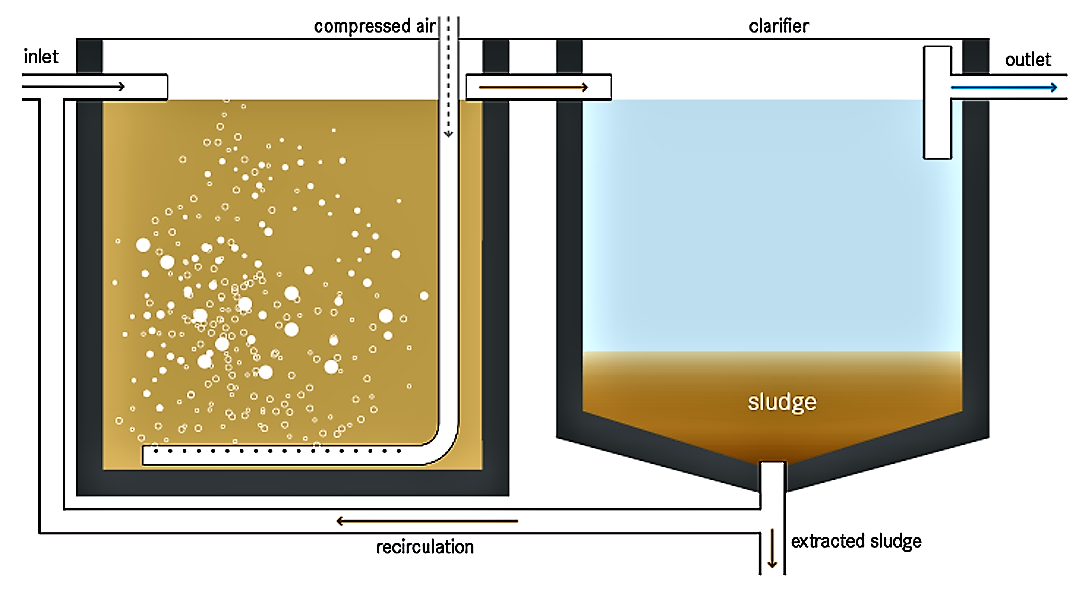
A typical activated sludge treatment systems, including physical pre-treatment (primary clarifier), biological treatment by activated sludge in the aerated tank, physical removal (secondary clarifier) of solids and sludge retention as a post-treatment (either by physical settling or membrane filtration). Excess sludge is stabilized in a digester and then either reused in agriculture (composting, land application) or disposed safely. Source: Water Treatment Plant
Activated sludge reactors are aerobic suspended-growth type processes (in opposition to fixed-film or attached-growth processes. Large amounts of injected oxygen allow maintaining aerobic conditions and optimally mixing the active biomass with the wastewater to be treated. To maintain a relatively high amount of active microorganisms useful in removing organic substances from the wastewater, the sludge is separated from the effluent by settling in a secondary clarifier (UNEP 2004) or by membrane filtration and kept in the process by recirculation to the aeration tank. Several modifications of this basic process have been developed, including different aeration devices, different means of sludge collection and recycling to the aeration tank or primary clarifier, and process enhancement trough the addition of an inert media area on which biofilm can grow (combined fixed-film/suspended-growth process). Although aerobic bacteria are the most dominant microorganisms in the process, other aerobic, anaerobic and/or nitrifying bacteria along with higher organisms can be present. Thus, besides the removal of organic matter, nutrients (organic ammonia, phosphorus) can also be removed biologically by nitrification/denitrification and biological uptake of phosphorus. The exact composition of microorganisms depends on the reactor design, the environment and the wastewater characteristics (TILLEY et al. 2008). To achieve optimal conditions for both, organic and nutrients removal, a sequences of changing aerobic and anaerobic chambers are used.
Processes for nitrification and denitrification in activated sludge systems. A) pre-denitrification in the same reactor, B) pre-denitrification in a primary step and C) Post-denitrification. Source: WIKIPEDIA (2010)
Activated sludge systems are highly efficient for organic matter and nutrient removal, though pathogen removal is low. In the view of reuse of the effluent in agriculture, it is not beneficial to remove all nutrients while standards for pathogen removal are barely met. As treatment occurs by biological processes, activated sludge could be considered as a naturally based technology. Yet, it does not fit the definition entirely because of the need for high and ongoing energy inputs that make the technology expensive to operate and maintain (ROSE 1997). As the system is also of high complexity and strongly mechanised, it is mainly adapted for centralised systems where energy, mechanical and technical spare equipment and skilled staff are available.
Activated sludge reactors are one part of a complex wastewater treatment system (U.S. EPA 2002), including a primary treatment (including screening or screening and pre-settling), one or more main aerated treatment chambers; aeration devices; a device for appropriate mixing to keep the sludge in suspension; a secondary clarifier to separate the biomass from the treated effluent and collect settled biomass; excess sludge treatment; and generally a non-linear, highly complex circulation regime (e.g. recirculation loops, by-passing etc.).
Complete overall process flow scheme of a conventional large-scale activated sludge system. Wastewater is pre-treated (screening and settling), passes to the activated sludge chamber, is then post-settled in a secondary clarifier, eventually filtered and finally disinfected if required. Excess sludge is digested, thickened and then incinerated. Source: ENDRESS+HAUSER (2002)
Example of a complete activated sludge treatment system (London). Source: CITY OF LONDON (n.y.)
Screening removes materials such as napkins, rags and other coarse particles that may damage mechanical equipment further down the treatment plant. Sand and similar heavy particles are removed next in a grit chamber where they settle to the ground. This chamber only wants to remove coarse grit and the wastewater spends only a relatively short period (some minutes) in it (UNEP & MURDOCH 2004). Smaller solids are removed in a settling or sedimentation tank. In this unit, the wastewater spends more time (about one hour) to allow for a good separation. The sludge from this mechanical primary treatment (including screening and settling in the grit chamber and the sedimentation tank) is called primary sludge and, as all excess sludge, requires an advanced further treatment chain.
After this primary treatment, the main unit containing the activated sludge follows. The pre-treated wastewater is mixed with the concentrated underflow activated sludge from the secondary clarifier in an aerated tank. Aeration is provided either by mechanical surface agitators or by submerged diffusers of compressed air (WSP 2008). Aeration provides oxygen to the activated sludge and at the same time thoroughly mixes the sludge and the wastewater (UNEP & MURDOCH 2004). During aeration and mixing, the bacteria form small clusters or flocs (TILLEY et al. 2008). Under these conditions, the bacteria in the activated sludge degrade the organic substances in the wastewater. They use the organic substance for energy, growth and reproduction. The end products are carbon dioxide (CO2), water (H2O) and new cells: One portion of the waste organic matter gives energy to the bacteria as it is oxidized to CO2. Another portion is transformed into new cells using the energy obtained from the oxidation.
After a few hours in the aeration chamber, the mixture then enters the secondary settling tank (clarifier), where the flocculated microorganisms settle and are removed from the effluent stream. The settled microorganisms (the activated sludge) are then recycled to the head end of the aeration tank to be mixed again with wastewater and continue to grow and form new sludge and to degrade organics. To maintain an optimal amount of sludge in the system, the rate of recirculation of settled sludge varies from 20 to 100%. Excess sludge produced each day (waste activated sludge) must be processed in a further treatment chain together with the sludge from the primary treatment facilities. A conventional excess sludge treatment chain consists in anaerobic digestion, thickening, incineration and the safe disposal, e.g. in a landfill. More sustainable way would be to compost the sludge (either before or instead of digestion) in order to reuse the nutrients in agriculture.
Activated sludge processes can be operated either in high-rate or extended-aeration mode. In the high-rate mode (high nutrient input per unit of microbial biomass), organic waste consumed by the activated sludge produces a high amount of excess sludge. In extended-aeration systems (low-rate: low nutrient input per unit of microbial biomass), biological oxygen demand (BOD) removal is higher and little excess sludge is produced. Yet, extended-aeration processes are slower and can thus treat less wastewater at a time (UNEP & MURDOCH 2004). Depending on the flow rate of wastewater, several parallel trains of primary (screening and settling) and secondary (aeration tanks and secondary clarifier) stages can be employed (UNEP & MURDOCH 2004). Hydraulic retention times in the whole systems range from some hours up to several days for the liquid phase. Proceeding of excess sludge can take somehow longer depending on the type of thickening and anaerobic digestion applied. The effluent from a properly designed and operated activated-sludge plant is of high quality, usually having BOD and TSS concentrations equal to or less than 10 mg/L (CRITES & TCHOBANOGLOUS 1998). The removal of both, biological oxygen demand (BOD) and suspended solids (TSS) generally lies within 80 to 100% depending on the influent concentrations, the system set-up and temperature (UNEP 2004; SANIMAS 2005; WSP 2008).
Nutrients such as nitrogen and phosphorus are also removed in activated sludge process but require a set-up of different aerated and non-aerated chambers in hybrid activated sludge systems. Biological removal of nitrogen is first achieved by the transformation of organic nitrogen into ammonia, followed by the aerobic conversion of ammonia (NH4+) to nitrite (NO2-) and then nitrate (NO3-) and the anaerobic transformation of nitrate to gaseous nitrogen (N2), which is then released to the atmosphere. The transformation of ammonia to nitrate via an intermediate step of nitrite is called nitrification. The transformation of nitrate to gaseous nitrogen is referred as denitrification. Thus, a combination of both, aerobic and anaerobic (anoxic) processes are required to achieve complete elimination of nitrogen from the wastewater. In many activated sludge treatment systems, an anaerobic tank is therefore either integrated after the aerated basin and before clarification (post-denitrification); or just before the aeration tank (pre-denitrification). In the case of pre-denitrification, nitrification takes place in the aerated tank after the aerobic pre-tank. Denitrification only occurs when the effluent from the aerated tank, containing nitrite, is re-circulated like the sludge.
The removal of phosphorus in activated sludge systems can be done chemically or biologically. Biological elimination of phosphorus in conventional wastewater treatment system occurs through the uptake of phosphorus by some bacterial cells. Generally speaking, all bacteria contain a fraction of phosphorus in their biomass due to its presence in cellular components, such as membrane phospholipids and Deoxyribonucleic acid (DNA). Therefore, as bacteria in a wastewater treatment plant consume nutrients in the wastewater, they grow and phosphorus is incorporated into the bacterial biomass. However, only little phosphorus can be removed this way, as the phosphorus mass fraction in volatile sludge is only about 2.5% (HAANDEL&LUBBE 2007). This results in an effluent concentration of about 2 to 7 mg P/L for municipal sewage with a COD concentration of 500 mg/L (HAANDEL&LUBBE 2007). However, it will in general be required to lower the effluent phosphorus concentration to a value ≤ 1 mg P/L.
Initially, the advanced techniques used for phosphorus removal were all based on physical-chemical treatment methods. Chemical-physical removal is achieved when iron salts (in the form of the soluble FeCl3 or FeSO4) are added before the aerated main tank. The iron salts dissociate rapidly in the water, as the iron Fe3+ preferably associates with the phosphorus, forming non-soluble Fe3PO4, which than precipitates and accumulates in the sludge. This has the advantage that also some other nutrients (i.e. nitrogen) are co-precipitated, thus reducing the required volume of the treatment unit for nitrification/denitrification. However, as a certain overdosing of metal salts is necessary to obtain the required low effluent phosphorus values, this procedure can result in high costs of chemicals and a significant increase of excess sludge production. Furthermore, the accumulation of ions (increased salt content) may seriously restrict the reuse possibilities of the effluent. A more modern process is the enhanced biological phosphorus removal. Enhanced biological phosphorus removal is based on the cultivation of some special phosphorus accumulating bacteria, which, compared to 2.5% P in conventional activated sludge, can lead to up to 38% of P accumulation in the sludge (HAANDEL&LUBBE 2007). These special polyphosphate-accumulating organisms (PAO) can develop in the sludge under strictly anaerobic conditions, growing on some fermentation products (volatile fatty acids, VFA). When they are transferred with the sludge to an aerobic environment, they start to use the energy they stored with the VFA in their cells and store phosphorus instead. This additionally stored phosphorus is removed from the effluent with the settled sludge. In practice, a biological phosphorus removal is accomplished by the sequencing of anaerobic, anoxic and aerobic chamber and a complex recirculation system (CRITES & TCHOBANOGLOUS 1998).
Different system configuration for combined biological nitrogen and phosphorus removal. Source: HAANDEL&LUBBE (2007)
When both nitrogen and phosphorus are to be removed, the combination becomes even more complex. As it is vital for the growth of PAO that volatile fatty acids are present in the anaerobic reactor, it is of crucial importance that the return of nitrate to the anaerobic reactor is avoided: In that case, the volatile fatty acids would be used for denitrification by non-PAO organisms (HAANDEL&LUBBE 2007). The process can be further improved by combining it with a fermenter to assure VFA supply. In summary, enhanced biological phosphorus removal requires generally an anaerobic stage (for PAO cultivation), an anoxic stage (for denitrification) and an aerobic stage (for nitrification and phosphorus accumulation) in series.
Nowadays, activated sludge systems, where valuable nutrients (phosphorus and nitrogen) and organic matter are incinerated instead of re-circulated to the food production in agriculture are not perceived as sustainable any more. The introduction of nitrogen removal into an activated sludge plant increases the reactor volume significantly and leads to higher energy consumption of approximately 60 to 80% for aeration (MAURER 2003). The elimination of phosphorus requires either the addition of chemicals and subsequent disposal of inorganic sludge or an increase of complexity and reactor volume for enhanced biological phosphorus removal. At the same time, N and P are essential for agriculture and have to be produced technically from natural resources. Phosphorus is gained from rock phosphates, which deplete in quantity and quality and nitrogen fixation is determined by the cost and availability of fossil fuels (MAURER 2003). Therefore, it becomes more and more interesting to recover these valuable nutrients from wastewater streams and reusing it for agricultural purposes, avoiding the costs of extensive wastewater treatment and saving resources.
Different versions of the original reactor set-ups have been tested. The most common are plug-flow reactors (PFR) and continuous stirred-tank reactors (CSTR) processes (CRITES & TCHOBANOGLOUS 1998). In plug-flow systems, the different aerobic and anaerobic stages correspond only to zones, while completely stirred processes require a single tank for each step.
Oxidation ditch activated sludge system. Source: Source: http://water.me.vccs.edu/concepts/oxidation.html and http-//www.aireo2.com/main.asp?pind=trioval [Accessed: 23.03.2010]
Typical plug-flow activated sludge systems are oxidation ditches. Oxidation ditches are large round or oval ditches (channel reactors) with one or more horizontal aerators to guarantee oxygen supply, and to mix and move the content around the ditch. Screened influent enters the oxidation ditch, is aerated and circulates at about 0.25 to 0.35 m/s (SANIMAS 2005). Operation can be continuous or intermittent. Primary sedimentation is usually not required, but secondary sedimentation tanks are generally used. The required treatment volume per capita is about 1 m³ (SANIMAS 2005). Oxidation ditches are suitable for areas where land availability is high. They have the advantage that they are relatively easy to maintain and are resilient to shock loads that often occur in smaller communities (e.g. at breakfast time and in the evening). Typical hydraulic retention time of is between 24 to 48 hours with a sludge age of 12 to 20 days (http://en.wikipedia.org/wiki/Activated_sludge). For more information on oxidation ditches, please refer to U.S. EPA (2000), WSP (2007) or WSP (2008).
Sewage treatment in a deep shaft activated sludge system. Source: http://www.wholewatersystems.com/H2OTREATMENT/VBR.htm [Accessed: 23.03.2010]
Where land is in short supply, sewage may be treated by injection of oxygen into a pressured return sludge stream, which is injected into the base of a deep columnar tank buried in the ground. This type of activated sludge reactor is called deep shaft. Such shafts may be up to 100 m deep. As the sewage rises the oxygen forced into solution by the pressure at the base of the shaft breaks out as molecular oxygen providing a highly efficient source of oxygen for the microorganisms contained in the activated sludge. The rising oxygen and injected return sludge provide the physical mechanism for mixing. Mixed sludge and wastewater influent is decanted at the surface and separated into supernatant and sludge components. The efficiency of deep shaft treatment can be high but they require skilled professionals for construction, operation and maintenance; and additionally a large amount of energy (adapted from http://en.wikipedia.org/wiki/Activated_sludge [Accessed: 23.03.2010]).
Primary storage reactor and sequential batch reactor for activated sludge treatment. Source: SANIMAS (2005)
Sequencing Batch Reactor process scheme including the five essential process steps: (1) fill, (2) react, (3) settle, (4 and 5) draw and idle. Source: www.inma.ucl.ac.be/EOLI/ [Accessed: 28.03.2010]
The process can also be operated in batches, where the different conditions are all achieved in the same reactor but at different times (UNEP & MURDOCH 2004). This type of reactor is called sequential batch reactor (SBR). The treatment consists of a cycle of five stages: fill, react, settle, draw and idle. During the reaction type, oxygen is added by an aeration system. During this phase, bacteria oxidize the organic matter just as in activated sludge systems. Thereafter, aeration is stopped to allow the sludge to settle. In the next step, the water and the sludge are separated by decantation and the clear layer (supernatant) is discharged from the reaction chamber (METCALF & EDDY 2007). Depending on the rate of sludge production, some sludge may also be purged. After a phase of idle the tank is filled with a new batch of wastewater (UNEP & MURDOCH 2004). At least two tanks are needed for the batch mode of operation as continuous influent needs to be stored during the operation phase. (Very) small systems (e.g. serving small settlements) may apply only one tank. In this case, the influent must either be retained in a pond or continuously discharged to the bottom of the tank in order not to disturb the settling, draw and idle phases. SBRs are suited to lower flows because the size of each tank is determined by the volume of wastewater produced during the treatment period in the other tank (UNEP & MURDOCH 2004). For more information on SBR activated sludge systems, please consult WSP (2007) or U.S. EPA (1999).
Construction and maintenance costs are very high as activated sludge treatment units are highly mechanised. Also operation is expensive due to the requirement of permanent professional operation, high electricity consumption (pumping and aeration) and costly mechanical parts (SANIMAS 2005).
Mechanical equipments (pumps, aerates, mixers) require continuous maintenance and control, and supply of oxygen and sludge is essential (WSP 2008). Control of concentrations of sludge and oxygen levels in the aeration tanks is required and technical appliances (e.g. pH-meter, temperature, oxygen content etc.) need to be maintained carefully. To make sure that optimal living conditions for the required bacteria are guaranteed and a satisfying effluent quality is met, the influent as well as the effluent should be supervised and controlled constantly (e.g. by a centralized computerized monitoring system). Two of the most serious problems with the activated-sludge process are (1) a phenomenon known as bulking, in which the sludge from the aeration tank will not settle, and (2) the development of biological surface foam (CRITES & TCHOBANOGLOUS 1998). Bulking can be caused either by organisms that grow in filamentous form instead of flocs and will not settle, or the growth of microorganisms that incorporate large volumes of water into their cell structure, making their density near that of water. Foaming is caused most often by the excessive growth of an organism called Nocardia (CRITES & TCHOBANOGLOUS 1998). Filamentous organisms can be controlled by the addition of chemicals (e.g. chlorine or hydrogen peroxide) to the recycled activated sludge; the alteration of the dissolved-oxygen concentration in the aeration tank; the addition of nutrients and growth factors to favour other microorganisms etc. Nocardia can be controlled by avoiding the recycling of the skimmed foam or the addition of a chemical agent (e.g. polymers or chlorine) on the surface (CRITES & TCHOBANOGLOUS 1998).
The activated sludge wastewater treatment plant of Vienna (Austria). Source: www.wien.gv.at/ma53/rkfoto/2005/770g [Accessed: 23.03.2010]
Operation and maintenance of activated sludge system is generally carried out by skilled labourers, which should be sufficiently well trained regarding any health risks. The effluent water from the system is of high quality regarding chemical pollutants; helminth eggs, bacteria or viruses are not removed in suspended-growth treatment processes (BAHRI 2009). Even though activated sludge treatment plants should be constructed far away from housings, the effluent should undergo an appropriate disinfection treatment before discharge (e.g. UV-light, chlorination). Excess sludge contains even higher amounts of microorganisms, as well as phosphorus and heavy metals if they are present in the influent wastewater. This can be the case because the wastewater treated in such reactors generally comes from an array of different sources (domestic, industrial and stormwater), which makes it a hard-to-treat mixture and therefore also a difficult resource to recycle. Hence, the sludge generally needs to be thickened and incinerated with the ashes being stored in a controlled landfill.
Working Principle | Activated sludge consisting of suspended flocs of active bacteria is mixed with the wastewater. The organic pollutants are used for growth by bacteria and thereby transformed to water, CO2 and new cell material. Nitrogen is removed by nitrification/denitrification and phosphorus is either removed chemically or biologically and accumulated in the excess sludge. Excess sludge requires a further treatment chain. |
Capacity/Adequacy | High-tech centralized system, not adapted for small communities. Almost every wastewater can be treated as long as it is biodegradable. Usually applied in densely populated areas for treatment of domestic wastewater. |
Performance | 80 to almost 100% BOD and TSS removal. High nitrogen removal. P accumulated in biomass and sludge. Low pathogen removal. HRT of some hours up to several days |
Costs | Very high construction and maintenance costs; operation very expensive due to requirement of permanent professional operation, high electricity consumption and costly mechanical parts. |
Self-help Compatibility | System parts not locally available; implementation only possible by experienced consultant firms. |
Activated sludge units require professional operation and maintenance providers. | |
Reliability | Fails in case of power failure or fall-out of technical equipment. |
Main strength | High removal efficiency for large range of wastewaters. |
Main weakness | Highly mechanized system requiring expert design, operation and maintenance as well as mechanical spare parts. Large energy requirements (e.g. for aeration). |
By using an advanced conventional aerobic treatment process (e.g. activated sludge, trickling filter or rotating biological contactor) the space needed for treatment is reduced. The drawbacks of these systems are, however, that they need high amounts of electricity and that they produce sludge, which requires further treatment (WINBLAD & SIMPSON-HERBERT 2004). The technology is widely used for the treatment of municipal wastewater from medium to large towns where land is scarce and power is reliable (WSP 2008). However, activated sludge and activated sludge systems are highly complex (e.g. mechanical equipment, recirculation loops, etc.) and mainly appropriate for centralized wastewater treatment facilities (SASSE 1996; TILLEY et al. 2008). This implies the construction of long distance sewage channels and the availability of highly skilled and well-trained staff, constant electricity supply, technical equipment (e.g. spare parts, monitoring appliances), the funding for all of this, and well-organized management system. Therefore, the technology is suited for the treatment of large volumes of wastewater of 10000 up to 1 million population equivalent (SANIMAS 2005; TILLEY et al. 2008). The overall process of the activated sludge system, if well-functioning, is highly efficient for the removal of both settable (physical primary treatment) and dissolved, colloidal and particulate organic matter and nutrients (biological removal in the activated sludge) in almost every climate, though pathogen removal is low.

BAHRI, A. (2009): Managing the other side of the Water Cycle - Making Wastewater an Asset. Stockholm: Global Water Partnership (GWP) Technical Committee (TEC). PDF
CRITES, R.; TCHOBANOGLOUS, G. (1998): Small and Decentralized Wastewater Management Systems. New York: The McGraw-Hill Companies Inc.
ENDRESS+HAUSER (Editor) (2002): Guide to Instrumentation in Wastewater. (DVD). ENDRESS+HAUSER.
MAURER, M.; SCHWEGLER, T.; SCHWEGLER, P.; LARSEN, T.A. (2003): Nutrients in urine: energetic aspects of removal and recovery. In: Water Science and Technology 8 1, 37-46. PDF
JUNGE-BERBEROVIC, R.; University of Applied Sciences Waedenswil. (Editor) (2001): Possibilities and Limits of Wastewater-fed Aquaculture. . Waedenswil: University of Applied Sciences Waedenswil. URL [Accessed: 19.02.2010]. PDF
ASANO, T.; BURTON, F.; LEVERENZ, H.; TSUCHIHASHI, R.; TCHOBANOGLOUS, G.; METCALF & EDDY Inc. (Editor) (2007): Water Reuse: Issues, Technologies, and Applications. New York: McGraw-Hill.
ROSE, D.G. (1999): Community-Based Technologies for Domestic Wastewater Treatment and Reuse- options for urban agriculture. Ottawa: International Development Research Center Canada (IDRC). PDF
SANIMAS (Editor) (2005): Informed Choice Catalogue. pdf presentation. BORDA and USAID. PDF
TILLEY, E.; LUETHI, C.; MOREL, A.; ZURBRUEGG, C.; SCHERTENLEIB, R. (2008): Compendium of Sanitation Systems and Technologies. Duebendorf and Geneva: Swiss Federal Institute of Aquatic Science and Technology (EAWAG). URL [Accessed: 15.02.2010]. PDF
U.S.EPA (Editor) (1980): Onsite Wastewater Treatment Systems Manual. United States Environmental Protection Agency, Office of Water Office of Research and Development. PDF
U.S. EPA (1999): Sequencing Batch Reactors. United States Environment Protection Agency (U.S. EPA). PDF
U.S. EPA (Editor) (2000): Oxidation Ditches. United States Environment Protection Agency. URL [Accessed: 18.01.2011]. PDF
UNEP (Editor); Murdoch University (Editor) (2004): Environmentally sound technologies in wastewater treatment for the implementation of the UNEP/GPA "Guidelines on Municipal Wastewater Management". The Hague: United Nations Environment Programme Global Programme of Action (UNEP/GPA), Coordination Office. PDF
UNEP (Editor) (2004): A Directory of Environmentally Sound Technologies for the Integrated Management of Solid, Liquid and Hazardous Waste for SIDS in the Caribbean Region. Nairobi: United Nations Environment Programme Global Programme of Action (UNEP-GPA)) and Caribbean Environmental Health Institute (CEHI). PDF
HAANDEL, A.C. van; LUBBE, J.G.M. van der (2007): Mechanisms involved in Biological Phosphorus removal. In: HAANDEL, A.C. van; LUBBE, J.G.M. van der (2007): Handbook Biological Wastewater Treatment. Design and Optimisation of Activated Sludge Systems. Leidschendam, 188-191. URL [Accessed: 22.03.2010]. PDF
WINDBLAD, U.; SIMPSON-HERBERT, M. (2004): Ecological Sanitation - revised and enlarged edition. (pdf presentation). Sweden: Stockholm Environment Institute. URL [Accessed: 04.08.2010]. PDF
WSP (Editor) (2007): Philippines Sanitation Source Book and Decision Aid. pdf presentation. Washington: Water and Sanitation Program. PDF
WSP (Editor) (2008): Technology Options for Urban Sanitation in India. A Guide to Decision-Making. pdf presentation. Washington: Water and Sanitation Program. URL [Accessed: 26.03.2010]. PDF
WIKIPEDIA (Editor) (2010): Belebtschlammverfahren. URL [Accessed: 22.05.2012].
CITY OF LONDON (Editor) (n.y.): Activated Sludge Process. London, Canada: City of London. URL [Accessed: 22.05.2012].

HEINSS, U.; STRAUSS, M. (1999): SOS - Management of Sludges from On-Site Sanitation. Co-treatment of Faecal Sludge and Wastewater in Tropical Climates. Duebendorf and Accra: Swiss Federal Institute of Aquatic Science (EAWAG). URL [Accessed: 21.04.2010]. PDF
This article provides operational and design guidance for the co-treatment of faecal sludge in waste stabilisation ponds and in activated sludge sewage treatment plants. Problems which may arise when highly concentrated faecal sludge is not properly included in the design of the co-treatment system are also discussed.
JENSSEN, P.D.; VRAALE, L.; LINDHOLM, O. ; SENG, L. (Editor) (2007): Sustainable Wastewater Treatment. In: SENG, L. (Editor) (2007): Proceedings of the International Conference on Natural Resources and Environmental Management and Environmental Safety and Health. Norway. PDF
Wastewater contains organic matter and the three main nutrients for plant production: nitrogen, phosphorus and potassium. Nitrogen fertilizer is energy consuming to produce and phosphorus is a limited mineral resource. Scandinavia is pioneering sustainable solutions to wastewater treatment. Source separation (blackwater/greywater) systems produce almost zero emissions and open up exiting urban applications of sanitation options in order to close the loop.
MAURER, M.; SCHWEGLER, T.; SCHWEGLER, P.; LARSEN, T.A. (2003): Nutrients in urine: energetic aspects of removal and recovery. In: Water Science and Technology 8 1, 37-46. PDF
The analysis of different removal and recovery techniques for nutrients in urine shows that in many cases recovery is energetically more efficient than removal and new production from natural resources.
HELMER, R. (Editor); HESPANHOL, I. (Editor) (1997): Water Pollution Control - A Guide to the Use of Water Quality Management Principles. World Health Organization (WHO), Water Supply and Sanitation Collaborative Council (WSSCC) and United Nations Environment Programme (UNEP). URL [Accessed: 21.04.2010]. PDF
This document is rather old, but its publication was a milestone as it demonstrates WSSCCs capacity to bring together water and sanitation professionals from industrialised and developing countries to formulate practical guidance on a key issue of the day. Mainly regulatory, financial and technical aspects are discussed and illustrated with an extensive collection of case studies from the developing world.
WSP (Editor) (2007): Philippines Sanitation Source Book and Decision Aid. pdf presentation. Washington: Water and Sanitation Program. PDF
This Sanitation Sourcebook distils some of the core concepts of sanitation in a user-friendly format so that the book can serve as a practical reference to sanitation professionals and investment decision-makers, particularly the local governments. The annexe contains a practical collection of factsheets on selected sanitation system options.
WSP (Editor) (2008): Technology Options for Urban Sanitation in India. A Guide to Decision-Making. pdf presentation. Washington: Water and Sanitation Program. URL [Accessed: 26.03.2010]. PDF
These guidance notes are designed to provide state governments and urban local bodies with additional information on available technologies on sanitation. The notes also aid in making an informed choice and explain the suitability of approaches.
U.S.EPA (Editor) (1980): Design Manual - Onsite Wastewater Treatment and Disposal Systems. United States Environmental Protection Agency and Office of Water Office of Research and Development. URL [Accessed: 18.03.2010]. PDF
Rather old design manual for onsite wastewater treatment options. However, valuable information on established systems such as septic tanks, sandfilters, aerobic treatment units (suspendend growth and fixed film), disinfection, nutrient removal as well as wastewater segregation and recycling are given. Additional information is given on disposal methods and appurtenances.

BODIK, I.; RIDDERSTOLPE, P. (2008): Box 4.2: Forest irrigation in Kaageroed. In: BODIK, I. (Editor); RIDDERSTOLPE, P. (Editor) (2008): Sustainable sanitation in Central and Eastern Europe - addressing the needs of small and medium-size settlements. Stockholm, 68 . URL [Accessed: 21.04.2010]. PDF
Case study from Sweden, describing forest irrigation as a final treatment step and reuse option for activated sludge effluents.
ROBBINS, D.; STRANDE, L.; DOCZI, J. (2012): Opportunities in Fecal Sludge Management for Cities in Developing Countries: Experiences from the Philippines. North Carolina: RTI International . URL [Accessed: 15.01.2013]. PDF
In July 2012, a team from RTI International deployed to the Philippines to evaluate four FSM programs with the goal of reporting on best practices and lessons learned. The four cases—Dumaguete City, San Fernando City, Maynilad Water for the west zone of metro Manila, and Manila Water from the east zone of metro Manila—were chosen to highlight their different approaches to implementing FSM.
WENDLAND, C. (2008): Anaerobic Digestion of Blackwater and Kitchen Refuse. (PhD Thesis). Hamburg: Institut fuer Abwasserwirtschaft und Gewaesserschutz (AWW), Technische Universitaet Hamburg-Hamburg (TUHH). URL [Accessed: 11.03.2010]. PDF
Thesis assessing the anaerobic treatment of blackwater (toilet wastewater) from vacuum toilets without and with kitchen refuse and its potential for reuse and resources management sanitation concepts.

JENSSEN, P.D.; VRAALE, L.; LINDHOLM, O. ; SENG, L. (Editor) (2007): Sustainable Wastewater Treatment. In: SENG, L. (Editor) (2007): Proceedings of the International Conference on Natural Resources and Environmental Management and Environmental Safety and Health. Norway. PDF
Wastewater contains organic matter and the three main nutrients for plant production: nitrogen, phosphorus and potassium. Nitrogen fertilizer is energy consuming to produce and phosphorus is a limited mineral resource. Scandinavia is pioneering sustainable solutions to wastewater treatment. Source separation (blackwater/greywater) systems produce almost zero emissions and open up exiting urban applications of sanitation options in order to close the loop.
NEUPANE, K. (2004): ecosan - A Possible Approach to Sustainable Sanitation And Food Security. University of Applied Science Nordostniedersachen. PDF
This master thesis illustrates the history of conventional wastewater treatment and the shift in paradigm towards recycling-oriented systems.

UNEP (Editor) (2002): 4.2.1 Activated sludge treatment. In: UNEP (Editor); Murdoch University (Editor) (2004): Environmentally sound technologies in wastewater treatment for the implementation of the UNEP/GPA "Guidelines on Municipal Wastewater Management". The Hague. URL [Accessed: 22.07.2010]. PDF
U.S. EPA (Editor) (2000): Oxidation Ditches. United States Environment Protection Agency. URL [Accessed: 18.01.2011]. PDF
U.S. EPA (1999): Sequencing Batch Reactors. United States Environment Protection Agency (U.S. EPA). PDF
Technical factsheet on the design, application, performance and operation of sequencing batch reactors (SBRs), a type of activated sludge wastewater treatment plants. English, Spanish
U.S.EPA (Editor) (1980): Onsite Wastewater Treatment Systems Manual. United States Environmental Protection Agency, Office of Water Office of Research and Development. PDF
Rather old design manual for onsite wastewater treatment options. However, valuable information on established systems such as septic tanks, sand filters, aerobic treatment units (suspended growth and fixed film), disinfection, nutrient removal as well as wastewater segregation and recycling are given. Additional information is given on disposal methods and appurtenances.
MECC (Editor) (n.y.): Course ENV149: Wastewater Treatment Plant Operation: Lesson 10: Secondary Treatment. Big Stone Gap: Mountain Empire Community College (MECC). URL [Accessed: 18.03.2010]. PDF
The Mountain Empire Community College ‘Water and Wastewater Distance Learning Course’ makes available all its documentation on the web. This section describes secondary treatment systems, including trickling filters, rotating biological contactors, activated sludge, operation and control, stabilization ponds, aerated lagoons and intermittent sand filters.
http://en.wikipedia.org [Accessed: 19.03.2010]
General Wikipedia article on activated sludge systems.
http://web.deu.edu.tr/atiksu/ana52/ani406.html [Accessed: 09.03.2010]
Different material on activated sludge wastewater treatment systems available on the Tropak Hompage hosted by the Turkish Dokuz Eylul University in Izmir.
http://www.ademe.fr/partenaires/Boues/Pages/f14.htm [Accessed: 19.03.2010]
This page explains in a very short and comprehensive way how activated sludge processes are applied for municipal wastewater treatment in France.