Vertical Flow Constructed Wetland

Compiled by:
Beat Stauffer (seecon international gmbh)

Executive Summary

A vertical flow constructed wetland (vertical flow CW) is a planted filter bed for secondary or tertiary treatment of wastewater (e.g. greywater or blackwater). Pre-treated wastewater (e.g. from a septic tank or an Imhoff tank) is distributed over the whole filter surface and flows vertically through the filter. The water is treated by a combination of biological and physical processes. On the bottom of the filter, there is a drainage system which collects the treated wastewater. A vertical flow constructed wetland needs a specific filter surface of 1 to 4 m2 per population equivalent (HOFFMANN et al. 2010), depending on the climate. Normally, sand and gravel is used to construct the filter body. The filtered water of a well functioning constructed wetland can be used for irrigation, aquaculture, groundwater recharge or is discharged in surface water. To design a vertical flow constructed wetland, expert knowledge is recommended. They are relatively inexpensive to build where land is affordable and can be maintained by the local community.

In Out

Blackwater, Greywater, Brownwater

Fertigation Water, Treated Water

Introduction

Constructed wetlands are secondary treatment facilities for household (blackwater or greywater, in some cases also brownwater) and/or biodegredable municipal or industrial wastewater. Constructed wetlands are a treatment step of DEWATS systems and they can even be used as a tertiary treatment system for polishing after activated sludge or trickling filter plants (HOFFMANN et al. 2010). The plants grown in the wetland may be the used for composting or biogas production (see also composting small scale, composting large scale or anaerobic digestion). Effluents, if they correspond to the WHO guidelines (see also WHO 2006): Guidelines for the safe use of wastewater excreta and greywater Volume I, Volume II, Volume III and Volume IV) may be used for fertigation.

Basically, there are three different types of constructed wetlands (CWs). They are classified according to the water flow regime as:


These three types of CWs may be combined with each other in hybrid constructed wetlands in order to exploit the specific advantages of the different systems.

One of the main advantages of CWs is that they are natural systems and thus not require chemicals, energy or high-tech infrastructure. Moreover, there are suited to be combined with aquaculture or sustainable agriculture (irrigation).

Treatment Process and Basic Design Principles

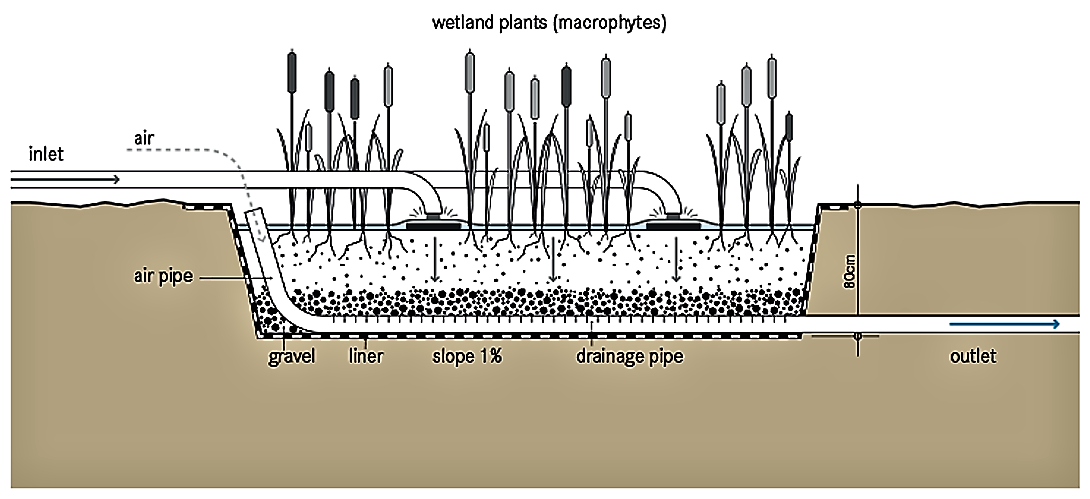
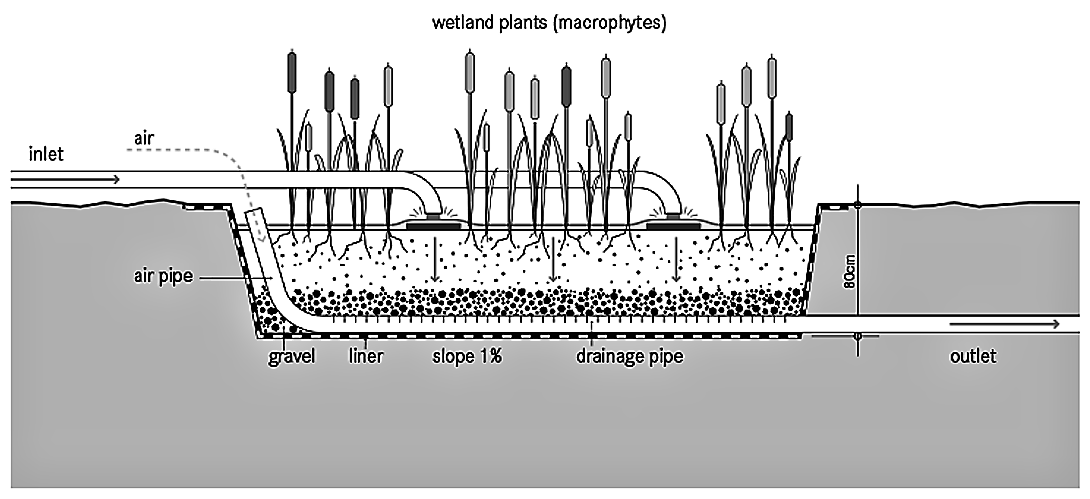
In vertical filter beds wastewater is intermittently applied (either by pump or self-acting syphon device) onto the surface and then drains vertically down through the filter layers towards a drainage system at the bottom. In some cases, the distribution pipes are covered with gravel to avoid open water puddles. The treatment process is characterised by intermittent short-term loading intervals (4 to 12 doses per day) and long resting periods during which the wastewater percolates through the unsaturated substrate, and the surface dries out. The intermittent batch loading enhances the oxygen transfer and leads to high aerobic degradation activities. Therefore, vertical filters always need pumps or at least siphon pulse loading, whereas horizontal flow constructed wetlands can be operated without pumps (if topography allows). The treatment process of constructed wetlands is based on a number of biological and physical processes (adsorption, precipitation, filtration, nitrification, predation, decomposition, etc.) (HOFFMANN et al. 2010).

      MOREL and DIENER (2006)

Vertical flow constructed wetland. Source: MOREL and DIENER (2006)     

To avoid clogging, pre-treatment is necessary. This separates solid materials (e.g. faeces or kitchen slop) as well as grease or oil from the liquid. Depending on the situation, there are several possibilities such as grease trap, septic tank, anaerobic baffled reactor, imhoff tank, biogas settler, UASB reactor, or compost filter (HOFFMANN et al. 2010).

Plants

            B. STAUFFER (2010)

A vertical constructed wetland in Switzerland vegetated with Phragmites australis. Source: B. STAUFFER (2010)

In contrast to a non-planted filter, plants in constructed wetlands are an important part of the design. Plants are aesthetically pleasant and serve as a  habitat for wildlife. Dead plant material is a natural insulations layer and protects the filter during winter in cold climates. Furthermore, the vegetation transfers oxygen to the filter zone and plants and its roots provide an appropriate habitat for microbiological growth in the root zone. But the most essential function of the vegetation, i.e. the roots system is to maintain the permeability in the filter (HOFFMANN et al. 2010 and TILLEY et al. 2008). Due to the high oxygen supply into the filter, the rates of nitrification are higher than in a horizontal flow filter. (MOREL and DIENER 2006). Most common plants for vertical constructed wetlands are Phragmites australis, Typha cattalis and Echinochloa Pyramidalis (TILLEY et al. 2008). Bamboo or papyrus should also be possible, but have not been investigated yet (HOFFMANN et al. 2010). More possible plants and their characteristics can be found in HOFFMANN et al. 2010.


Substrate

(Adapted from HOFFMANN et al. 2010)

                 HOFFMANN et al. (2010)

Left: Vertical flow filter during construction in Brazil (lined with polythene liner), drains are being covered with gravel. Right: Vertical flows filter in Peru during filling with sand. Source: HOFFMANN et al. (2010)

The provision of a suitably permeable substrate in relation to the hydraulic and organic loading is the most critical design parameter of subsurface flow constructed wetlands. Most treatment problem occur when the permeability is not adequately chosen for the applied load.The drainage pipes at the base are covered with gravel. On top of this gravel layer, there is a sand layer (40-80 cm thick) which contains the actual filter bed of the subsurface flow CW. On top of the sand layer there is another gravel layer (about 10 cm), in order to avoid water accumulating on the surface. The top gravel layer does not contribute to the filtering process.


Design recommendations regarding the substrate to be used in subsurface flow filters are:


  • The sand should have a hydraulic conductivity (kf-value) of about 10-4 to 10-3 m/s.
  • The filtration sand layer needs to have a thickness of 40 to 80 cm.
  • The recommended grain size distribution for the substrate is shown in the graphic below.
  • The substrate should not contain loam, silt or other fine material, nor should it consist of material with sharp edges (Figure 8 illustrates the properties of suitable sand).

                      HOFFMANN et al. (2010)

It is important to pay attention to grain size. The most important aspect is a sufficiently coarse grain size. The d10, which corresponds to the grain size where 10 % of the grains are smaller than that grain size, should be between 0.1 mm and 0.4 mm. Having the choice it is recommended to have a d10 closer to 0.4 mm. The material should not have a d10 coarser than 0.4 mm as the filtration in the filter is affected. The steeper the sieving curves the better. Source: HOFFMANN et al. (2010)                     

What filter material should be useddepends on the local conditions and the experiences of the design engineer. HOFFMANN et al. (2010) recommend sand as a substrate, because in their point of view it is the most suitable substrate for the application of subsurface flow CWs for wastewater or greywater treatment in developing countries.

Filter Size

In cold climates (annual average < 10°C), an area of 4 m2/p.e. is necessary. In warmer climates (annual average > 20°C), 1.2 m2/p.e. is enough, if the filter is designed correctly (HOFFMANN et al. 2010).

Costs Considerations

The capital costs of constructed wetlands are highly dependent on the costs of sand since the bed has to be filled with sand; and on the cost of land (HOFFMANN et al. 2010). Financial decisions on treatment processes should not primarily be made on capital costs, but on net present value or whole-of-life costs, which includes the annual costs for operation and maintenance (HOFFMANN et al. 2010).

Compared to other intensive (high-rate) aerobic treatment options (e.g. activated sludge), constructed wetlands are natural systems, which work extensively. That means treatment may require more land and time, but you can save costs because of lower operation, which requires no or only little electrical energy and operators can be trained people from the community (low-skilled people). It means also that there is no need for sophisticated equipment, expensive spare parts or chemicals (GAUSS 2008). According to HOFFMANN et al. (2010) constructed wetlands are usually cheaper to build than high-rate aerobic plants but for larger plants, they are usually more expensive in terms of capital costs.

For large-scale treatment plants of more than 10 000 PE in areas where land is available cheaply, free-surface-flow constructed wetlands and waste stabilisation ponds have lower capital costs than subsurface-flow constructed wetlands (horizontal and vertical) due to the high amounts of sand and gravel fill required for the bed of the sub-surface flow constructed wetland. Plants and liners may substantially add to the costs if they are unavailable locally (EAWAG/SANDEC 2008). Moreover, design and construction of subsurface-flow constructed wetland requires skilled technical staff. However, the cost may be reduced if the material is acquired locally.

Operation and Maintenance

In general the O&M requirements for constructed wetlands are relatively simple (no high-tech appliances or chemical additives), allowing community organisations or a private, small-scale entrepreneur to manage the system after adequate capacity building and with technical support (GAUSS 2008). However, a CW will require maintenance for the duration of its life. This aspect is frequently overlooked in decision-making processes.

With time, the gravel will become clogged with accumulated solids and bacterial film. The material may have to be replaced every 8 to 15 or more years. Maintenance activities should focus on ensuring that primary treatment effectively lowers organics and solids concentrations before entering the wetland (TILLEY et al.).

A very critical situation occurs when the filter smells like “foul eggs”. This is an indicator for anaerobic conditions. In this case the filter should be rested and the loads must be readjusted (HOFFMANN et al. 2010). It needs to be controlled regularly whether pre-treatment facilities work properly, and they have to be emptied frequently and sludge must be discharged correctly (see human-powered emptying and transport and motorised emptying and transport).

Vertical systems require more technical expertise than other wetland technologies (see HOFFMANN et al. 2010).

Health Aspects

The risk of mosquito breeding is low since – if properly designed – there is no standing water. It should be ensured that residents do not come in contact with the sludge/wastewater in the pre-treatment facility nor with the influent of the filter because of the risk if infection (TILLEY et al. 2008).

Greywater, which has been treated in subsurface flow constructed wetlands generally meets the standards for pathogen levels for safe discharge to the environment without further treatment. In case of domestic wastewater, the situation could be different and for safety reasons, disinfection (by tertiary treatment) might be necessary, depending on the intended reuse application (HOFFMANN et al. 2010).

The biggest health risk arises from settled wastewater in the pre-treatment facility. This should be considered during inspections and emptying. A proper emptying process (human powered or motorised) can decrease the health risks (TILLEY et al. 2008). After that, also sludge must be treated correctly, for example in drying beds or composting facilities.

At a Glance

Working Principle

Pre-treated grey- or blackwater is applied intermittently to a planted filter surface, percolates through the unsaturated filter substrate where physical, biological and chemical processes purify the water. The treated wastewater is collected in a drainage network (adapted from MOREL and DIENER 2006).

Capacity/Adequacy

It can be applied for single households or small communities as a secondary or tertiary treatment facility of grey- or blackwater. Effluent can be reused for irrigation or is discharged into surface water (MOREL and DIENER 2006).

Performance

BOD = 75 to 90%; TSS = 65 to 85%; TN < 60%; TP < 35%; FC ≤ 2 to 3 log; MBAS ~ 90%; (adapted from: MOREL & DIENER 2006)

Costs

The capital costs of constructed wetlands are dependent on the costs of sand and gravel and also on the cost of land required for the CW. The operation and maintenance costs are very low (MOREL and DIENER 2006).

Self-help Compatibility

O&M by trained labourers, most of construction material locally available, except filter substrate could be a problem. Construction needs expert design. Electricity pumps may be necessary.

O&M

Emptying of pre-settled sludge, removal of unwanted vegetation, cleaning of inlet/outlet systems.

Reliability

Clogging of the filter bed is the main risk of this system, but treatment performance is satisfactory.

Main strength

Efficient removal of suspended and dissolved organic matter, nutrients and pathogens; no wastewater above ground level and therefore no odour nuisance; plants have a landscaping and ornamental purpose (MOREL and DIENER 2006).

Main weakness

Even distribution on a filter bed requires a well-functioning pressure distribution with pump or siphon. Uneven distribution causes clogging zones and plug flows with reduced treatment performance; high quality filter material is not always available and expensive; expertise required for design, construction and monitoring (MOREL and DIENER 2006).

Applicability

Constructed wetlands are generally used as secondary treatment process, which means that the wastewater is treated in a primary treatment step to remove solids and prevent clogging. Primary treatments, such septic tanks, anaerobic baffled reactors, imhoff tanks, biogas settlers, UASB reactors, or compost filter are the most suited lower the BOD and prevent clogging of the constructed wetland.

Depending on the volume of water, and therefore the size of required land surface, wetlands can be appropriate for small sections of urban areas or more appropriate for peri-urban and rural communities. It is a good treatment technology for communities that already have a primary treatment facility. In this case, the hybrid constructed wetland maybe combined with a solids-free sewer system.

Constructed wetlands are natural systems and do not require electrical energy (unless for pumps), nor chemicals, although the wetland will require some maintenance for the duration of its life. Where land is cheap and available, it is a good option as long as the community is organised enough to thoroughly plan and maintain the wetland for the duration of its life.

Constructed wetlands are best suited to warm climates but can be designed to tolerate some freezing and periods of low biological activity (TILLEY et al. 2008). Shade from plants and protection from wind mixing is limiting the dissolved oxygen in the water.Constructed wetlands allow for the combination with aquaculture and agriculture (irrigation) what contributes to the optimisation of the local water and nutrient cycle.

Advantages

  • Utilisation of natural processes
  • No chemical & electrical energy required
  • Low operation and maintenance
  • Can be built and repaired with locally available materials
  • Does not have mosquito or odour nuisance problems since there is no surface water
  • Less clogging than in a horizontal flow constructed wetland
  • High reduction in BOD, suspended solids and pathogens
  • Construction can provide short-term employment to local labourers

Disadvantages

  • Long start up time to work at full capacity
  • Requires large land area
  • Requires expert design and supervision
  • High quality filter material is not always available and expensive
  • Moderate capital cost depending on land, liner, fill, etc.; low operating costs Pre-treatment is required to prevent clogging
  • Dosing system requires more complex engineering
  • Not very tolerant to cold climates

References Library

EAWAG/SANDEC (Editor) (2008): Sanitation Systems and Technologies. Lecture Notes . Duebendorf: Swiss Federal Institute of Aquatic Science (EAWAG), Department of Water and Sanitation in Developing Countries (SANDEC). PDF

GAUSS, M.; WSP (Editor) (2008): Constructed Wetlands: A Promising Wastewater Treatment system for Small Localities. Experiences from Latin America. Washington D.C.: The World Bank. URL [Accessed: 12.12.2011]. PDF

HOFFMANN, H.; PLATZER, C.; WINKER, M.; MUENCH, E., v.; GTZ (Editor) (2011): Technology Review of Constructed Wetlands. Subsurface Flow Constructed Wetlands for Greywater and Domestic Wastewater Treatment. Eschborn: Deutsche Gesellschaft für Technische Zusammenarbeit GmbH (GTZ) Sustainable sanitation - ecosan program. URL [Accessed: 14.11.2011]. PDF

MOREL, A.; DIENER, S. (2006): Greywater Management in Low and Middle-Income Countries, Review of different treatment systems for households or neighbourhoods. Duebendorf: Swiss Federal Institute of Aquatic Science (EAWAG), Department of Water and Sanitation in Developing Countries (SANDEC). URL [Accessed: 19.05.2010]. PDF

TILLEY, E.; LUETHI, C.; MOREL, A.; ZURBRUEGG, C.; SCHERTENLEIB, R. (2008): Compendium of Sanitation Systems and Technologies. Duebendorf and Geneva: Swiss Federal Institute of Aquatic Science and Technology (EAWAG). URL [Accessed: 15.02.2010]. PDF

Further Readings Library

Reference icon

HOFFMANN, H.; PLATZER, C.; WINKER, M.; MUENCH, E., v.; GTZ (Editor) (2011): Technology Review of Constructed Wetlands. Subsurface Flow Constructed Wetlands for Greywater and Domestic Wastewater Treatment. Eschborn: Deutsche Gesellschaft für Technische Zusammenarbeit GmbH (GTZ) Sustainable sanitation - ecosan program. URL [Accessed: 14.11.2011]. PDF

This publication intends to help spread awareness and knowledge about the technology of subsurface flow constructed wetlands in developing countries. Constructed wetlands (CWs) can be used as part of decentralised wastewater treatment systems, due to their “robust”, “low-tech” nature with none or few moving parts (pumps) and relatively low operational requirements. CWs can be used for the treatment of domestic and municipal wastewater or greywater, and play an important role in many ecological sanitation (ecosan) concepts.


Reference icon

KUSCHK, P. ; WIESSNER, A.; MUELLER, R.; KAESTNER, M. (2005): Constructed Wetlands – Treating Wastewater with Cenoses of Plants and Microorganisms. Leipzig-Halle: UFZ Centre for Environmental Research. URL [Accessed: 12.10.2011]. PDF

The underlying philosophy of phytoremediation research at UFZ (Centre for Environmental Research) is to exploit and to optimise the processes in the rhizosphere. Low-cost, simple systems will be developed to control the environmental problems of different countries in several continents irrespective of their industrial capabilities and conditions – without losing sight of the key principle of cleaning up polluted environmental media in a natural, ecologically balanced way.


Reference icon

MOREL, A.; DIENER, S. (2006): Greywater Management in Low and Middle-Income Countries, Review of different treatment systems for households or neighbourhoods. Duebendorf: Swiss Federal Institute of Aquatic Science (EAWAG), Department of Water and Sanitation in Developing Countries (SANDEC). URL [Accessed: 19.05.2010]. PDF

This report compiles international experience in greywater management on household and neighbourhood level in low and middle-income countries. The documented systems, which vary significantly in terms of complexity, performance and costs, range from simple systems for single-house applications (e.g. local infiltration or garden irrigation) to rather complex treatment trains for neighbourhoods (e.g. series of vertical and horizontal-flow planted soil filters).


Reference icon

SASSE, L. ; BORDA (Editor) (1998): DEWATS . Decentralised Wastewater Treatment in Developing Countries. Bremen: Bremen Overseas Research and Development Association (BORDA). PDF

Exhaustive report on technological, operational and economic aspects of decentralised waste water treatment systems. Spreadsheet examples support the reader in designing and planning waste water treatment systems components.


Reference icon

STRAUSS, M.; MONTANGERO, A. (2002): FS Management – Review of Practices, Problems and Initiatives. London and Duebendorf: DFID Project R8056, Capacity Building for Effective Decentralised Wastewater Management, Swiss Federal Institute of Aquatic Science (EAWAG), Department of Water and Sanitation in Developing Countries (SANDEC). URL [Accessed: 24.05.2012]. PDF

A study on management and institutional aspects regarding the challenges and possible improvements in managing faecal sludge.


Reference icon

TILLEY, E.; LUETHI, C.; MOREL, A.; ZURBRUEGG, C.; SCHERTENLEIB, R. (2008): Compendium of Sanitation Systems and Technologies. Duebendorf and Geneva: Swiss Federal Institute of Aquatic Science and Technology (EAWAG). URL [Accessed: 15.02.2010]. PDF

This compendium gives a systematic overview on different sanitation systems and technologies and describes a wide range of available low-cost sanitation technologies.


Reference icon

UN-HABITAT (Editor) (2008): Constructed Wetlands Manual. Kathmandu: UN-HABITAT, Water for Asian Cities Program. URL [Accessed: 15.02.2012]. PDF

This manual has been prepared as a general guide to the design, construction, operation and maintenance of constructed wetlands for the treatment of domestic wastewater as well as introduction to the design of constructed wetland for sludge drying.


Reference icon

UNEP (Editor) (n.y.): Waste Stabilization Ponds and Constructed Wetlands Manual. . United Nations Environmental Programme International Environmental Technology Center (UNEP-IETC) and the Danish International Development Agency (Danida). URL [Accessed: 19.04.2010]. PDF

Design manual for designers, builders and operators on the design and operation of artificially constructed wetlands and waste stabilization ponds. The supporting information includes a standard systems approach which can be adopted universally; the theoretical background on the biological, chemical and physical processes of each method, the current state of the technology and technical knowledge on how to design, operate and maintain them; and theoretical knowledge on how best the models may be used to describe the systems.


Reference icon

VYMAZAL, J. (2010): Constructed Wetlands for Wastewater Treatment. Prague: Department of Landscape Ecology. URL [Accessed: 17.08.2011]. PDF

This document explains how constructed wetlands work and there is a collection of different wetlands all over the world.


Reference icon

WHO (Editor) (2006): Guidelines for the safe use of wastewater excreta and greywater. Volume IV. Excreta and Greywater Use in Agriculture. Geneva: World Health Organisation. URL [Accessed: 26.02.2010]. PDF

Volume IV of the Guidelines for the Safe Use of Wastewater, Excreta and Greywater recognizes the reuse potential of wastewater and excreta (including urine) in agriculture and describes the present state of knowledge as regards potential health risks associated with the reuse as well as measures to manage these health risks following a multi-barrier approach.


Reference icon

WSP (Editor) (2008): Technology Options for Urban Sanitation in India. A Guide to Decision-Making. pdf presentation. Washington: Water and Sanitation Program. URL [Accessed: 26.03.2010]. PDF

These guidance notes are designed to provide state governments and urban local bodies with additional information on available technologies on sanitation. The notes also aid in making an informed choice and explain the suitability of approaches.


Reference icon

ENPHO (Editor) (n.y.): Decentralised Wastewater Management Using Constructed Wetlands. Kathmandu: Environment and Public Health Organization (ENPHO). URL [Accessed: 17.08.2011]. PDF

This paper describes the importance of small-scale decentralised wastewater treatment using reed bed treatment systems (constructed wetlands) in Nepal. It shows how public/community participation can support small-scale construction work while ensuring checks on quality and price of construction, including examples.


Reference icon

NATURE (Editor); MORGAN, P.; OTTERPOHL, R.; PARAMASIVAN, S.; HARRINGTON, E. (2012): Ecodesign: The Bottom Line. In: Nature: International Weekly Journal of Science 486, 186-189. URL [Accessed: 19.06.2012]. PDF

There is no single design solution to sanitation. But there are universal principles for systematically and safely detoxifying human excreta, without contaminating, wasting or even using water. Ecological sanitation design — which is focused on sustainability through reuse and recycling — offers workable solutions that are gaining footholds around the world, as Nature explores on the following pages through the work of Peter Morgan in Zimbabwe, Ralf Otterpohl and his team in Germany, Shunmuga Paramasivan in India, and Ed Harrington and his colleagues in California.


Case Studies Library

Reference icon

ECOSAN CLUB (Editor) (2013): Selected contributions from the 1st WATERBIOTECH conference, 9-11 October 2012, Cairo, Egypt. Vienna: Ecosan Club. URL [Accessed: 29.01.2013]. PDF

This issue publishes selected contributions from the 1st WATERBIOTECH conference. WATERBIOTECH („Biotechnology for Africa‘s sustainable water supply“) is a coordination and support action funded within the Africa call of the EU 7th Framework Programme.


Reference icon

GJINALI, E.; NIKLAS, J. (2009): Wastewater treatment using constructed wetlands Tirana, Albania - draft. Eschborn: Sustainable Sanitation Alliance (SuSanA). URL [Accessed: 06.10.2011]. PDF

Within the BMZ (German Federal Ministry for Economic Cooperation and Development) financed project on “Advice on the Decentralisation of the Water and Sewerage Sector in Albania” the GIZ and MPWT (Albanian Ministry of Public Works and Transport) initiated the pilot constructed wetland to raise awareness for low cost, appropriate and decentralised sanitation technologies in line with EU standards. It is aimed to be used as a model treatment plant by the main actors of the sector for training, demonstration, research and replication in peri-urban and rural areas of Albania.


Reference icon

LIPKOW, U.; MUENCH, E. von (2010): Constructed Wetland for a Peri-urban Housing Area Bayawan City, Philippines. Eschborn: Sustainable Sanitation Alliance (SuSanA). URL [Accessed: 10.01.2011]. PDF

Case study on constructed wetlands for a peri-urban housing area. Septic tanks are used to pre-treat the sewage. The pre-treated wastewater is transported through a small-bore sewer system.


Reference icon

MOHAMED, A. ; KLINGEL, F.; BRACKEN, P.; WERNER, C. (2009): Effluent reuse from constructed wetland system Haran Al-Awamied, Syria. Eschborn: Sustainable Sanitation Alliance (SuSanA) . URL [Accessed: 26.01.2011]. PDF

In the village of Haran Al-Awamied a gravity sewer system already existed and waste water was collected for irrigation without any treatment. GTZ and MHC (Syrian Ministry of Housing and Construction) initiated a project for a new ecological treatment plant (settling tank and a vertical flow CW).


Reference icon

OTTER-WASSER (Editor) (2009): Ecological housing estate, Flintenbreite, Luebeck, Germany - draft. Eschborn: Sustainable Sanitation Alliance (SuSanA). URL [Accessed: 25.04.2010]. PDF

In the Flintenbreite in Luebeck, Germany, blackwater is collected in vacuum toilets. Together with organic wastes from the kitchen it is converted to biogas. Greywater is treated in a reed-bed filter. The project demonstrated the consistent utilisation of ecological building materials, the use of self-sustaining, integrated energy and wastewater concepts, and the implementation of innovative energy saving technologies, with a minimisation of interference in nature, and a responsible, integrative and active cohabitation of the inhabitants.


Reference icon

RAJBHANDARI, K. (n.y.): Sunga Constructed Wetland for Wastewater Management. A Case Study in Community Based Water Resource Management. Shanta Bhawan: WaterAid Nepal. URL [Accessed: 15.08.2011]. PDF

The Kathmandu Valley faces critical problems regarding the availability of drinking water, the quality of water and wastewater management. To improve the wastewater management, constructed wetlands, mostly planted with reed, were constructed. The project area is in Madhyapur Thimi municipality, one of Nepal’s oldest settlements.


Reference icon

RAUSCHNING, G.; BERGER, W.; EBELING, B.; SCHOEPE, A. (2009): Ecological Settlement in Allermoehe Hamburg, Germany. Eschborn: Sustainable Sanitation Alliance (SuSanA). URL [Accessed: 09.02.2011]. PDF

The project was planned to be a model settlement with high resource and energy efficiency through both the building and landscape architecture and by using appropriate ecological technology components.


Reference icon

ROBBINS, D.; STRANDE, L.; DOCZI, J. (2012): Opportunities in Fecal Sludge Management for Cities in Developing Countries: Experiences from the Philippines. North Carolina: RTI International . URL [Accessed: 15.01.2013]. PDF

In July 2012, a team from RTI International deployed to the Philippines to evaluate four FSM programs with the goal of reporting on best practices and lessons learned. The four cases—Dumaguete City, San Fernando City, Maynilad Water for the west zone of metro Manila, and Manila Water from the east zone of metro Manila—were chosen to highlight their different approaches to implementing FSM.


Reference icon

U.S. EPA (Editor) (1993): Constructed Wetlands for Wastewater Treatment and Wildlife Habitat. Washington DC: Environmental Protection Agency (EPA). URL [Accessed: 22.09.2011]. PDF

This document provides brief descriptions of 17 wetland treatment systems from that are providing significant water quality benefits while demonstrating additional benefits such as wildlife habitat. The projects described include systems involving both constructed and natural wetlands, habitat creation and restoration, and the improvement of municipal effluent, urban stormwater and river water quality. Each project description was developed by individuals directly involved with or very familiar with the project in a format that could also be used as a stand-alone brochure or handout for project visitors.


Reference icon

GAUSS, M.; WSP (Editor) (2008): Constructed Wetlands: A Promising Wastewater Treatment system for Small Localities. Experiences from Latin America. Washington D.C.: The World Bank. URL [Accessed: 12.12.2011]. PDF

This report provides an overview of how constructed wetlands serve as natural wastewater treatment systems. It focuses especially on the subsurface horizontal flow type—a technology that has high potential for small and medium-size communities because of its simplicity, performance reliability, and low operation and maintenance requirements. The ability of this wetland to reduce pathogens renders the effluent suitable for irrigation of certain crop species if additional health and environmental protection measures are taken. This report describes several experiences with constructed wetland schemes in Central and South America: a full-scale pilot plant in Nicaragua, a community-managed constructed wetland scheme in El Salvador, and other systems in Colombia, Brazil, and Peru.


Reference icon

JENSSEN, P. (2005): Decentralized Urban Greywater Treatment at Klosterenga Oslo. In: Ecological Engineering-Bridging between Ecology and Civil Engineering, 84-86. URL [Accessed: 21.02.2012]. PDF

Today it is possible to foresee completely decentralized wastewater treatment systems in urban areas where the blackwater fractions (urine and faecal matter) is reclaimed for fertilizer and potentially energy production. The water from kitchen sinks and showers (greywater) is treated locally in compact low maintenance systems that constitute attractive landscape elements. These systems can coexist with decentralized water supply.


Reference icon

MUELLEGGER, E. (Editor); LANGERGRABER, G. (Editor); LECHNER, M. (Editor) (2012): Treatment Wetlands. Vienna: EcoSan Club. URL [Accessed: 18.07.2012]. PDF

Issue 12 of Sustainable Sanitation Practice (SSP) on „Treatment wetlands“ includes 6 contributions: (1.) the Austrian experience with single-stage sand and gravel based vertical flow systems with intermittent loading (the Austrian type is for treating mechanically pre-treated wastewater), (2.) the French experiences with two-stage vertical flow systems treating raw wastewater. (3.) EcoSan Club‘s experiences with TWs in Uganda, (4.) results from multi-stage TW treating raw wastewater in Morocco. (5.) results from horizontal flow experimental systems from Egypt, and (6.) experiences from Denmark and UK on reed beds treating excess sludge from activated sludge plants.


Awareness Raising Material Library

Reference icon

HORWITZ, P.; FINLAYSON, M.; WEINSTEIN, P. (2012): Healthy Wetlands, Healthy People: A Review of Wetlands and Human Health Interactions. Ramsar Technical Report No. 6. Gland and Geneva: Secretariat of the Ramsar Convention on Wetlands and The World Health Organization (WHO). URL [Accessed: 05.03.2012]. PDF

Despite the production of more food and extraction of more water globally, wetlands continue to decline and public health and living standards for many do not improve. Why is this – and what needs to change to improve the situation? If we manage wetlands better, can we improve the health and well-being of people? Indeed, why is this important? This report seeks to address these questions.


Training Material Library

Reference icon

WAFLER, M. (2008): Small-scale Constructed Wetlands for Greywater and Total Domestic Wastewater Treatment. Vienna: seecon international gmbh. PDF

This training material quantifies and characterises grey- and total domestic wastewater production and exemplifies designing of small-scale horizontal and vertical flow constructed wetland system.


Reference icon

WAFLER, M. (2008): Technical Lecture Greywater Management. Vienna: seecon international gmbh. PDF

This PDFPresentation quantifies and characterises grey- and total domestic wastewater production and exemplifies designing of small-scale horizontal and vertical flow constructed wetland system.