

Executive Summary
Fog harvesting provides a cheap complementary water source for arid and semiarid, rural regions. As the wind blows the fog through specially designed nets (fog collectors), tiny droplets of condensed water form on the mesh. They are collected in a gutter and transported to a storage site. The collected water does meet the WHO standards and can be used as drinking water. One large fog collector, with a 40 m2 collecting surface, can produce up to an average of 200 litres per day throughout the year. It costs around 1000 to 1500 USD each and can last 10 years.
| In | Out |
|---|---|
Freshwater, Drinking Water |
Introduction
(Adapted from MUNICH RE FOUNDATION n.y. and SCHEMENAUER & CERECEDA 1997)
The ever-growing need for freshwater in both developing and developed countries is indisputable and both increasing populations and the contamination (water pollution) of existing supplies will lead to constantly escalating demands. Water can be collected in almost every stage of the water cycle. The use of non-traditional water supplies such as the collection of fog must be considered as a complementary source and not as replacement. As clouds move over hills and mountains, the hilltops and ridge lines are enveloped in fogs.
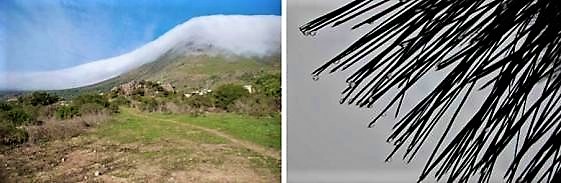
Just as the leaves and needles of trees can collect some of the water in these fogs, large artificial collectors can produce a flow of potable water. Specially designed nets (fog collectors) are used to capture the moisture carried by the air. Tiny droplets of condensed water form on the mesh and are collected in a gutter and transported to a storage site. Other precipitation harvesting technologies for drinking water purposes are: rural rainwater harvesting, or urban rainwater harvesting).
Basic Design Principles
(Adapted from UNEP 1997 and SCHEMENAUER & CERECEDA 1997)
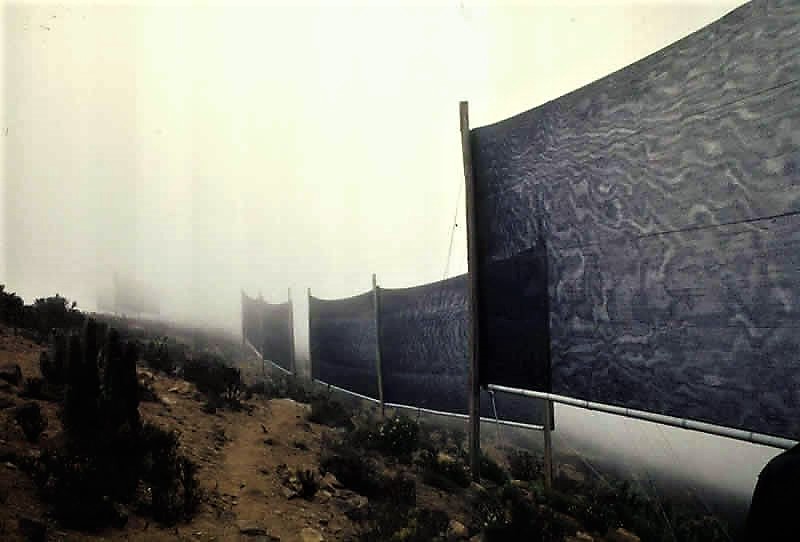
A fog collector is simply a frame that supports a section of mesh in a vertical plane. The large, operational fog collectors are typically made of two supporting posts, and cables on which the mesh is suspended. In addition, there is a network of guy wires to support the posts, a plastic trough to collect the water, and pipes to move water from the troughs to a reservoir or cistern. The large collectors are usually 12 m long and 6 m high. The mesh covers the upper 4 m of the collector. This gives a collecting surface of 48 m2 and typical water production rates of 150 to 750 litres per day depending on the site. Alternatively, the collectors may be more complex structures, made up of a series of such collection panels joined together. The number and size of the modules chosen will depend on local topography and the quality of the materials used in the panels. Multiple-unit systems have the advantage of a lower cost per unit of water produced, and the number of panels in use can be changed as climatic conditions and demand for water vary.
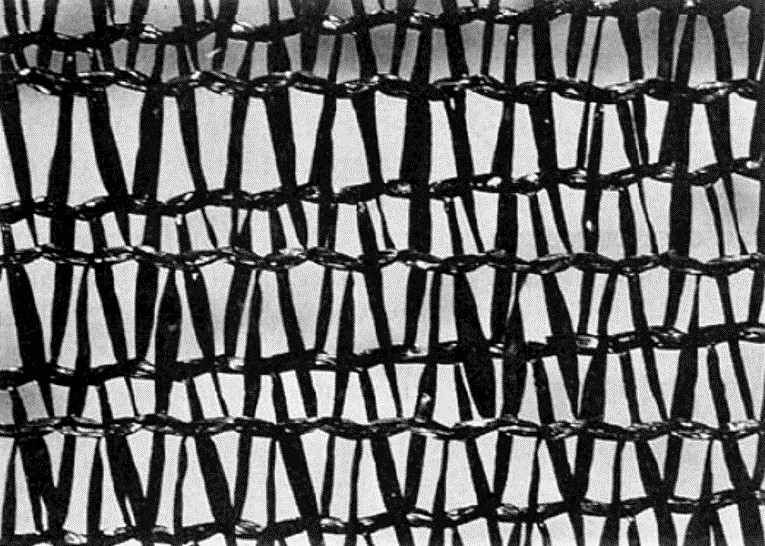
The surface of fog collectors is usually made of fine-mesh nylon or polypropylene netting. Studies of various mesh densities in El Tofo (Chile) showed high efficiency at 35% coverage, mounted in double layers (UNEP 1997). This proportion of polypropylene-surface-to-opening extracts about 30% of the water from the fog passing through the nets (UNEP 1997). As water collects on the net, the droplets join to form larger drops that fall under the influence of gravity into a trough or gutter at the bottom of the panel, from which it is conveyed to a storage tank or cistern. The collector itself is completely passive, and the water is conveyed to the storage system by gravity. If site topography permits, the stored water can also be conveyed by gravity to the point of use. The storage and distribution system usually consists of a plastic channel or PVC pipe approximately 110 mm in diameter, which can be connected to a 20 nun to 25 nun diameter water hose for conveyance to the storage site/point of use (see also water distribution pipes) (UNEP 1997).
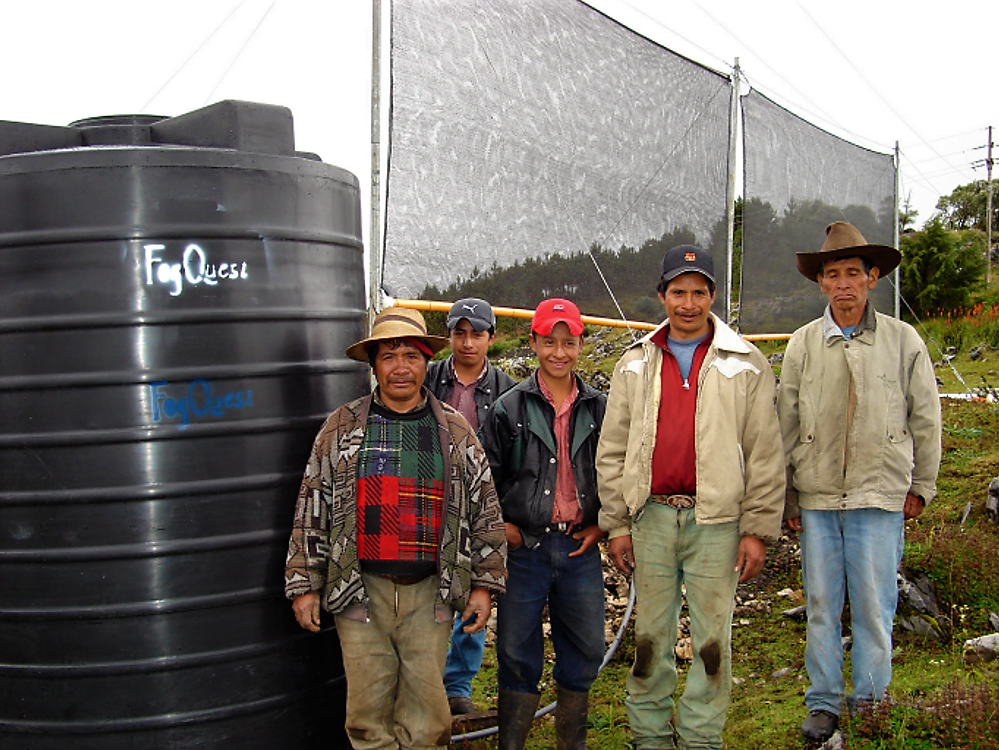
Storage facilities should be provided for at least 50% of the expected maximum daily volume of water consumed (UNEP 1997). However, because the fog phenomenon varies from day to day, it may be necessary to store additional water to meet demands on days when no fog water is collected. Chlorination of storage tanks may be necessary if the water is used for drinking or cooking purposes.
Cost Consideration
(Adapted from FOGQUEST n.y.)
Costs are variable depending on location, access and whether all labour costs are donated. The experience of FogQuest (www.fogquest.org) shows that small fog collectors for an evaluation cost 75 to 200 USD each to build. The large 40 m2 fog collectors cost about 1000 to 1500 USD each and can last 10 years. A village project producing about 2000 litres per day will cost about 15’000 USD.
Health Aspects
(Adapted from FOGQUEST n.y.)
Fog water chemistry has been studied and found to meet the WHO drinking water standards. Because it is produced in remote areas few sources of potential contamination are present. Normally bacterial contamination would also not be an issue since it is very unlikely that there would be harmful bacteria in the fog. The mesh itself rapidly cleans itself from any dust that may have settled on it during a dry period. Once the water is produced by the fog collector the same precautions and considerations apply as for any other water source (e.g. biosand filter, SODIS, chlorination; or in general HWTS).
At a Glance
| Working Principle | As the fog moves through the nets tiny fog droplets accumulate on the mesh and join to form larger drops that fall under the influence of gravity into a trough or gutter at the bottom of the panel, from which it is conveyed to a storage tank or cistern. |
| Capacity/Adequacy | One large fog collector, with a 40 m2 collecting surface, will typically produce an average of 200 litres per day throughout the year. On some days no water is produced. On other days as much as 1000 litres will be generated (FOGQUEST n.y.). |
| Performance | Water harvested from fog meets the WHO drinking water standards (FOGQUEST n.y.). |
| Costs | The small fog collectors for an evaluation cost 75 to 200 USD each to build. A large 40 m2 fog collector costs about 1000 to 1500 USD each and can last 10 years. A village project producing about 2000 L a day will cost about 15’000 USD (FOGQUEST n.y.). |
| Self-help Compatibility | Expert knowledge needed for choosing the optimal location and material. The construction itself is simple. |
| O&M | Cheap and easy to maintain and repair (FUREY 1998). |
| Reliability | There are both day to day variations in fog-water production as well as seasonal variations, as is the case with rainfall (FOGQUEST n.y.). |
| Main strength | Low capital investment and other costs compared to conventional sources of potable water in mountainous and arid areas (FUREY 1998). |
| Main weakness | Yield varies from day to day as well as seasonal depending on the location (FOGQUEST n.y.). |
Fog collection is a resource that should be evaluated in areas where other traditional sources of water, for example, surface water, wells or rainwater collection, cannot meet the needs of the people and where a water pipeline or desalination plants are impractical or too costly. The application focus is located in arid and semiarid regions (SCHEMENAUER & CERECEDA 1997). Conditions for fog water harvesting are best where there are persistent winds from one direction to transport low-level cloud and advective fog (FUREY 1998).The map below indicates potential locations.
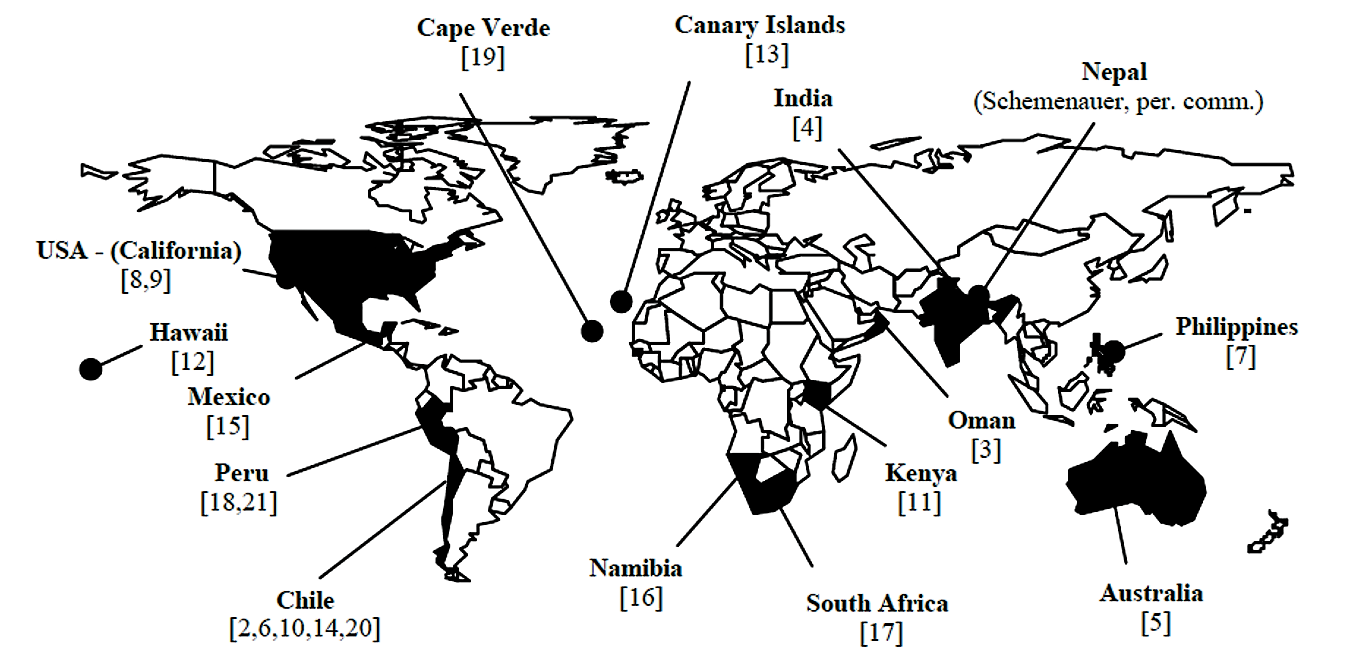
According to SCHEMENAUER (2008) there are two major applications for fog water collection in arid regions:
- Fog collectors can provide water meeting WHO drinking water standards to rural communities and groups of homes; this water is inexpensive to produce and can be delivered to the homes by gravity flow.
- Fog collectors can provide water for reforestation of ridge lines and the upper parts of mountains where it is impractical to import water from conventional sources; the fog water can be delivered to drip irrigation systems by gravity flow and the resulting forests, if properly situated, can become self-sustaining by directly collecting fog water.
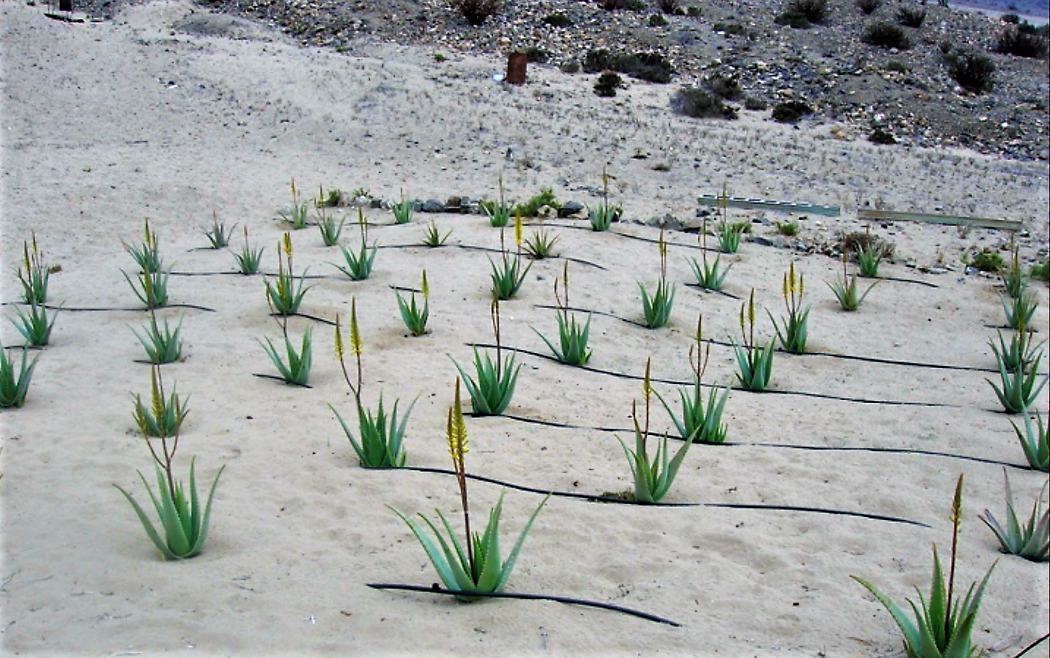
Also the potential use for agriculture has been studied, for example for a drip irrigation system as shown in the picture above (SCHEMENAUER 2008).
Fog Research
This paper provides a scientific background on fog, including the definition of fog, the types of fog, and the relevance of fog in research.
EUGSTER, W. (2008): Fog Research. In: Die Erde : Volume 139 , 1-2. URL [Accessed: 21.03.2019]
Fog Nets for Eritrea: Why Fog Nets?
A Proposed Standard Fog Collector for Use in High-Elevation Regions
This document contains information about standard fog collectors and their construction.
SCHEMENAUER, R. ; CERECEDA, P. (1994): A Proposed Standard Fog Collector for Use in High-Elevation Regions. In: Journal of Applied Meteorology : Volume 33 , 1313-1322. URL [Accessed: 13.07.2011]Fog Collection

This is a general description about fog collection.
SCHEMENAUER, R. CERECEDA, P. (1997): Fog Collection. Norwich: Tiempo. [Accessed: 13.07.2011] PDF
Chapter 1.3 Fog harvesting

This document gives a brief technical overview over fog harvesting.
UNEP (1997): Chapter 1.3 Fog harvesting. In: UNEP (1998): Source Book of Alternative Technologies for Freshwater Augmentation in Latin America and the Caribbean. Nairobi: . URL [Accessed: 20.07.2011]Fog Research
This paper provides a scientific background on fog, including the definition of fog, the types of fog, and the relevance of fog in research.
EUGSTER, W. (2008): Fog Research. In: Die Erde : Volume 139 , 1-2. URL [Accessed: 21.03.2019]A Proposed Standard Fog Collector for Use in High-Elevation Regions
This document contains information about standard fog collectors and their construction.
SCHEMENAUER, R. ; CERECEDA, P. (1994): A Proposed Standard Fog Collector for Use in High-Elevation Regions. In: Journal of Applied Meteorology : Volume 33 , 1313-1322. URL [Accessed: 13.07.2011]Fog Collection
This is a general description about fog collection.
SCHEMENAUER, R. CERECEDA, P. (1997): Fog Collection. Norwich: Tiempo. [Accessed: 13.07.2011] PDFCollecting fog on El Tofo
This paper highlights critically the cultural (software) aspects of a fog harvesting project, which started in 1990 in El Tofo, Chile.
DALE, S. (2003): Collecting fog on El Tofo . URL [Accessed: 09.07.2019]Fog Catchers Harvest Air’s Water in Arid Place
This document presents illustrative an implemented fog harvesting project in Peru.
FOGHARVESTING (n.y): Fog Catchers Harvest Air’s Water in Arid Place. FOGHARVESTING. [Accessed: 20.07.2011] PDFFog-water harvesting along the West Coast of South Africa: A feasibility study
This paper investigates the potential for fog harvesting of the West Coast of South Africa.
OLIVER, J. (2002): Fog-water harvesting along the West Coast of South Africa: A feasibility study. In: Water SA: Volume 28 , 4. URL [Accessed: 21.03.2019]Chapter 5.2 Fog harvesting in Chile

This document presents the technical aspects of a fog harvesting project, which started in 1990 in El Tofo, Chile.
UNEP (1997): Chapter 5.2 Fog harvesting in Chile. In: UNEP (1998): Source Book of Alternative Technologies for Freshwater Augmentation in Latin America and the Caribbean. Nairobi: . URL [Accessed: 09.07.2019]Results from the Workshop on Success Factors for Fog Collection Projects

This document specifies the success factors for fog collection projects.
MUNICH RE FOUNDATION (2010): Results from the Workshop on Success Factors for Fog Collection Projects. 5th International Fog Conference 25-30 July 2010. Munich: MUNICH RE FOUNDATION. [Accessed: 14.07.2011] PDFChapter 1.3 Fog harvesting
This document gives a brief technical overview over fog harvesting.
UNEP (1997): Chapter 1.3 Fog harvesting. In: UNEP (1998): Source Book of Alternative Technologies for Freshwater Augmentation in Latin America and the Caribbean. Nairobi: . URL [Accessed: 20.07.2011]Fogquest: Sustainable Water Solutions
This website of the charity FogQuest provides a broad overview over fog harvesting as well as several videos on fog collection.
Collecting fog on El Tofo
This article is about one of the first fog harvesting projects, which started in 1990 in El Tofo, Chile.
http://www.scienceinafrica.co.za/
This article is about fog harvesting projects in South Africa.