


Executive Summary
Water resources can be neither developed nor managed rationally without an assessment of the quantity and quality of water available. Water resources assessment (WRA) is a tool to evaluate water resources in relation to a reference frame, or to evaluate the dynamics of the water resource in relation to human impacts or demand. Water resources assessment is a classic tool used in Integrated Water Resources Management (IWRM). In the framework of SSWM, parallel to the water resources assessment, also a material flow analysis needs to be conducted, to receive a complete picture of the water and nutrient cycles.
Introduction
(Adapted from GWP 2008; EMPOWERS PARTNERSHIP n.y.)
Water resources assessment (WRA) is the process of measuring, collecting and analysing relevant parameters on the quantity and quality of water resources for the purposes of a better development and management of water resources.
WRA is a tool to evaluate water resources in relation to a reference frame, or evaluate the dynamics of the water resource in relation to human impacts or demand. WRA is applied to a unit such as a catchment, sub-catchment or groundwater reservoir. It is part of the IWRM approach, linking social and economic factors to the sustainability of water resources and associated ecosystems. Depending on the objective of the assessment, WRA may look at a range of physical, chemical and biological features in assessing the dynamics of the resource.
Water resource assessment is a systematic study of the status of water services and resources, and of trends in accessibility and demand within a specific domain of interest.
The international Glossary of Hydrology (HUBERT n.y.) defines water resources assessment as the “determination of sources, extent, dependability and quality of water resources for their utilisation and control.”
Purpose of Water Resources Assessment
(Adapted from EMPOWERS PARTNERSHIP n.y.)
Conducting water resources assessment in your area helps clarifying the following issues:
- Current status of water resources at different scales, including inter-and intra-annual variability
- Current water use (including variability), and the resulting societal and environmental trade-offs
- Scale related externalities, especially when patterns of water use are considered over a range of temporal and spatial scales
- Social and institutional factors affecting access to water and their reliability
- Opportunities for saving or making more productive, efficient and/or equitable
- Efficacy and transparency of existing water-related policies and decision making processes
- Conflicts between existing information sets, and the overall accuracy of government (and other) statistics
By conducting a water resources assessment (WRA), you are establishing a common, agreed and trusted information base that can be used by stakeholders as a basis for informed and effective decision making. In order to improve your sanitation and water system with the aim to make it more sustainable, it is of prime importance to conduct a water resources assessment. Especially when a comprehensive and large-scale change in the water and sanitation system is envisaged, it is crucial to know the various parameters related to water quality and quantity in your area. If you, for example, want to save water and make water use more efficient, it is important to know the various water consumers and their actual water consumption. Only with a sound understanding of the present situation of water consumption in your project area, you can decide where and how to save water.
Components of Water Resources Assessment
(Adapted from UNESCO and WMO 1997)
In order to conduct a comprehensive water resources assessment, you need various experts from different backgrounds who conduct, collect and analyse data required for the assessment.
The following graph illustrates the main components of a water resources assessment:
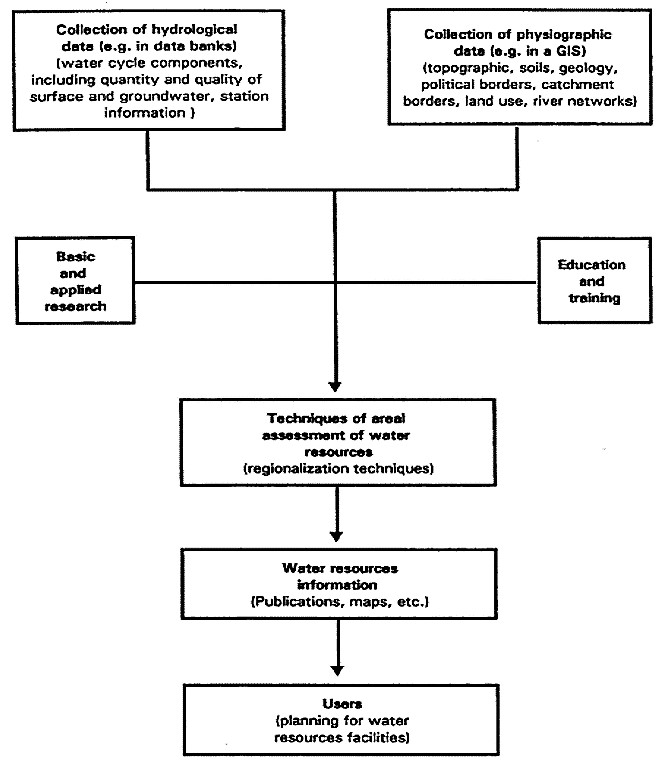
Collection of hydrological data - the collection of historical data on water cycle components at a number of points distributed over the assessment area such as quantity and quality of surface and groundwater.
- Collection of physiographic data - obtaining data on the natural characteristics of the terrain that determine the areal and time variations of the water cycle components, such as topography, soils, surface and bed rock geology, land-use and land-cover. These characteristics are designated for brevity as physiographic characteristics.
- Collection of data from basic and applied research - further research related to water resources can be essential especially when some data is missing or the available date is out of date. Furthermore, research may be needed in order to develop the required technology used for the water resources assessment.
- Education and training – All the basic water resources assessment activities require skilled manpower and this in turn require training and education of the manpower need.
- Techniques of areal assessment of water resources - techniques of transforming data into information and of relating the hydrological data to the physiographic data for the purpose of obtaining information on the water-resource characteristics at any point of the assessment area.
Things to Consider
(Adapted from GWP 2008)
A water resources assessment often needs to be carried out in several steps of increasing complexity. A rapid water resources assessment may help identify and list the most important issues and identify priority areas (you could also see “understand your system” for this purpose). On the basis of this early assessment, more detailed investigations may be required. Assessments for large or long-term projects need to include the examination of changes in land use and possible soil degradation as well as climate variability and change.
Linking water resources assessment to environmental impact assessment has shown to build cross-sectoral linkages and heighten awareness (see PPT) of key issues.
Strategic impact assessment can help in the analysis of change capacity of a river basin, to protect both quantity and quality.
Traditional water resource assessment aimed to provide the basis for the supply of infrastructure to meet projected needs. Assessments have a much wider remit in an IWRM perspective, incorporating cross-sectoral tools such as:
- Demand assessment, which examines the competing uses of water with the physical resource base and assesses demand for water (at a given price), thus helping to determine the financial resources available for water resource management.
- Environmental impact assessment and strategic impact assessment collect data on the social and environmental implications of development programmes and projects. Environmental impact assessment is an important tool for cross-sectoral integration involving project developers, water managers, decision-makers and the public. It can be seen as a special form of water resources assessment.
- Social impact assessment, which examines how social and institutional structures affect water use and management, or how a specific project might affect social structures.
- Risk or vulnerability assessment, looking at the likelihood of extreme events, such as flood and droughts, and the vulnerability of society to them.
Subscribe here to the new Sanitation and Water Entrepreneurship Pact (SWEP) newsletter. SWEP is a network of organizations joining hands to help entrepreneurs design and develop lasting water and sanitation businesses.
Content Example for a Water Resources Assessment
(Adapted from US ARMY CORPS OF ENGINEERS 1999)
The following list is an example how the content of a water resources assessment could look like for your project area:
1. Introduction
2. Country Profile
- Geography
- Population and social impacts
- Economy
- Flood control
- Legislative framework
3. Current Uses of Water Resources
- Water supply
- Domestic uses and needs
- Industrial/commercial uses and needs
- Agricultural uses and needs
- Hydropower
- Stream gauge network
- Waterway transportation
4. Surface Water Resources
- Precipitation and climate
- Rivers and basins
- Lakes and swamps
- Deforestation effects
5. Ground Water Resources
- Aquifer definition and characteristics
- Hydrogeology
6. Water Quality
- Surface water
- Ground water
- Domestic waste disposal
In order to improve your sanitation and water system with the aim to make it more sustainable, it is of prime importance to conduct a water resources assessment. Especially when a comprehensive and large-scale change in the water and sanitation system is envisaged, it is crucial to know the various parameters related to water quality and quantity in your area. If you want to save water and therefore use water more efficiently in your project area, it is important to know the various water consumers and their actual water amount they use. Only by with a sound understanding of the present situation of water consumption in your project area, you can decide where and how to save water.
However, to receive a complete picture of the water and nutrient cycles in place, parallel to a WRA, also a material flow analysis needs to be conducted.
Day 4 – Water Resources Assessment. Introduction
Water Resources Assessment
Water Resources Assessment. Handbook for Review of National Capabilities
This handbook explains the main components of water resources assessment done by national authorities.
UNESCO ; WMO (1997): Water Resources Assessment. Handbook for Review of National Capabilities. Geneva and Paris: World Meteorological Organisation (WMO) and United Nations Educational Scientific Cultural Organisation (UNESCO) URL [Accessed: 12.09.2010]Water Resources Assessment Of Haiti
This document is an example of a water resources assessment in Haiti.
US ARMY CORPS OF ENGINEERS (1999): Water Resources Assessment Of Haiti. Washington, DC: US Army Corps of Engineers URL [Accessed: 09.04.2019]International Glossary of Hydrology
Judicious management of groundwater through participatory hydrological monitoring
This report developed under the APWELL project deals with participatory hydrological monitoring in an effort to sensitize the individual groundwater users on judicious use of groundwater. Participatory hydrological monitoring improves the users’ understanding of local groundwater resource characteristics and helps local communities to form a community opinion to support appropriate measures for managing the available resources equitably.
APWELL Project (2003): Judicious management of groundwater through participatory hydrological monitoring. A manual. Andhra Pradesh, India.: Andhra Pradesh Groundwater Bore well Irrigation Schemes Project (APWELL Project) URL [Accessed: 15.01.2013]Day 4 – Water Resources Assessment. Introduction
Water Resources Assessment for the Planning Region. Middle Rio Grande Regional Water Plan
This document describes how to conduct a water resources assessment and includes explanations about how to evaluate the water budget, water supply, water quality issues and water supply considering legal limitations.
WATER ASSEMBLY (2006): Water Resources Assessment for the Planning Region. Middle Rio Grande Regional Water Plan. Albuquerque: Water Assembly URL [Accessed: 12.09.2010]Asian Water Development Outlook 2013. Measuring Water Security in Asia and the Pacific
This second edition of the Asian Water Development Outlook (AWDO) provides a quantitative and comprehensive view of water security in the countries of Asia and the Pacific. By focusing on critical water issues, AWDO 2013 provides finance and planning leaders with recommendations on policy actions to improve water governance and guidance on investments to increase their country's water security
ADB (2013): Asian Water Development Outlook 2013. Measuring Water Security in Asia and the Pacific. Manila: Asian Development Bank (ADB) URL [Accessed: 28.03.2013]Trends in groundwater pollution: loss of groundwater quality and related aquifers services
The purpose of this Thematic Paper is to review the trends in groundwater quality and pollution, taking into account the physical, environmental, institutional and social actors involved in groundwater quality governance. The final goal is to diagnose historical and current issues related to groundwater use under the threat of pollution, and to identify prospects for improved and sustainable aquifer governance through prevention and mitigation of the factors that may impact water quality.
FAO GEF IAH IHP World Bank (2012): Trends in groundwater pollution: loss of groundwater quality and related aquifers services. FAO URL [Accessed: 08.04.2013]Nonouti, Kiribati Water Resources Assessment
This document is an example of a water resources assessment of Nonouti, Kiribati.
OVERMARS, M. (2003): Nonouti, Kiribati Water Resources Assessment. Suva: South Pacific Applied Geoscience Commission (SOPAC). [Accessed: 22.04.2012] PDFWater Resources Assessment of the Mora River
This document is an example of a water resources assessment of the Mora River in New Mexico.
THOMSON, B. ABDUL-MEHDI, A. (2009): Water Resources Assessment of the Mora River. Albuquerque: University of New Mexico URL [Accessed: 12.09.2010]Water Resources Assessment Of Haiti
This document is an example of a water resources assessment in Haiti.
US ARMY CORPS OF ENGINEERS (1999): Water Resources Assessment Of Haiti. Washington, DC: US Army Corps of Engineers URL [Accessed: 09.04.2019]Water Resources Assessment. Handbook for Review of National Capabilities
This handbook explains the main components of water resources assessment done by national authorities.
UNESCO ; WMO (1997): Water Resources Assessment. Handbook for Review of National Capabilities. Geneva and Paris: World Meteorological Organisation (WMO) and United Nations Educational Scientific Cultural Organisation (UNESCO) URL [Accessed: 12.09.2010]Water Scarcity Factsheet
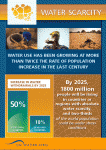
Thematic Factsheet on Water Scarcity. The world contains an estimated 1 400 million cubic km of water. Only 0.003% of this vast amount, about 45 000 cubic km, are what is called "fresh water resources", i.e. water that can be used for drinking, hygiene, agriculture and industry.
UN Water (2013): Water Scarcity Factsheet. United Nations Water URL [Accessed: 09.04.2019]