In composting toilets, faeces or excreta fall into a composting chamber together with cleansing material. Dry organic material such as sawdust is added to adjust moisture content and C/N ratio in order to obtain optimum conditions for thermophilic composting. Organic household waste can also be added. Depending on the process, shorter or longer maturation periods and maybe also secondary treatment are required. Urine might be diverted to decrease humidity of the compost and to be reused separately. The final product is a humus-like soil (humanure), which is valuable as soil amendment improving its fertility, structure and water retention capacity.
| In | Out |
|---|---|
Composting toilets are toilets systems, which allow to minimise water use and to recycle nutrients contained in excreta and faeces. There are various different systems (i.e. pits or vaults; urine diversion or not; low-tech and high-tech; single-vault continuous or multiple vault batch). The functioning of the various different composting toilet systems is basically the same. Faecal matter and toilet paper or other dry cleansing material fall into a composting chamber. Organic household waste can also be added. Good ventilation serves to prevent excessive humidity and odour. To increase composting properties, dry material, which contains carbon (such as sawdust or ash) are added. This regulates the carbon to nitrogen ratio (C/N) and enhances the composting process. If ash and lime are used as adding material, this has the additional beneficial effect of raising pH, which leads to improved pathogen die-off (JOENSSEN et al. 2004, see also SCHOENNING & STENSTROEM 2004 for more information on alkaline treatment). Often, composting toilets also have a drainage system to allow the drainage of liquids. This leachate has very high concentrations of nutrients, organics but also contain pathogens. They need to be collected, treated and if possible reused (see also leach field, soak pits, evapotranspiration beds, fertigation). Urine diversion usually reduces leachate production (GTZ 2006). The end product of composting toilet is an odourless (and generally stabilised) material, called humanure, which is a valuable as soil conditioner (improving nutrient content, structure and water retention capacity of the soil). Depending on the local conditions, humanure can be harvested after some weeks or years. After this, it may be directly reused or requires a secondary treatment for complete pathogen removal (see also drying and storage of faeces, co-composting small-scale and large-scale).
Design scheme of a pre-fabricated composting toilet for a cottage hou sing. Source: ENVIROLET (n.y.).
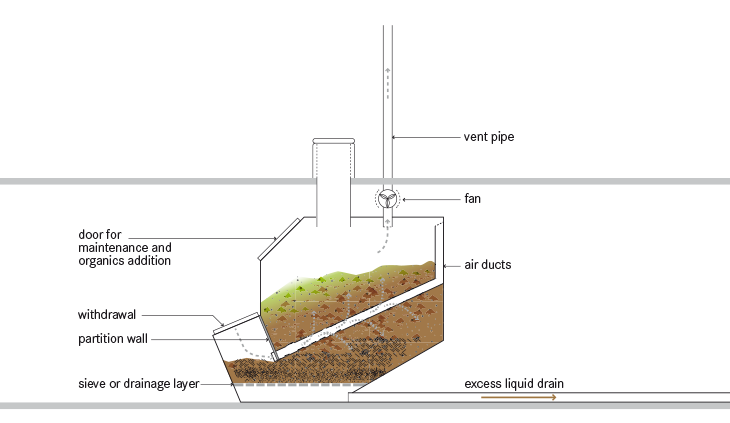
Composting toilets have a chamber in which all excreta and faeces are confined. The design of the chamber varies much but generally, they are watertight and well aerated (as composting is an aerobic process). Urine is either diverted or not, and there may be a drainage system or not. A grinder or mixer to homogenise the compost is included in some high-tech models but not necessarily required. The chambers are built as vaults above ground (like for the clivus multrum, the double vault Vietnamese composting toilet or the skyloo, see picture below) or underground pits. This factsheet focuses on above ground composting toilets (vault composting toilets). You can find information on typical pit composting toilets in the factsheets for the arborloo and the fossa alterna. In continuous vault composting toilets, such as the clivus multrum, compost can continuously be harvested on one end, while faeces fall into the other. In batch systems, the composting chamber is changed once it is full and the next one is used during which the other one is closed and left aside for maturation. Batch systems, especially in low-tech models, are much safer as they prevent mixing of fresh and matured material (WHO 2006). Typical batch systems are double vaults or movable containers (WHO 2006).
The TerraNova composting toilet. Air moves through channels through the compost. Maturated can be harvested at the bottom. Source: BERGER (2009)
Composting toilets rely on the aerobic degradation of organic matter, resulting in a hygienic product that can be used as soil fertiliser. Composting is possible at high temperatures (thermophilic composting) and at low temperatures (ambient or mesophilic composting). Thermophilic composting is faster and more efficient to inactivate pathogens. The optimal operational conditions for thermophilic composting are (GTZ 2006):
The carbon to nitrogen ration (C/N) of excreta (including urine) is about 7 to 8, but for optimal thermophilic composting, it needs to be 20 to 35 (WHO 2006). The addition of paper, wood or bark chips, sawdust, ash or other similar substances will help to increase the C/N ratio. However, if the C/N ration becomes too high (> 30 to 35), then the composting is slowed down, impairing the attainment of required temperatures. Adding bulk material is also important to reduce humidity in the chamber and thus the potential of odour and fly breeding problems (WHO 2006). The addition of organic household waste can also help to raise the C/N ratio (WHO 2006). It can be added to a composting toilet through the toilet itself or through a separate chute. The toilet can be designed either with or without urine diversion (see also urine diversion components). Urine adds more water and it has a very high nitrogen content. With urine diversion, less bulking agent is needed and the C/N ratio is naturally enhanced.
Front view of a compo sting toilet model „skyloo“, and a brick single-vault composting toilet with a movable container. Source: MORGAN (2007).
Ventilation of composting toilets is important in order to maintain low moisture content of the compost and to prevent odour. Best ventilation is designed similar as for urine diversion dehydration toilets. It can be done naturally or mechanically. Mechanical ventilation requires a fan or another mechanical device and power/solar energy. For natural ventilation, a difference of pressure (or temperature) is required inside and outside the vaults. This can be given by wind or a stack effect. The stack effect can be achieved by installing the ventilation pipe outside and expose it to the sun (it may also be painted in black). When the air in the pipe heats up, it rises upwards out of the vent; a downward draught of cooler air of higher density then flows in through the squat plate hole, replacing the vacuum space created after warm air rising (OKETCH 2005). Due to its complexity, thermophilic composting can be difficult to manage and often, the operating range of composting toilets is varying within the thermophilic, mesophilic and ambient composting (WHO 2006). Even though the pathogen content is considerably reduced in composting toilets, complete pathogen destruction can only be achieved if good process conditions can be guaranteed. This can be done by using an advanced toilet design with insulation for maintaining a high temperature within the whole composting chamber (GTZ 2006). If thermophilic composting cannot be guaranteed, longer maturation times or a secondary treatment may be required (see also co-composting at small and large scale or drying and storage of faeces). In practice, thermophilic composting of faeces at the domestic level is questionable, as only slight elevation of the temperature was recorded in some trial (SCHOENNING & STENSTROEM). Therefore low-cost composting toilets at the household level may only be adapted if a secondary treatment is provided to ensure safety of the system. As a secondary treatment on a larger scale, where the process can be insulated and monitored, composting might be more effective (SCHOENNING & STENSTROEM 2004).
After complete maturation, the humus-like toilet compost is safe an d can be used as fertiliser. Source: MORGAN (2007)
The combination of ammonia, high temperature, high pH and high aeration means that N in the form of ammonia can be lost to the atmosphere (JOENSSON et al. 2004). These losses are somewhat decreased if the C/N ratio is adjusted. At an optimal C/N ratio, the losses might be 10 to 50 % (JOENSSEN et al. 2004). If urine is mixed with the faeces and composted together, then the N input to the compost with the urine is increased 3 to 8 times and most of the N from the urine is lost, mainly in the form of ammonia (JOENSSEN et al. 2004).
If operation conditions for thermophilic composting are adequate (moisture content 50 to 60 %, carbon to nitrogen ratio 30 to 35 and mixing with bulking material), the temperature will rise to between 50 and 65 °C (WHO 2006). Such temperatures will effectively inactivate pathogens (WHO 2006). Otherwise, secondary treatment will be necessary (see above). After a secondary treatment step, humanure is a highly valuable soil conditioner.
There are many designs and models offered by manufacturers all over the world with a large range of prices (GTZ 2006). Low-tech composting toilets can also be self-constructed with locally available material.
In composting toilet sufficiently organic bulking material should be added after each use in order to enhance the drying process and control the C/N ratio (JOENSSEN et al. 2004). The immediate coverage of the fresh faeces with an additive material also lowers nuisances caused by odour or flies. A squeeze test can be used to check the moisture level within the composting chamber. A squeeze test requires the user to squeeze a handful of compost (TILLEY et al. 2008): The compost should not crumble and feel dry, nor should it feel like a wet sponge. Rather, the compost should only leave a few drops of water in the user’s hand. With time, salt or other solids may build up in the tank or in the leachate collecting system, which can be dissolved with hot water and/or scraped out (TILLEY et al. 2008). In multi-vault/container systems, filling is generally stopped when the vault is 2 to 3 quarters full (WSP 2007; WHO 1992). Then content is covered with soil and the vaults or containers are sealed. The maturation periods depends on temperature and the local climate. Under optimum thermophilic conditions, it may only take some weeks until the faeces or excreta are decomposed and hygienised. However, batch systems should be designed such as each filled vaults/containers can maturate for at least during two years (WHO 1992). That means that each vault of a double-vault composting toilet should be large enough to hold at least two years’ accumulation (WHO 1992). Emptying composting toilet constitutes a critical handling point. The emptying frequency depends on the size of the chambers, the feeding rate and the composting rate (volume reduction, pathogen removal) (GTZ 2006). Generally, composting chambers should be emptied every 2 to 10 years (TILLEY et al. 2008). Proper protection measures, mainly personal protection, should be taken, especially if the material is not fully hygienised (WHO 2006). In this case the material should be further treated or stored out of reach from people until proper maturation times have been reached (WHO 2006). In addition to protective clothing (e.g. gloves and boots), normal hygiene and washing after the emptying operation are important (WHO 2006).
Working Principle | Faecal matter is collected in vaults or pits together with organic bulking agents. At optimum conditions, thermophilic composting takes place transforming the faeces or excreta into humus like toilet compost (humanure), which can be used as a soil amendment. |
Capacity/Adequacy | Composting toilets can be constructed everywhere. Pre-fabricated high-tech models are available. Simpler composting toilets can be constructed by the user itself with locally available material. |
Performance | Depends much on the local climatic conditions and operation and maintenance. At optimum conditions, resulting humanure is completely safe. |
Costs | Depends on technology level; from moderate to high-cost. |
Self-help Compatibility | Can be built and repaired with locally available material. Expert design maybe required. |
Composting toilets require the frequent addition of organic bulking material and control of moisture and temperature. | |
Reliability | If well maintained and constructed, high. |
Main strength | No water required and no risk of soil water pollution; Produces humanure. |
Main weakness | Requires large amount of organic bulking material and thermophilic composting is not always achieved. |
Composting toilets are suitable for both industrialised and developing countries, especially in arid regions and regions without piped water for sewers (GTZ 2006). Composting toilets can be constructed at the household level, or they can be built in cluster for institutions, schools, hostels and so on (CALVERT 1999). However, open access community compost toilets are not recommended other than in well-educated and highly motivated communities (CALVERT 1999). Composting toilets can be built beside or as part of a house in rural, urban or peri-urban areas and can even be established inside a house or apartment (CALVERT 1999). In several projects, composting toilets have also been successfully implemented in houses with several floors with the collecting chamber being situated in the basement (GTZ 2006). Composting toilets are generally sealed systems; therefore they are also adapted to areas prone to flooding or high water table (CALVERT 1999). Composting toilets are slightly more expensive than urine diversion dehydration toilets in terms of excreta management because of the need for the control of the C/N ration (GTZ 2006), but the nutrients contained in the compost from composting toilets are more readily available than those from dehydration toilets (GTZ 2006).

BERGER, W. (Editor); LORENZ-LADENER, C. (Editor) (2008): Komposttoiletten - Sanitärtechnik ohne Wasser. Staufen: Ökobuch. URL [Accessed: 21.11.2010]. PDF
BERGER, W. (2009): Results in the Use and Practise of Composting Toilets in Multi Storey Houses in Bielefeld and Rostock, Germany- Presentation. Hamburg: Berger Biotechnik AG. URL [Accessed: 22.11.2010]. PDF
CALVERT, P. (1999): Compost Toilets. Bourton on Dunsmore: Practical Action UK. URL [Accessed: 11.08.2010]. PDF
ENVIROLET (Editor) (n.y.): Envirolet modern pre-fab home or cottage installation. Envirolet Waterless Remote System. URL [Accessed: 11.08.2010].
GTZ (Editor) (2010): Basic overview of Composting Toilets (with and without urine diversion). Eschborn: German Agency for Technical Cooperation (GTZ) GmbH. URL [Accessed: 22.11.2010]. PDF
JOENSSON, H.; RICHERT, A.; VINNERAAS, B.; SALOMON, E. (2004): Guidelines on the Use of Urine and Faeces in Crop Production . Stockholm: EcoSanRes. URL [Accessed: 17.04.2012]. PDF
MORGAN, P.; EcoSanRes (Editor) (2007): Toilets That Make Compost . Stockholm: Stockholm Environment Institute. PDF
OKETCH, M. (2005): Systems for Enhancing Ventilation for Improved Control of Odour and Fly Nuisance in Dry Urine Diverting Ecological Sanitation Toilets. URL [Accessed: 22.07.2010]. PDF
SCHOENNING, C.; STENSTROEM, T.A. (2004): Guidelines on the Safe Use of Urine and Faeces in Ecological Sanitation Systems. Stockholm: Stockholm Environment Institute (SEI). PDF
TILLEY, E.; LUETHY, C.; MOREL, A.; ZURBRUEGG, C.; SCHERTENLEIB, R. (2008): Compendium of Sanitation Systems and Technologies. Duebendorf and Geneva: Swiss Federal Institute of Aquatic Science and Technology (EAWAG). URL [Accessed: 15.02.2010]. PDF
UNEP (Editor); Murdoch University (Editor) (2004): Environmentally sound technologies in wastewater treatment for the implementation of the UNEP/GPA "Guidelines on Municipal Wastewater Management". The Hague: United Nations Environment Programme Global Programme of Action (UNEP/GPA), Coordination Office. PDF
WHO (Editor) (2006): Guidelines for the safe use of wastewater excreta and greywater. Volume IV. Excreta and Greywater Use in Agriculture. Geneva: World Health Organisation. URL [Accessed: 26.02.2010]. PDF
WSP (Editor) (2007): Philippines Sanitation Source Book and Decision Aid. pdf presentation. Washington: Water and Sanitation Program. PDF

BERGER, W. (2011): Technology Review of Composting Toilets. Eschborn: Deutsche Gesellschaft für Internationale Zusammenarbeit (GIZ). URL [Accessed: 06.02.2012]. PDF
This GIZ publication explains the design, use and operational requirements of composting toilets. Ample examples for composting toilets from around the world are included in the publication to show that these types of toilets have a wide range of applications under a variety of circumstances (for wealthy or poor people; for cold, hot, wet or dry climates; for urban or rural settings). The appendix contains a listing of suppliers.
GTZ (Editor) (2010): Basic overview of Composting Toilets (with and without urine diversion). Eschborn: German Agency for Technical Cooperation (GTZ) GmbH. URL [Accessed: 22.11.2010]. PDF
The publication explains the purposes of urine diversion, its benefits and challenges, possibilities of urine treatment and reuse in agriculture. It provides an overview on design and operational aspects for equipment needed, such as waterless urinals and urine diversion toilets. An appendix with a worldwide listing of suppliers for waterless urinals and urine diversion toilet pedestals and squatting pans is also available.
ECOSANCLUB (Editor) (2011): Sustainable Sanitation Practice. Toilets. Vienna: Ecosan Club. URL [Accessed: 01.01.1970]. PDF
WHO (Editor) (2006): Guidelines for the safe use of wastewater excreta and greywater. Volume IV. Excreta and Greywater Use in Agriculture. Geneva: World Health Organisation. URL [Accessed: 26.02.2010]. PDF
Volume IV of the Guidelines for the Safe Use of Wastewater, Excreta and Greywater recognizes the reuse potential of wastewater and excreta (including urine) in agriculture and describes the present state of knowledge as regards potential health risks associated with the reuse as well as measures to manage these health risks following a multi-barrier approach.
WINDBLAD, U.; SIMPSON-HERBERT, M. (2004): Ecological Sanitation - revised and enlarged edition. (pdf presentation). Sweden: Stockholm Environment Institute. URL [Accessed: 04.08.2010]. PDF
This book is one of the most fundamental and important books that defined the concept of ecological sanitation. The first version came out in 1998 - this version presents the findings of over ten years of research and development in ecological sanitation supported by SIDA (Swedish International Development Cooperation Agency).
ESREY, S. A. (Editor); GOUGH, J. (Editor); RAPAPORT, D. (Editor); SAWYER, R. (Editor); MAYLING, S.H. (Editor); VARGAS, J. (Editor); WINBLAD, U. (Editor) (1998): Ecological Sanitation. Stockholm: Novum Grafiska AB. URL [Accessed: 22.07.2010]. PDF
This book puts forward ecological sanitation as an alternative to conventional sanitation, and was one of the very first of its kind. It documents different options of ecosan based on dehydrating and composting toilets in use around the world. The book has been reviewed and enlarged since then.
JENKINS, J. (2005): The Humanure Handbook. A Guide to Composting Human Manure. Grove City: Joseph Jenkins Inc. . URL [Accessed: 16.08.2010].
A comprehensive book on recycling human excrement without chemicals, high technology or pollution. Well written, practical, and thoroughly researched, this self-published book is built on nearly twenty years of experience by the author, who tells us about every aspect of dealing with excrement on the home-scale level. Only available for free as web book.
MORGAN, P.; EcoSanRes (Editor) (2007): Toilets That Make Compost . Stockholm: Stockholm Environment Institute. PDF
This book describes in an easy-to-understand and picture-based way how to construct three different low cost sanitation solutions, namely arborloos, fossa alterna and urine diversion toilets.
NIWAGABA, C. (2007): Human Excreta Treatment Technologies - prerequisites, constraints and performance. Uppsala: Swedish Agricultural University (SLU), Department of Biometry and Engineering. PDF
The thesis consists of three papers, the first of which investigates incineration of faecal matter as a treatment and sanitation method using a locally fabricated incinerator made of steel sheets. The second and third papers investigate composting of faeces and food waste at two size scales, using 78-litre and 216- litre wooden reactors.
NWP (Editor) (2006): Smart Sanitation Solutions. Examples of innovative, low-cost technologies for toilets, collection, transportation, treatment and use of sanitation products. Amsterdam: Netherlands Water Partnership (NWP). URL [Accessed: 13.04.2010]. PDF
Smart Sanitation Solutions presents examples of low-cost household and community-based sanitation solutions that have proven effective and affordable. A wide range of innovative technologies for toilets, collection, transportation, treatment and use of sanitation products that have already helped thousands of poor families to improve their lives is illustrated.
TILLEY, E.; LUETHY, C.; MOREL, A.; ZURBRUEGG, C.; SCHERTENLEIB, R. (2008): Compendium of Sanitation Systems and Technologies. Duebendorf and Geneva: Swiss Federal Institute of Aquatic Science and Technology (EAWAG). URL [Accessed: 15.02.2010]. PDF
This compendium gives a systematic overview on different sanitation systems and technologies and describes a wide range of available low-cost sanitation technologies.
U.S. EPA (Editor) (1999): Composting Toilets. Washington: United States Environmental Protection Agency, Office of Water. URL [Accessed: 16.08.2010]. PDF
Factsheet including information related to microbial die-off rates and health risks.
WSP (Editor) (2007): Philippines Sanitation Source Book and Decision Aid. pdf presentation. Washington: Water and Sanitation Program. PDF
This Sanitation Sourcebook distils some of the core concepts of sanitation in a user-friendly format so that the book can serve as a practical reference to sanitation professionals and investment decision-makers, particularly the local governments. The annexe contains a practical collection of factsheets on selected sanitation system options.
WATER AID (Editor) (2011): Construction of Ecological Sanitation Latrine. Kathmandu: Water Aid. URL [Accessed: 19.10.2011]. PDF
This document sets out the principles for adopting an ecological sanitation approach, as well as providing guidance on the construction ecological sanitation latrines and their operation. It is intended to support sanitation field practitioners and WaterAid in Nepal ’s partners in the delivery of appropriate services and technologies to fit the needs of different users. .It is also equally hoped that this document will be of value to other organisations and sector stakeholders involved in sanitation promotion and ecological sanitation.
TOUBKISS, J. (2010): How to Manage Public Toilets and Showers. Cotonou and Paris: Partenariat pour le Développement Municipal (PDM) and Programme Solidarité Eau (pS-Eau). URL [Accessed: 19.10.2011]. PDF
The purpose of this decision-making aid is to provide practical advice and recommendations for managing toilet blocks situated in public places. It is primarily aimed at local decision-makers in developing countries and at their partners (project planners and managers).
GTZ (Editor) (2010): Appendix: Range of manufacturers and commercially available composting toilets. Eschborn: German Agency for Technical Cooperation (GTZ) GmbH. URL [Accessed: 22.11.2010]. PDF
List of supplier for commercially available composting toilets.

BERGER, W. (2009): From pit latrine to nutrient conservation – Design and construction of an optimised public dehydration toilet in Ghana. Hamburg: Berger Biotechnik AG. URL [Accessed: 22.11.2010]. PDF
As part of the project "Ecological development at Valley View University in Accra, Ghana", a public dehydration toilet building for about 250 male students was constructed on a campus as a first step, to find out about acceptance, function and treatment conditions.
BERGER, W. (2009): From pit latrine to nutrient conservation – Design and construction of an optimised public dehydration toilet in Ghana- Presentation. Hamburg: Berger Biotechnik AG. URL [Accessed: 22.11.2010]. PDF
This presentation describes the installation of a public dehydration toilet building for about 250 male students at Valley View University in Accra, Ghana.
BERGER, W. (2009): Results in the Use and Practise of Composting Toilets in Multi Storey Houses in Bielefeld and Rostock, Germany. Hamburg: Berger Biotechnik AG. URL [Accessed: 22.11.2010]. PDF
This is a an article concerning composting toilets in four story buildings.
BERGER, W. (2009): Results in the Use and Practise of Composting Toilets in Multi Storey Houses in Bielefeld and Rostock, Germany- Presentation. Hamburg: Berger Biotechnik AG. URL [Accessed: 22.11.2010]. PDF
This is a a presentation concerning composting toilets in four story buildings.
HOLMER, R.; SuSanA (Editor) (2009): UDD Toilets with Reuse in Allotment Gardens.. (pdf presentation). Cagayan de Oro Philippines: Sustainable Sanitation Alliance. URL [Accessed: 11.08.2010]. PDF
Case study on an urban agriculture project with urine reuse in Northern Mindanao, Philippines.
DAWA, S.; KREUTZER, G.; PANESAR, A. (2009): Improved traditional composting toilets with urine diversion, Leh, Jammu and Kashmir State, India - draft. Eschborn: Sustainable Sanitation Alliance (SuSanA). URL [Accessed: 02.08.2010]. PDF
In Leh, a small town in Jammu and Kashmir, people try to replace traditional sanitation systems by waterborne toilet systems. This project tries to revitalise the traditional ecological sanitation practice that is threatened to fall into oblivion. Different improvements of the traditional Ladhaki toilets are suggested. Due to an extremely dry climate, it is possible to process human excreta indoors without prior diversion of urine, by using a combination of soil composting and dehydration.
HOFFMANN, H.; RUEN, S.; SCHOEPE, A. (2009): Blackwater and greywater reuse system, Chorrillos, Lima, Peru. Eschborn: Sustainable Sanitation Alliance (SuSanA). URL [Accessed: 02.08.2010]. PDF
The following technologies were installed in the education centre “San Christoferus”: Constructed wetland for greywater treatment; compost filter for blackwater treatment; and double-vault urine diversion dehydration toilets. The aim of the project was to reduce water consumption and limit the wastewater flowing to the public sewer system, of which the largest part is discharged without treatment.

DUNCAN, D. (2008): Is it Time to kill off the Flush Toilet?. In: TIME.com. URL [Accessed: 10.08.2008]. PDF
Critical article on the conventional flush-and-forget toilet systems on the occasion of the World Toilet Summit and Expo in Macau.

CALVERT, P. (1999): Compost Toilets. Bourton on Dunsmore: Practical Action UK. URL [Accessed: 11.08.2010]. PDF
This technical brief describes a compost toilet that has proven to be most effective in water-logged areas where pit-latrines and septic tanks are inappropriate.
UNKNOWN (n.y.): Composting Latrines. PDF
Construction and design manuals for double-vault composting latrines.
USAID (Editor) (n.y.): Constructing Compost Toilets. Washington: United States Agency for International Development (USAID). URL [Accessed: 11.08.2010]. PDF
Technical brief on the construction of composting toilets.
USAID (Editor) (n.y.): Designing Compost Toilets. Washington: United States Agency for International Development (USAID). URL [Accessed: 11.08.2010]. PDF
Technical brief on the design of composting toilets.
USAID (Editor) (n.y.): Operating and Maintaining Compost Toilets. Washington: United States Agency for International Development (USAID). URL [Accessed: 11.08.2010]. PDF
VALLEY VIEW UNIVERSITY (Editor) (2008): Small scale composting of human faeces - in a Nutshell. Hohenheim: University of Hohenheim (Germany), Berger Biotechnik, Valley View University Ghana. URL [Accessed: 11.08.2010]. PDF
This leaflet provides a summary on why and how to compost faeces.
NETWAS (n.y.): Proper Use and Safe Handling of Ecosan By-Products. Kampala: Network for Water and Sanitation (NETWAS). URL [Accessed: 29.09.2011]. PDF
This poster illustrates how to use Ecosan toilets and handle faecal compost in a safe way.
NETWAS (n.y.): Primary and Secondary Processing of Ecosan By-Products. Kampala: Network for Water and Sanitation (NETWAS). URL [Accessed: 29.09.2011]. PDF
This poster illustrates how to transform faecal waste to usable compost.
HOFFMANN, H. (2012): Construction of Bench Style Double Vault Urine Diversion Toilet and Alternatives. Lima: Rotaria del Peru SAC. URL [Accessed: 26.03.2012]. PDF
The use of Urine Diversion (UD) in dry toilets allows faeces dehydration. Urine can be reused as urea, while faeces are dried in a double vault system of alternate use. The moisture comes out using ventilation pipes. After 2 years the end product can be emptied and reused without having any health risk. Water from washing can be treated in a constructed wetland and reused for instance for irrigation.
http://forest.mtu.edu/ [Accessed: 18.08.2010]
A web portal giving an excellent introduction to composting toilets and latrine technology in developing countries. A brief introduction followed by the best links and sources available to put you on the road to ecological sanitation.
http://www.berger-biotechnik.com/ [Accessed: 18.08.2010]
German provider of pre-fabricated composting toilets.
http://www.youtube.com/ [Accessed: 21.07.2010]
This weblink connects to a video showing the preparation and demonstrating the pressing of a candle filter.
http://www.youtube.com/ [Accessed: 21.07.2010]
This weblink connects to a video showing the preparation and demonstrating the pressing of a candle filter.