UDDT

Compiled by:
Martin Wafler (seecon international gmbh), Dorothee Spuhler (seecon international gmbh)

Executive Summary

Urine-diversion dehydration toilets (UDDTs) are simple, low-cost, on-site sanitation facilities that make use of desiccation (dehydration) processes for the hygienically safe on-site treatment of human excreta. Urine-diversion dehydration toilets divert all liquids (i.e. urine and anal cleansing water, if applicable) in order to keep the faeces as dry as possible. Adding wood ash, lime, dry earth etc. after defecation helps in lowering the moisture content and to raise the pH, which enhances pathogen die-off during storage. Separately collected urine is rich in nutrients and low in pathogens and can be used as fertiliser. Faeces from UDDTs can be composted or stored and dried before using them as soil amendment for crop production.

In Out

Urine, Faeces

Fertiliser, Compost/Biosolids

Urine-diversion dehydration toilets (UDDTs) divert all liquids (i.e. urine and anal cleansing water, if applicable) from the faeces to keep the processing chamber contents dry. UDDTs make use of desiccation (dehydration) processes for the hygienically safe on-site treatment of human excreta. Adding wood ash, lime, sawdust, dry earth etc. after defecation helps in lowering the moisture content and raise the pH. The system thus creates conditions of dryness, raised pH and time for pathogen die-off (WINBLAD et al. 2004). If wet anal cleansing habits prevail in a community, anal cleansing water must be diverted (e.g. by providing a separate washbowl) for practical reasons.

Urine is collected in containers for direct use, storage, further processing (desiccation, struvite production, etc.). Hygienised urine can be used at small or at large scale, or locally discharged by infiltration into the soil (e.g. evapotranspiration bed). Faeces collected in UDDTs can either be dehydrated (storage and dehydration) or composted (co-composting  small-scale or large scale) before they are used as soil amendment.

 WAFLER (2009)

Double-vault urine diversion dehydration toilet, Vietnamese style, Bhutan. Source: WAFLER (2009)

There are two distinct types of UDDTs: double-vault UDDTs and single-vault UDDTs. In order to facilitate collection of the finished compost-like material (desiccated faeces and cover material), the former ones are designed to operate in batches whilst the latter ones provide only one collection cum storage compartment for containment of faeces. Therefore, off-site storage and drying or secondary treatment (e.g. co-composting  small-scale or large scale, etc.) have to be planned for.In general, UDDTs are built entirely above ground to provide for easy access to the processing chambers, which are placed on a solid floor of concrete, bricks or clay and the floor is built up to at least 10 cm above ground so that heavy rains do not flood it (WINBLAD et al. 2004).

Note that in some countries UDDTs are also referred to as composting toilets. This is sometimes misleading as urine-diversion dehydration toilets and composting toilets operate in slightly different ways.


Double-Vault Urine Diversion Dehydration Toilets

 CREPA (2007)

The vaults are covered with metal sheets that are inclined by 45 degrees and orientated towards the sun in order to speed up the drying process. Source: CREPA (2007)

Present-day designs of double-vault UDDTs are based on the Vietnamese double-vault dry toilet, which was developed in the 1960s by local authorities (WINBLAD et al. 2004). Adapted to local needs and climatic conditions (e.g. toilet seats, anal cleansing water diversion, etc.), double-vault UDDTs have been introduced, amongst other countries, in Bangladesh, China, Ecuador, El Salvador, Guatemala, India, Kenya, Mexico, the Philippines, South Africa, Sweden, Vietnam, Yemen, but also cold-climate countries such as Mongolia, Nepal and Romania as cost-effective sanitation component in rural, peri-urban and urban settings.

With double-vault UDDTs, faecal matter is collected and stored in twin-pit compartments, which are used alternately. Daily deposits are made into one of the compartments. After each use, a handful of cover material (wood ash, sawdust, soil, lime, etc.) is sprinkled over the faeces to absorb moisture and help in speeding up the dehydration process. When one vault is full (which should take roughly one year), the respective compartment is sealed while the other compartment is put in use. The storage time is counted from the date of the last faecal matter contribution to a compartment, and should be at least one year to provide sufficient time for desiccation and hygienisation. Urine and anal cleansing water must be diverted for practical reasons; urine may be collected separately and be applied as nitrogen-rich liquid fertiliser to agricultural land, and water used for anal cleansing may be infiltrated locally into the soil. The compost-like material (desiccated faeces and cover material, also called humanure) can be applied to agricultural land as a soil amendment in order to increase the organic matter content, improve the water-holding capacity and increase the availability of nutrients.

Another popular model, mainly used in Africa and disseminated by the CREPA (Centre Régional de l’Eau Potable et l’Assainissement à faible couts) is the ”Tecpan” UDDT. These UDDTs have metal sheets as vault chamber doors, which are exposed to the sun, in order to absorb heat, transfer it into the vaults and speed up the drying process.

Single-Vault Urine Diversion Dehydration Toilets

Left: Low-cost, single-vault urine-diversion dehydration toilet in Libertad, Misamis Oriental, Philippines. Source: WAFLER (2010). Centre and top right: Construction of a single-vault UDDT in Burkina Faso. Source: CREPA 2007. Bottom right: single-vault urine-diversion dehydration toilet under construction in Zambia. Source: CREPA (2007).

Single-vault UDDTs, unlike double-vault UDDTs, provide only one collection cum storage compartment for the containment of faeces. Therefore, secondary storage and drying or other types of treatment (e.g. co-composting, etc.) are necessary. Urine and anal cleansing water diversion is equally important for double-vault UDDTS in order to maintain the dehydration process. The most practical design of single-vault UDDTs is to provide moveable containers. Movable containers allow removing the faeces easily once the container is full without disrupting the functionality of the toilet.

“Hanging urine-diversion dehydration toilet” in coastal area in Libertad, Misamis Oriental, Philippines. Source: WAFLER (2010)

It is recommend to fill the bottom of the movable containers with some dry adding material in order to absorb leaking liquid and increase the stability of the bucket when it is still empty. An empty rice bag can serve as additional confinement for the faeces. It can be easily sealed with a piece of cord once it is full and stored for further drying and hygienisation without transferring the faeces or coming in contact with them. Once the hygienisation period is over, the humanure bags can be directly transported for reuse in agriculture, similar to compost bags. “Hanging UDDTs” are specifically adapted to meet the needs of people living in coastal areas. Developed and implemented by the “Water, Agroforestry, Nutrition and Development (WAND) Foundation” in Initao and Libertad, Misamis Oriental, Philippines, hanging UDDTs provide for on-site sanitation in coastal areas that are influenced by tide and/or along river sides that are frequently flooded.


Urine-diversion Pans/Pedestals

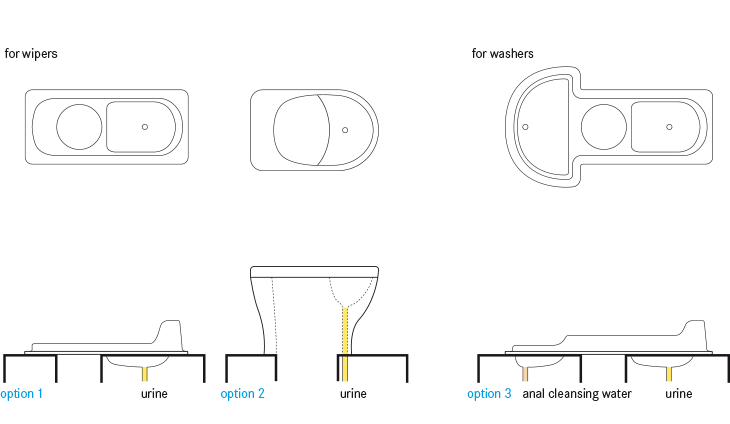
There are a wide range of urine-diversion pans and pedestals available for use in UDDT. For worldwide listing of suppliers please see MUENCH (2010).

Left: Urine-diversion squatting pan with anal cleansing water collection bowl (made from fibre-reinforced plastic). Source: WAFLER (2010). Right: Ceramic urine-diversion pedestal with separate bowl for collection of anal cleansing water. Source: UNESCO-IHE (n.y.) 


Costs Considerations

(adapted from MUENCH 2009)

The construction of a UDDT can usually be done with locally available materials and labour. Prefabricated parts may include toilet seats or squatting pans. If those parts do not need to be imported from abroad, they are usually cheap and can be even cheaper than self-constructed squatting pans made from cement. Squatting pans made of ceramics which are not very costly and easy to maintain, are also available. The construction costs of a double-vault UDDT are slightly higher than the construction costs for a VIP or pit latrine. Single-vault UDDTs can be constructed very cheaply, depending on the creativity of the constructors and the locally available materials.

Operation and Maintenance

(adapted from TILLEY et al. 2008)

A UDDT is slightly more difficult to keep clean than other toilets because of both the lack of water and the need to separate the solid faeces and liquid urine. For cleaning, a damp cloth may be used to wipe down the seat and the inner bowls. Special care should be taken to prevent cleaning water from entering the vaults. Some toilets are easily removable and can be cleaned more thoroughly. No design will work for everyone and therefore, some users may have difficulty separating both streams perfectly which may result in extra cleaning and maintenance. A detailed “To-do list for operation and maintenance” is compiled in MUENCH (2009). Greywater from kitchen, bathrooms, laundry areas, etc. must not be disposed off in the UDDT, but be taken care of individually (e.g. applied to greywater towers, vertical gardens or surface, horizontal or vertical flow constructed wetlands, etc.).

Additives

Plant ash, lime, dried soil or sawdust can be added after each defecation as a bulking agent to enhance the drying process (JOENSSEN et al. 2004). The immediate coverage of the fresh faeces with an additive material can considerably lower nuisances caused by odour or flies. Faster drying also means that the biological degradation is small if sufficient additive is used and thus, the losses of organic matter and N from the faeces to the air are small (JOENSSEN et al. 2004). Ash and lime have the additional beneficial effects of raising pH, which leads to improved pathogen die-off (JOENSSEN et al. 2004). The addition of ash and lime should therefore be preferred (SCHOENNING & STENSTROEM 2004).

Health Aspects and Acceptance

(adapted from: TILLEY et al. 2008)

The UDDT is not intuitive or immediately obvious to some users. At first, users may be hesitant about using it, and mistakes (e.g. faeces in the urine bowl) may deter others from accepting this type of toilet as well. Education and demonstration projects are essential in achieving good acceptance with users.

At a Glance

Working Principle

Urine-diversion dehydration toilets (UDDTs) make use of desiccation (dehydration) processes for the hygienically safe on-site treatment of human excreta. UDDTs divert all liquids (i.e. urine and anal cleansing water, if applicable) from the faeces to keep the processing chamber contents dry. Adding wood ash, lime, etc. after each defecation helps in lowering moisture content and raise the pH. The system thus creates conditions of dryness, raised pH and time for pathogen die-off.

Capacity/Adequacy

UDDTs are mainly suitable for regions with high average temperatures, long dry and short rainy seasons or arid climatic conditions with high evaporation rates. Nevertheless, with the right designs, they can also work in a more humid climate and it is also possible to utilise a UDDT in regions with cold climate conditions. There should be a need for humanure or urine as fertiliser.

Performance

Depends strongly on user’s operation and maintenance

Costs

Moderate investment costs and low operation costs

Self-help Compatibility

Can be produced with locally available material. Operation is simple but staff/community should be trained.

O&M

Addition of drying material to the faeces after each use. Removal of faeces when vaults are full and changing of urine tanks. Control in order to prevent liquid infiltration into the dehydration chambers.

Reliability

High, if the processing chamber(s) are kept dry.

Main strength

Low-tech and no requirement of energy.

Main weakness

Education and demonstration projects are essential in achieving good acceptance with users.

Applicability

UDDTs are mainly suitable for regions with high average temperatures, long dry and short rainy seasons or arid climatic conditions with high evaporation rates. Nevertheless, with the right designs, they can also work in a more humid climate and it is also possible to utilise a UDDT in regions with cold climate conditions. UDDTs are waterless systems that are particularly suitable for conditions where water is scarce or expensive. The products of UDDTs, collected urine and humanure, are both valuable fertiliser and need to be either reused correctly on-site or transported to a site where they can be reused or discharged correctly. Therefore, UDDTs are particularly adapted for households or communities with need for such types of fertilising products. UDDTs are suitable for various cultural settings: they can be designed to suit both sitting and squatting cultures and to cope with the use of water for wet anal cleaning cultures as well (MUENCH 2009). 

Advantages

  • Suitable for hard rock soil areas, high ground water levels and areas prone to flooding
  • no contamination of groundwater sources due to contained processing of human faeces
  • Single-vault UDDTs have very low construction costs and are more in the communal setting
  • They allow for an easy treatment and reuse of excreta
  • Urine can be used directly as a fertilizer
  • No need for water
  • Simple in construction

Disadvantages

  • Double-vault UDDTs require large surface area for construction
  • Possibility of smell if not well operated and too much liquid (urine, anal cleansing water, etc.) enters the processing compartment
  • Regular shifting of containers from single-vaults
  • Transport of not yet hygienised human excreta to secondary storage and/or processing site may be required
  • Difficult to use for small children

References Library

BLUME, St. (2009): Cost Optimization of Single Door UDDTs - Final Draft. URL [Accessed: 07.07.2010]. PDF

TILLEY, E.; LUETHI, C.; MOREL, A.; ZURBRUEGG, C.; SCHERTENLEIB, R. (2008): Compendium of Sanitation Systems and Technologies. Duebendorf and Geneva: Swiss Federal Institute of Aquatic Science and Technology (EAWAG). URL [Accessed: 15.02.2010]. PDF

MUENCH, E. (2009): Urine-Diversion Dehydration Toilets. Eschborn: German Agency for Technical Cooperation (GTZ) GmbH. URL [Accessed: 07.07.2010]. PDF

MUENCH, E., v.; WINKER, M.; GTZ (Editor) (2009): Urine diversion components. Overview of Urine Diversion Components such as Waterless Urinals, Urine Diversion Toilets, Urine Storage and Reuse Systems. Eschborn: German Agency for Technical Cooperation (GTZ) GmbH. URL [Accessed: 27.07.2010]. PDF

MUENCH, E., v.; WINKER, M.; GIZ (Editor) (2011): Appendix 1 for technology review of urine diversion components. Worldwide listing of suppliers for waterless urinals. Eschborn: Deutsche Gesellschaft für Internationale Zusammenarbeit (GIZ) GmbH. URL [Accessed: 29.04.2011]. PDF

MUENCH, E., v.; WINKER, M.; GIZ (Editor) (2011): Appendix 2 of technology review of urine diversion components. Worldwide listing of suppliers for urine diversion squatting pans (for UDDTs or for urine diversion flush toilets). Eschborn: Deutsche Gesellschaft für Internationale Zusammenarbeit (GIZ) GmbH. URL [Accessed: 29.04.2011]. PDF

MUENCH, E., v.; WINKER, M.; GIZ (Editor) (2011): Appendix 3 of technology review of urine diversion components. Worldwide listing of suppliers for urine diversion pedestals/seats (for UDDTs or for UD flush toilets). Eschborn: Deutsche Gesellschaft für Internationale Zusammenarbeit (GIZ) GmbH. URL [Accessed: 29.04.2011]. PDF

JOENSSON, H.; RICHERT, A.; VINNERAAS, B.; SALOMON, E. (2004): Guidelines on the Use of Urine and Faeces in Crop Production . Stockholm: EcoSanRes. URL [Accessed: 17.04.2012]. PDF

SCHOENNING, C.; STENSTROEM, T.A. (2004): Guidelines on the Safe Use of Urine and Faeces in Ecological Sanitation Systems. Stockholm: Stockholm Environment Institute (SEI). PDF

WINDBLAD, U.; SIMPSON-HERBERT, M. (2004): Ecological Sanitation - revised and enlarged edition. (pdf presentation). Sweden: Stockholm Environment Institute. URL [Accessed: 04.08.2010]. PDF

Further Readings Library

Reference icon

RIECK, C.; MUENCH, E. von; HOFFMANN, H. (2012): Technology Review of Urine Diversion Dehydration Toilets (UDDTS). Eschborn: Deutsche Gesellschaft für Internationale Zusammenarbeit (GIZ). URL [Accessed: 18.03.2013]. PDF

This technology review – which is part of GIZ’s series of technology reviews on sustainable sanitation technologies – deals with urine diversion dehydration toilets (UDDTs) and has recently been updated and restructured. It is putting the focus on general design aspects for double vault UDDTs, specific settings, costs, operation and maintenance and practical experiences. The UDDT is portrayed as a valid sanitation alternative for rural and urban areas in cases when other conventional systems (sewer systems or pit latrines) are not suitable.


Reference icon

MUENCH, E., v.; WINKER, M.; GIZ (Editor) (2011): Appendix 1 for technology review of urine diversion components. Worldwide listing of suppliers for waterless urinals. Eschborn: Deutsche Gesellschaft für Internationale Zusammenarbeit (GIZ) GmbH. URL [Accessed: 29.04.2011]. PDF

This document contains a worldwide list of suppliers for waterless urinals. The tables of suppliers provided here are not complete listings but give only an indication of available products. If you spot errors or omissions, please contact the authors at ecosan@giz.de. In the brackets below each listing the date for provision of the information/last update of information is given. Please be aware that not all information is from 2011. An entry in this list does not imply a recommendation by GIZ. Costs are indicative only.


Reference icon

MUENCH, E., v.; WINKER, M.; GIZ (Editor) (2011): Appendix 2 of technology review of urine diversion components. Worldwide listing of suppliers for urine diversion squatting pans (for UDDTs or for urine diversion flush toilets). Eschborn: Deutsche Gesellschaft für Internationale Zusammenarbeit (GIZ) GmbH. URL [Accessed: 29.04.2011]. PDF

This document contains a worldwide list of suppliers for urine diversion squatting pans. The tables of suppliers provided here are not complete listings but give only an indication of available products. If you spot errors or omissions, please contact the authors at ecosan@giz.de. In the brackets below each listing the date for provision of the information/last update of information is given. Please be aware that not all information is from 2011. An entry in this list does not imply a recommendation by GIZ. Costs are indicative only.


Reference icon

MUENCH, E., v.; WINKER, M.; GIZ (Editor) (2011): Appendix 3 of technology review of urine diversion components. Worldwide listing of suppliers for urine diversion pedestals/seats (for UDDTs or for UD flush toilets). Eschborn: Deutsche Gesellschaft für Internationale Zusammenarbeit (GIZ) GmbH. URL [Accessed: 29.04.2011]. PDF

This document contains a worldwide list of suppliers for urine diversion pedestals/seats (for UDDTs or for UD flush toilets). The tables of suppliers provided here are not complete listings but give only an indication of available products. If you spot errors or omissions, please contact the authors at ecosan@giz.de. In the brackets below each listing the date for provision of the information/last update of information is given. Please be aware that not all information is from 2011. An entry in this list does not imply a recommendation by GIZ. Costs are indicative only.


Reference icon

ECOSAN CLUB (Editor) (2011): Toilets. Vienna: Ecosan Club. URL [Accessed: 01.01.1970]. PDF


Reference icon

BLUME, St. (2009): Cost Optimization of Single Door UDDTs - Final Draft. URL [Accessed: 07.07.2010]. PDF

The report provides a detailed description and cost analysis for single door double-vault urine diversion dehydration toilets (UDDTs) in Kenya. Furthermore, optimizations are identified for different components of the UDDT design.


Reference icon

OKETCH, M. (2005): Systems for Enhancing Ventilation for Improved Control of Odour and Fly Nuisance in Dry Urine Diverting Ecological Sanitation Toilets. URL [Accessed: 22.07.2010]. PDF

This research report described information for improved ventilation, fly and odour control as well as impact of improved ventilation on drying within faecal chambers and pathogen die-off in dehydration toilets.


Reference icon

GROTH, F. (2005): Ventilation of dry toilets. Pinkafeld: Fachhochschulstudiengänge Burgenland GmbH. URL [Accessed: 11.08.2010]. PDF

This thesis aims at showing possibilities to improve ventilation standards of dry toilet facilities. Therefore, numerous structures were monitored over a period of three months, from March to June, in the southwestern districts of Uganda. The considerations and recommendations of this paper should support further development and improve future toilet structures in view of ventilation practices and design purviews. It should therefore contribute to a higher quality and acceptance of the dry toilets in the long term.


Reference icon

WAFLER, M. (2008): Assessment of Urine-Diversion Dehydration Toilet Designs with Respect to Construction Materials Used and Associated Costs. URL [Accessed: 07.07.2010]. PDF

The document compiles the assessment of different UDDTs designs with respect to the construction materials used (e.g. country burned bricks, cement hollow blocks, ferro-cement, etc.) and their associated construction costs. Optimization and cost estimates are based upon the assessment of various designs of UDDTs applied in India and bills of quantity (BOQ).


Reference icon

GENSCH, R. ; MISO, A.; ITSCHON, G. (2011): Urine as Liquid Fertilizer in Agricultural Production in the Philippines. Cagayan de Oro: Sustainable Sanitation Center Xavier University (XU), the Philippine Sustainable Sanitation Knowledge Node, the Philippine Ecosan Network, and the Sustainable Sanitation Alliance (SuSanA). URL [Accessed: 04.05.2011]. PDF

This field guide has been developed to accommodate the ever-increasing demand for more detailed and scientifically backed information on how to use urine in agricultural production. It is intended primarily for practitioners and experts in the water, sanitation, planning, and agriculture sectors, as well as local and national government officials from the various sectors, NGO and individuals interested and working in the field of agriculture and sustainable sanitation in the Philippines and the wider Southeast Asian region.


Reference icon

GENSCH, R.; MISO, A.; ITCHON, G.; SAYRE, E. (2010): Low-Cost Sustainable Sanitation Solutions for Mindanao and the Philippines. A Practical Construction Field Guide. Cagayan de Oro City: Xavier University. URL [Accessed: 06.10.2011]. PDF

After a brief introductory chapter on the Philippine sanitation situation and basic principles of sustainable sanitation, the manual focuses on the introduction of different low-cost sanitation solutions comprising the arborloo toilet, the 1-chamber and 2-chamber UDDT, hanging UDDTs, and the ecopee urinal. Each technology is briefly described by giving general information on how it works, operation and maintenance requirements, reuse or safe disposal options, and in which setting this technology might be appropriate. In addition, a picture-based guide on how to construct each technology is provided as well as the necessary technical drawings and rough cost estimates based on current prices. Since a sanitation system does not end with the toilet itself, the last chapter also provides information on the overall management of the system including collection, transport, treatment, and final reuse of urine, feces and composting products in agriculture.


Reference icon

WATER AID (Editor) (2011): Construction of Ecological Sanitation Latrine. Kathmandu: Water Aid. URL [Accessed: 19.10.2011]. PDF

This document sets out the principles for adopting an ecological sanitation approach, as well as providing guidance on the construction ecological sanitation latrines and their operation. It is intended to support sanitation field practitioners and WaterAid in Nepal ’s partners in the delivery of appropriate services and technologies to fit the needs of different users. .It is also equally hoped that this document will be of value to other organisations and sector stakeholders involved in sanitation promotion and ecological sanitation.


Reference icon

MONVOIS, J.; GABERT, J.; FRENOUX, C.; GUILLAUME, M. (2010): How to Select Appropriate Technical Solutions for Sanitation. Cotonou and Paris: Partenariat pour le Développement Municipal (PDM) and Programme Solidarité Eau (pS-Eau). URL [Accessed: 19.10.2011]. PDF

The purpose of this guide is to assist local contracting authorities and their partners in identifying those sanitation technologies best suited to the different contexts that exist within their town. The first part of the guide contains a planning process and a set of criteria to be completed; these assist you in characterizing each area of intervention so that you are then in a position to identify the most appropriate technical solutions. The second part of the guide consists of technical factsheets which give a practical overview of the technical and economic characteristics, the operating principle and the pros and cons of the 29 sanitation technology options most commonly used in sub-Saharan Africa.


Reference icon

TOUBKISS, J. (2010): How to Manage Public Toilets and Showers. Cotonou and Paris: Partenariat pour le Développement Municipal (PDM) and Programme Solidarité Eau (pS-Eau). URL [Accessed: 19.10.2011]. PDF

The purpose of this decision-making aid is to provide practical advice and recommendations for managing toilet blocks situated in public places. It is primarily aimed at local decision-makers in developing countries and at their partners (project planners and managers).


Reference icon

VISHWANATH, S.; VISHWANATH, C. (n.y.): Composting Toilets – The Future of Sanitation?. URL [Accessed: 11.08.2010]. PDF

Well-illustrated article describing the principle of ecosan and dry composting toilets applied to a household.


Reference icon

CANADAY, C. (2011): Simple Urine-diverting Dry Toilets (UDDTs) Built with Recycled or Readily Available Materials. Pastaza: Omaere Ethnobotanical Park. URL [Accessed: 22.02.2012]. PDF

The goal of this paper is to show that conversion to using UDDTs can be more a matter of shifting paradigms than capital investment. People can learn the concept and apply it on their own, with materials that they already have access to.


Case Studies Library

Reference icon

DEEGENER, S.; SAMWEL, M.; ANAKHASYAN, E. (2009): UDD Toilets in Rural School Hayanist, Armenia. Eschborn: Sustainable Sanitation Alliance (SuSanA). URL [Accessed: 07.07.2010]. PDF

This case study reports the establishment of a sustainable, affordable and safe school sanitation system in a rural area in Armenia. A total number of 7 Double-Vault UDDTs serve ca. 350 students (females and males) and 26 staff members. Urine is stored for 6 months before application.


Reference icon

DUSINGIZUMUREMYI, E. (2010): Urine Diversion Dehydration Toilets in Rural Schools Huye and Ngororero Districts, Rwanda. Eschborn: Sustainable Sanitation Alliance (SuSanA). URL [Accessed: 11.08.2010]. PDF

This case study reports the establishment of single vault UDDTs as a pilot and demonstration project in Rwanda to test the new concept of ecological sanitation with UDDTs in rural primary schools and provide a healthy school environment. Because of the high number of users and the anticipated amount of faeces to be collected per day, UDDTs with a single vault were chosen. The faeces are sanitised in a separate drying shelter.


Reference icon

FALL, A. (2009): Urban Urine Diversion Dehydration Toilets and Reuse Ouagadougou Burkina Faso - Draft. Eschborn: Sustainable Sanitation Alliance (SuSanA). URL [Accessed: 07.07.2010]. PDF

This case studies reports form the implementation of ecosan toilets in the peri-urban area of Ouagadougou financed by the European Union. The aim of the project was to demonstrate ecosan on an urban level with a centralised collection and treatment facilities and commercialisation of hygienised urine and faeces.


Reference icon

HOLMER, R.; SuSanA (Editor) (2009): UDD Toilets with Reuse in Allotment Gardens.. (pdf presentation). Cagayan de Oro Philippines: Sustainable Sanitation Alliance. URL [Accessed: 11.08.2010]. PDF

Case study on an urban agriculture project with urine reuse in Northern Mindanao, Philippines.


Reference icon

KASSA, K. (2010): Urine Diversion Dry Toilet (UDDT) for Agafari´s Household, Arba Minch, Ethiopia. Eschborn: Sustainable Sanitation Alliance (SuSanA). URL [Accessed: 12.12.2012]. PDF

This case study reports the replacement of pit latrine with UDDT at one household in Arba Minch, Ethiopia. A single-vault UDDT serves family members and rural merchants staying overnight. Urine is applied for banana, mango and lemon plants and the dried excreta are co-composted along with organic material in the owner’s farmland.


Reference icon

KASSA, K. (2010): UDD Toilets for Nelson Mandela Private School, Arba Minch, Ethiopia. Eschborn: Sustainable Sanitation Alliance (SuSanA). URL [Accessed: 11.08.2010]. PDF

This case study reports replacement of pit latrines with a UDDT block (six single-vault UDDTs) for Nelson Mandela School, a private school from grade 1 to 9 with a total of 200 students and teachers, in Arba Minch, Ethiopia. The school staff operates and maintains the toilet (storage conditions of excreta, urine, hand washing facilities, cleaning of toilets, provision of drying agent like ash). The school janitor is responsible for providing the drying agents.


Reference icon

LIPKOW, U. (2009): Urine-Diversion Dehydration Toilets in Rural Areas, Bayawan City, Philippines. Eschborn: Sustainable Sanitation Alliance (SuSanA) . URL [Accessed: 07.07.2010]. PDF

In Bayawan City (Philippines), UDDTs were installed on household and public level. Vegetable growers and small-scale farmers use the fertilising products.


Reference icon

LORENZ, St.; KHAWAJA, N. (2010): Rural Urine Diversion Dehydration Toilets (after 6 years), Hanahai and Paje villages, Botswana. Eschborn: Sustainable Sanitation Alliance (SuSanA) . URL [Accessed: 11.08.2010]. PDF

This case study reports the project history and lessons learnt (after 6 years) from construction of a total o 42 UDDTs in two villages in Botswana.


Reference icon

MNKENI, P.N.S.; AUSTIN, L.M. (2009): Fertiliser value of human manure from pilot urine-diversion toilets. Fort Hare and Pretoria: Department of Agronomy, Faculty of Science and Agriculture, University of Fort Hare and CSIR Built Environment Unit. URL [Accessed: 05.01.2011]. PDF

This study, evaluates the effectiveness of human manure as a source of nutrients using cabbage as a test crop at Ntselamanzi location, Alice, South Africa as part of a project intended to generate knowledge and good practice in ecological sanitation.


Reference icon

MUCHIRI, E.; MUTUA, B. (2010): UDD Toilets at a Church and Nursery School, Nakuru, Kenya – Draft. Eschborn: Sustainable Sanitation Alliance (SuSanA). URL [Accessed: 12.12.2012]. PDF

This case study reports the improvement on sanitation by establishing two single-vault UDDTs, one double-vault UDDT and a urinal for a population of 50 church members and 25 children in Nakuru, Kenya. Dry faecal matter from the UDDT is applied around banana plants and trees, and urine is used to grow corn and vegetables on an experimental basis.


Reference icon

MUCHIRI, E.; MUTUA, B. (2010): Urine Diversion Dehydration Toilets at a Residential Plot, Nakuru, Kenya - Draft. Eschborn: Sustainable Sanitation Alliance (SuSanA). URL [Accessed: 12.12.2012]. PDF

This case study reports the design and construction of a toilet block consisting of three single vault UDDTs for a population of 28 households at a residential plot in Hilton estate, a high-density low-income settlement in the North-Western part of Nakuru Town. To overcome problems associated to the misuse of the toilets by visitors and strangers who were not familiar with the proper use, a new toilet management system has been put in place, where the three UDDTs are divided among the 28 households, who are supposed to take care and maintain the toilets.


Reference icon

MUELLEGGER, E.; SCHLICK, J.; WERNER, Ch. (2009): UDD Toilets at a Girls Secondary School, Kalungu, Uganda. Eschborn: Sustainable Sanitation Alliance (SuSanA). URL [Accessed: 11.08.2010]. PDF

This case study reports upgrading of water supply and sanitation facilities for 350 students and 50 teachers at the girls boarding school of the “Sacred Heart Sisters” in Kalungu, Uganda. For the students, the existing pit latrines were replaced by 45 UDDTs, which are in line with the “National Strategy to promote ecological sanitation in Uganda”. For the teachers, a UDDT building was constructed near the entrance of the school to serves as a demonstration unit for visitors. The remaining wastewater (greywater with a small share of black water from the sisters' house where three flush toilets are still used) is treated in a horizontal sub-surface flow constructed wetland.


Reference icon

NETWAS ; EcoSanRes; SEI (2011): Ecological Sanitation in Uganda. Inspirational Success Stories from the Field. Kampala: NETWAS Uganda. URL [Accessed: 29.08.2011]. PDF

This document presents a range of different projects implemented in Uganda around ecological sanitation, such as school sanitation, biogas and sludge treatmemt. These documented cases have been compiled in completion of a 15 months Ecological Sanitation Research Project implemented by Network for Water and Sanitation (NETWAS) Uganda as the ecosanres Uganda Knowledge Node with support from the Stockholm Environment Institute (SEI).


Reference icon

RIECK, Ch. (2010): UDDTs Implemented by the Water Services Trust Fund, Kenya – Draft. Eschborn: Sustainable Sanitation Alliance (SuSanA). URL [Accessed: 11.08.2010]. PDF

This case study reports the construction of more than 1,000 double-vault UDDTs in Kenya. Various samples of urine and dried faeces taken over a period of three months were analysed and results show a sufficient rate of pathogen die-off in faeces if the toilets are used properly. Urine is directly applied (diluted 1:1 – 1:10) to plants such as kales, spinach, maize, mangos and bananas in the farms once the jerry cans are full.


Reference icon

SAYRE, E.; MUENCH, E. (2009): Rural Community and School UDD Toilets in Misamis Oriental, Libertad, Initao and Manticao, Philippines. Eschborn: Sustainable Sanitation Alliance (SuSanA) . URL [Accessed: 11.08.2010]. PDF

This case study reports the establishment of 23 community ecosan UDDTs at “barrio centres” and at primary schools (at 14 different locations), frequented by an estimated total of 1,000 people in the province Misamis Oriental, Philippines. The double-vault UDDT design was adopted from ecosan projects of the allotment gardens in Cagayan de Oro City. The concrete urine-diversion pedestals are manufactured by the WAND Foundation. Urine is diluted with water (1:15 dilution) and is used as fertilizer in household vegetable gardens, fruit orchards, and seedling nurseries where the seedlings are raised. When both faeces vaults are full (approximately one year for each vault, so 2 years in total), the faeces will be further decomposed in a vermicomposting process before being used as soil conditioner.


Reference icon

SENZIA, M.A. (2010): Urine Diversion Dehydration Toilets for Households, Arusha, Tanzania – Draft. Eschborn: Sustainable Sanitation Alliance (SuSanA) . URL [Accessed: 11.08.2010]. PDF

This case study reports pilot-scale implementation of UDDTs for eight households in Arusha, Tanzania. The UDDT technology was adopted from the NGO EEPCO (Environmental Engineering and Pollution Control Organization), and chosen due to the fact that the structure is permanent and there is the possibility of using the products from the toilet for local agriculture. Urine is used at the farms around the households as fertilizer.


Reference icon

SENZIA, M.A. (2010): UDDTs for a Primary School, Arusha, Tanzania - Draft. Eschborn: Sanitation Alliance (SuSanA) . URL [Accessed: 11.08.2010]. PDF

This case study reports construction of two double-vault UDDT demonstration toilets for 56 teachers from Daraja II primary school, Arusha, Tanzania. The school has a total of 2,457 students who share 17 pit latrines. The idea was to give the teachers time to understand the resource oriented concepts and especially the O&M part with their own facilities. In the future, when the teachers are familiar with the project, the project may be upscaled.


Reference icon

WAFLER, M. (2009): Sanitation Improvements at Navsarjan Boarding Schools, Gujarat, India – Draft. Eschborn: Sustainable Sanitation Alliance (SuSanA). URL [Accessed: 11.08.2010]. PDF

This case study reports design and construction of UDDTs at 3 primary boarding schools (with up to 210 pupils each) in rural Gujarat, India. The “compost” (i.e. desiccated faeces and cover material) and urine are applied as soil conditioner and nitrogen-rich liquid fertilizer to flower beds, kitchen gardens, etc.


Reference icon

WOLF, H.; ZOCH, B. (2010): Urine Diversion Dehydration Toilets in Rural Schools, Yemen – Draft. Eschborn: Sustainable Sanitation Alliance (SuSanA) . URL [Accessed: 11.08.2010]. PDF

This case study reports the construction of UDDTs at 30 schools in rural areas (desert areas, tropical low land, and mountains) in Yemen. Rainwater harvesting is the only economic way to provide water in the toilets. If the rainwater is insufficient, the water has to be bought and delivered by a water truck (which is expensive). Due to the resentments among the local population the reuse of urine was not a priority of the project.


Awareness Raising Material Library

Reference icon

WECF (Editor) (2010): How to Separate Urine. Utrecht/Munich/Annemasse: Women in Europe for a Common Future. URL [Accessed: 06.01.2011]. PDF

This flyer contains information about the importance of urine reuse. The nutrients in urine are easily taken up by plants. The fertilised plant will grow faster, develop more leaves and produce higher yields. Applying urine to crops instead of chemical fertilisers saves money and energy and produces a similar yield. One person produces about 500 liter urine per year.


Reference icon

ECOSAN PROMOTION PROJECT (Editor) (2008): Using the Ecosan Toilet. URL [Accessed: 07.07.2010]. PDF

This poster illustrates and explains how to properly used a urine-diversion dehydration toilet.


Reference icon

GTZ (Editor) (2008): Dry Toilets – Planning Process. Demonstration Unit in Adama. German Agency for Technical Cooperation (GTZ) GmbH. URL [Accessed: 11.08.2010]. PDF

Presentation of an integrated ecosan project in Ethiopia.


Reference icon

DUNCAN, D. (2008): Is it Time to kill off the Flush Toilet?. In: TIME.com. URL [Accessed: 10.08.2008]. PDF

Critical article on the conventional flush-and-forget toilet systems on the occasion of the World Toilet Summit and Expo in Macau.


Reference icon

MoHN (Editor) (2007): Introduction of Ecological Sanitation (Ecosan) - Urine Diversion Dry Toilet (UDDT) into he Public Health System. Colombo: Ministry of Healthcare and Nutrition (MoHN) (Sri Lanka). PDF

This document shows how the government of Sri Lanka has accepted dry composting toilets as a appropriate on-site sanitation system.


Reference icon

UNKNOWN (2006): Comment Utiliser Cette Latrines. URL [Accessed: 07.07.2010]. PDF

This poster illustrates and explains the “Do’s” and “Don’ts”


Reference icon

UNKNOWN (n.y.): The 21st Century Toilets Produce Fertilizer Instead of Waste Water. URL [Accessed: 07.07.2010]. PDF

This trilingual (French, English, and Arabic) poster illustrates and explains how to properly used a urine-diversion dehydration toilet.


Reference icon

UNKNOWN (n.y.): Les toilettes du 21 Siècle ne produisent pas d’eaux usées, mais de l’engrais. URL [Accessed: 07.07.2010]. PDF

This bi-lingual (French and Arabic) poster illustrates and explains how to properly used a urine-diversion dehydration toilet.


Training Material Library

Reference icon

ESF (Editor) (2009): Urine Diversion Dehydration Toilet (UDDT) - Construction Manual. Pune: Ecosan Services Foundation (ESF). URL [Accessed: 07.07.2010]. PDF

Design and construction manual on that also provides information on the nutrient value of human urine and faecal matter, general hygiene aspects, the reuse of sanitized urine and faecal matter, and costs of various Indian UDDT designs.


Reference icon

DEGENER, S.; SAMWEL, M.; GABIZON, S. (2006): Urine Diverting Toilets Principles, Operation and Construction. Utrecht/Munich: Women in Europe for a Common Future (WECF). URL [Accessed: 08.10.2010]. PDF

All about dry urine diversion toilets, from the principles, design, construction and operation


Reference icon

RIECK, C.; MUENCH, E. von; HOFFMANN, H. (2012): Technology Review of Urine Diversion Dehydration Toilets (UDDTS). Eschborn: Deutsche Gesellschaft für Internationale Zusammenarbeit (GIZ). URL [Accessed: 18.03.2013]. PDF

This technology review – which is part of GIZ’s series of technology reviews on sustainable sanitation technologies – deals with urine diversion dehydration toilets (UDDTs) and has recently been updated and restructured. It is putting the focus on general design aspects for double vault UDDTs, specific settings, costs, operation and maintenance and practical experiences. The UDDT is portrayed as a valid sanitation alternative for rural and urban areas in cases when other conventional systems (sewer systems or pit latrines) are not suitable.


Reference icon

HESPERIAN FOUNDATION (Editor) (2004): Sanitation & Cleanliness for a Healthy Environment. The Hesperian Foundation in Collaboration with the United Nations Development Programme (UNDP). URL [Accessed: 01.08.2010]. PDF

This booklet is a chapter from “A Community Guide to Environmental Health”. It offers basic information and learning activities to help communities understand and prevent sanitation-related health problems. The booklet includes instructions for building several kinds of latrines, as well as ecological sanitation solutions.


Reference icon

NETSSAF (Editor) (n.y.): Ecosan Latrine Training — Section 1. URL [Accessed: 07.07.2010]. PDF

This training material is comprised of flipchart illustrations on how to use a UDDT and a note to community officers on how to use the flipcharts.


Reference icon

NETSSAF (Editor) (n.y.): Ecosan Latrine Training — Section 2. URL [Accessed: 07.07.2010]. PDF

This training material is comprised of flipchart illustrations on how to use a UDDT and a note to community officers on how to use the flipcharts.


Reference icon

CASTILLO-CASTILLO, L. (2002): Sanitario Ecologico Seco. Manual de diseno, construccion, uso y mantenimiento. Guadalajara. PDF

This presentation contains all important information about ecological toilets (construction, functioning, O&M, etc.), and it is complemented with many illustrations and technical drawings.


Reference icon

HOFFMANN, H. (2012): Construction of Bench Style Double Vault Urine Diversion Toilet and Alternatives. Lima: Rotaria del Peru SAC. URL [Accessed: 26.03.2012]. PDF

The use of Urine Diversion (UD) in dry toilets allows faeces dehydration. Urine can be reused as urea, while faeces are dried in a double vault system of alternate use. The moisture comes out using ventilation pipes. After 2 years the end product can be emptied and reused without having any health risk. Water from washing can be treated in a constructed wetland and reused for instance for irrigation.


Important Weblinks

http://www.susana.org/

The official website of the Sustainable Sanitation Alliance SuSanA. SuSanA is a loose network of a number of organizations active in the field of sanitation, founded in 2007. The goals and objectives of SuSanA are to contribute to the achievement of the MDGs, to raise awareness on what sustainable sanitation solutions are and to promote them on a larger scale. The website contains a number of factsheets by the different SuSanA working groups on various subjects related to sustainable sanitation. There is section where everyone can upload important documents.

http://www.youtube.com/ [Accessed: 11.08.2010]

Green Toilet Talks (Part 1): A Documentary on Ecological Sanitation, explaining compost toilets.

http://www.youtube.com/ [Accessed: 11.08.2010]

Green Toilet Talks (Part 2): A Documentary on Ecological Sanitation, explaining compost toilets

http://www.youtube.com/ [Accessed: 11.08.2010]

Excellent documentary on the UDDTs in Bangalore (India).