


Executive Summary
The Logical Framework Approach (LFA) is a highly effective strategic planning and project management methodology with wide application. It is particularly valuable for water management and sanitation projects, especially because water ― the resource base ― has diverse and competing uses. It comprises an integrated package of tools for analysing and solving planning problems and for designing and managing their solutions (the approach). The product of this analytical approach is the logframe (the matrix), which summarises what the project intends to do and how, what the key assumptions are, and how outputs and outcomes will be monitored and evaluated.
Introduction
The Logical Framework Approach (LFA) is an analytical process and set of tools used to support project planning and management. According to the World Bank (2000), “the Logical Framework has the power to communicate the essential elements of a complex project clearly and succinctly throughout the project cycle. It is used to develop the overall design of a project, to improve the project implementation monitoring and to strengthen periodic project evaluation” (see also participatory monitoring and evaluation). It provides a set of interlocking concepts which are used as part of an iterative process to aid structured and systematic analysis of a project or programme idea (EUROPEAN COMMISSION 2004).
LFA is best started early in activity design, and should be thought as an ‘aid to thinking’. It allows information to be analysed and organised in a structured way, so that important questions can be asked, weaknesses identified and decision makers can make informed decisions based on their improved understanding of the project rationale, its intended objectives and the means by which objectives will be achieved (EUROPEAN COMMISSION 2004). A frequent problem with the application of the logframe approach is that the planning process and the preparation of the matrix are carried out separately from the project proposal or the budget, resulting in inconsistencies between the contents of the logframe matrix and the description of the project contained in the narrative of the main documents. Therefore, the application of the LFA should come first, and then provide the needed information for completing the other required documents.
There is a clear distinction between the Logical Framework Approach and the Logical Framework Matrix. The first refers to the steps involved in planning and designing the project. These steps include a stakeholder analysis, cause-effect analysis, objectives analysis, and alternatives analysis culminating in the design of the project. The matrix, which summarises the final design of the project, usually comprises 16 frames organised under 4 major headings (SALDANHA and WITTLE 2002).
Logical Framework Approach (Analytical Process)
(Adapted from AUSAID 2005)
Before starting with the activity design and the construction of the logframe matrix, it is important to undertake a structured analysis of the existing situation. LFA incorporates four main analytical elements to help guide this process:
- Problem Analysis: involves identifying what the main problems are and establishing the cause and effect relationships which result in, and flow from, these problems (see also problem and preference ranking, or problem tree analysis as methods for problem identification).
- Stakeholder Analysis: having identified the main problems and the cause and effect relationship between them, it is then important to give further consideration to who these problems actually impact on most, and what the roles and interests of different stakeholders might be in addressing the problems and reaching solutions (see also stakeholder identification).
- Analysis of Objectives: objective trees should be prepared after the problem tree has been completed and an initial stakeholder analysis (learn more about it starting by the stakeholder identification factsheet) has been undertaken. This will give an image of an improved situation in the future.
- Analysis of Strategies: comparison of different options to address a given situation.
The Logical Framework Matrix (Logframe)
The results of the stakeholder, problem, objectives and strategy analysis are used as the basis for preparing the Logical Framework Matrix. The Logical Framework Matrix (or more briefly the logframe) consists of a matrix with four columns and four (or more) rows, which summarise the key elements of a project plan and should generally be between 1 and 4 pages in length. However, this will depend on the scale and complexity of the project.
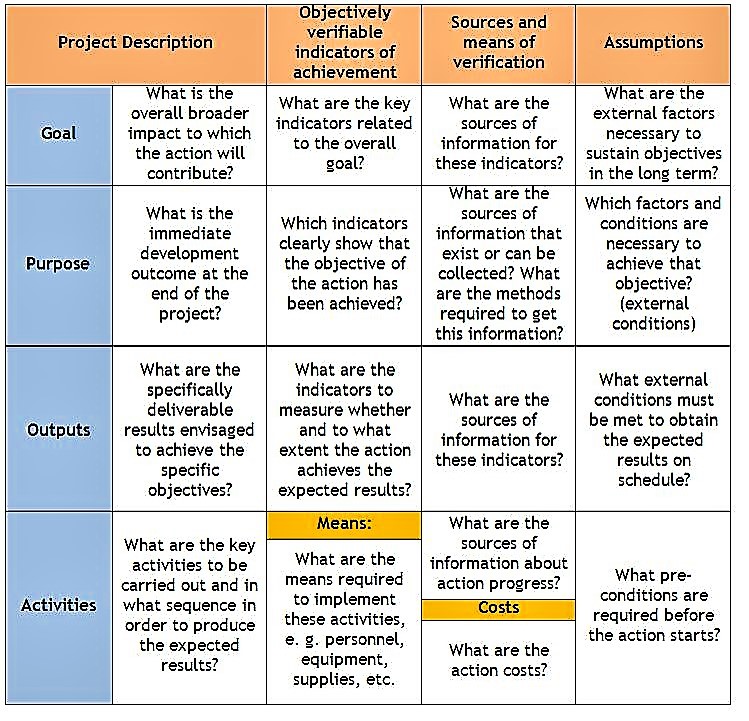
How to Prepare The Logical Framework Matrix?
(Methodology adapted from BOND 2003; examples taken from EUROPEAN COMMISSION 2004)
First Stage ― TOP DOWN:
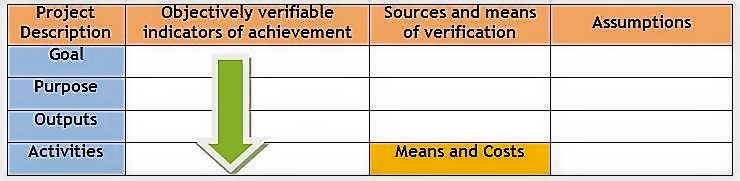
- Goal: starting at the top and using the information from the Objective Tree write the overall objective of the project. The overall objective may be beyond the reach of this project on its own, for instances: “To contribute to improved family health and the general health of the rive ecosystem”.
- Purpose: it describes the desired outcome that the project will achieve. This should be clear and brief. Example: “Improved river water quality”.
- Outputs: describe the project intervention strategy. There may be several outputs. Example: “1) Reduced volume of wastewater directly discharged into the river system by households and factories”.
- Activities: these are the tasks that are needed to achieve these outputs. There may be several for each output. Statements should be brief and with an emphasis on action words. Examples: “1.1) Conduct baseline survey of households and businesses; 1.2) Complete engineering specifications for expanded sewerage network, etc.”
- Inputs: when required to do so provide additional information, such as the means and costs, which are needed to carry out these activities.
Second Stage ― WORK ACCROSS:
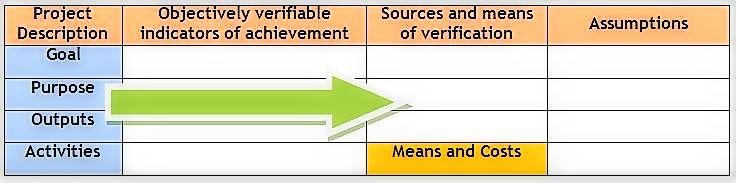
- Objectively verifiable indicators of achievement: starting from the top to the bottom of the hierarchy of the objectives, begin to work across the logframe identifying the Objective Verifiable Indicators for measuring the progress in terms of quantity, quality and time. There are two kinds of indicators: 1. Impact indicators: related to the overall goal, helps to monitor the achievement and the impact of the project. Example: “Incidence of water borne diseases, skin infections and blood disorders caused by heavy metals, reduced by 50% by 2008, specifically among low income families living along the river”. 2. Process (our outcome) indicators: related to the purpose and results. These measure the extent to which the stated objectives have been achieved. Example: “Concentration of heavy metal compounds (Pb, Cd, Hg) and untreated sewerage; reduced by 25% (compared to levels in 2003) and meets established national health/pollution control standards by end of 2007”.
- Sources and means of verification: the source of verification should be considered and specified at the same time as the formulation of indicators. This will help to test whether or not the indicators can be realistically measured at the expense of a reasonable amount of time, money and effort. The SOV should specify how, who and when the information will be gathered.
Third Stage ― BOTTOM UP:
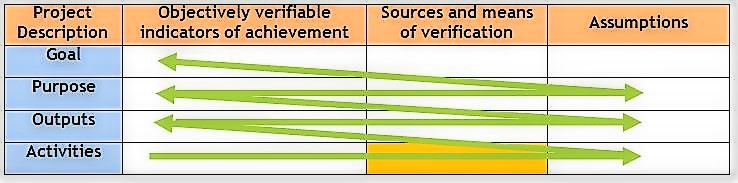
- Assumptions: reflecting up from the bottom of the logframe, consider how, if each assumption holds, it will be possible to move to the next stage of the project. Assumptions are external factors that have the potential to influence (or even determine) the success of a project, but lie outside the direct control of project managers. Assumptions are usually progressively identified during the analysis phase. The analysis of stakeholders, problems, objectives and strategies will have highlighted a number of issues (i.e. policy, institutional, technical, social and/or economic issues) that will impact on the project ‘environment’, but over which the project may have no direct control. In the case of the river water pollution example, important assumptions might include issues related to: 1. Rainfall and river flow (beyond the project’s control, but potentially critical in terms of changes in levels/concentration of pollutants found in the river); 2. Householders and businesses willingness to pay for improved sewerage connections.
The logframe is applied when planning, implementing and evaluating specific projects and programmes within an action plan. It is valuable for carrying out logical checks during project design as well as for monitoring progress and reviewing activities and output during project implementation (PHILIP et al. 2008).
Using LFA for project or program design imposes rigour in assessing what is to be achieved and the assumptions behind what interventions and activities will be required. Many international donors, such as the Asian Development Bank and the European Commission, require projects they fund to be designed according to an LFA (WUR 2010).
AusGuidelines 3.3 The Logical Framework Approach
These guidelines present the Logical Framework Approach, with the analysis of the situation and how to prepare the related matrix.
AUSAID (2005): AusGuidelines 3.3 The Logical Framework Approach. Sydney: Commonwealth of Australia URL [Accessed: 21.06.2019]Logical Framework Analysis
This short tutorial presents a three stages process to prepare the Logical Framework Matrix, with examples and tips.
BOND (2003): Logical Framework Analysis. London: BOND (Networking for International Development) URL [Accessed: 06.08.2010]Aid Delivery Methods, Project Cycle Management Guidelines
These Guidelines have been prepared to support ongoing improvements in the quality of EC development assistance. Part 2 offers an excellent description of the logical framework approach and how to construct the logframe matrix.
EUROPEAN COMMISSION (2004): Aid Delivery Methods, Project Cycle Management Guidelines . Brussels: European Commission - EuropeAid Cooperation Office URL [Accessed: 07.08.2010]Using the Logical Framework for Sector Analysis and Project Design: A User’s Guide

The logical framework is presented as a conceptual and analytical tool for undertaking sector analysis, project planning, and project management. This guide emphasises the basic concepts and underlying processes inherent in applying the logical framework. This guide uses a simplified example from the transport sector to illustrate these concepts and processes.
SALDANHA, C. WHITTLE, J. (1998): Using the Logical Framework for Sector Analysis and Project Design: A User’s Guide. Manila: Asian Development Bank URL [Accessed: 21.06.2019]Local Government and Integrated Water Resources Management (IWRM) Part III: Engaging in IWRM – Practical Steps and Tools for Local Governments

The set of materials entitled “Local Government and Integrated Water Resources Management (IWRM)” aims to assist Local Governments with active participation in IWRM. The materials are primarily targeted at local government officials, but are considered equally useful for individuals and organisations that work with local governments in the management of water resources.
PHILIP, R. ANTON, B. BONJEAN, M. BROMLEY, J. COX, D. SMITS, S. SULLIVAN, C. A. NIEKERK, K. van CHONGUICA, E. MONGGAE, F. NYAGWAMBO, L. PULE, R. BERRAONDO LOEPEZ, M. (2008): Local Government and Integrated Water Resources Management (IWRM) Part III: Engaging in IWRM – Practical Steps and Tools for Local Governments. Freiburg: ICLEI European Secretariat GmbH URL [Accessed: 17.04.2012]The Logframe Handbook: A Logical Framework Approach to Project Cycle Management

This handbook summarises the rationale and essential elements of the logframe for practitioners. In its Annex #1, the document presents examples of logframe Matrixes of typical projects of the Bank.
THE WORLD BANK (2000): The Logframe Handbook: A Logical Framework Approach to Project Cycle Management. Washington DC: The World Bank URL [Accessed: 21.06.2019]Participatory Planning Monitoring & Evaluation, Managing and Learning for Impact in Rural Development
Aid Delivery Methods, Project Cycle Management Guidelines
These Guidelines have been prepared to support ongoing improvements in the quality of EC development assistance. Part 2 offers an excellent description of the logical framework approach and how to construct the logframe matrix.
EUROPEAN COMMISSION (2004): Aid Delivery Methods, Project Cycle Management Guidelines . Brussels: European Commission - EuropeAid Cooperation Office URL [Accessed: 07.08.2010]AusGuidelines 3.3 The Logical Framework Approach
These guidelines present the Logical Framework Approach, with the analysis of the situation and how to prepare the related matrix.
AUSAID (2005): AusGuidelines 3.3 The Logical Framework Approach. Sydney: Commonwealth of Australia URL [Accessed: 21.06.2019]The Logframe Handbook: A Logical Framework Approach to Project Cycle Management
This handbook summarises the rationale and essential elements of the logframe for practitioners. In its Annex #1, the document presents examples of logframe Matrixes of typical projects of the Bank.
THE WORLD BANK (2000): The Logframe Handbook: A Logical Framework Approach to Project Cycle Management. Washington DC: The World Bank URL [Accessed: 21.06.2019]Logical Framework Analysis
This short tutorial presents a three stages process to prepare the Logical Framework Matrix, with examples and tips.
BOND (2003): Logical Framework Analysis. London: BOND (Networking for International Development) URL [Accessed: 06.08.2010]Using the Logical Framework for Sector Analysis and Project Design: A User’s Guide
The logical framework is presented as a conceptual and analytical tool for undertaking sector analysis, project planning, and project management. This guide emphasises the basic concepts and underlying processes inherent in applying the logical framework. This guide uses a simplified example from the transport sector to illustrate these concepts and processes.
SALDANHA, C. WHITTLE, J. (1998): Using the Logical Framework for Sector Analysis and Project Design: A User’s Guide. Manila: Asian Development Bank URL [Accessed: 21.06.2019]Logical Framework Analysis
This presentation gives an introduction to the Logical Framework Analysis (LFA) and its uses, so the readers will become familiar with the main steps in conducting LFA. It also gives the necessary background for to prepare the Project Planning Matrix.
UNSO (2000): Logical Framework Analysis. Beirut (Lebanon): Office to Combat Desertification and Drought (UNSO). Presentation at the Capacity Building Workshop for Dryland Management, May 3-5 2000. [Accessed: 06.08.2010] PDFWhat is a LogFrame?
A short description of the structure an components of a logical framework.