


Executive Summary
City Sanitation Plans are strategic planning processes for citywide sanita-tion sector development. Addressing technical and non-technical aspects of sanitation services, city sanitation plans include the vision, missions, and goals of sanitation development as well as strategies to meet these goals.
Introduction
City Sanitation (Master) Plans (CSP), sometimes also referred to as Municipal Sanitation Plans or Water and Sanitation Strategy Plans, are strategic planning processes for citywide sanitation sector development. To manage water resources, water safety plans (WSP) exist.
A citywide sanitation strategy includes the vision, missions, and goals of sanitation development as well as strategies to meet these goals. Each strategy is then translated into indicative programmes (and projects). The citywide sanitation strategy covers (WSP 2010):
- Technical aspects, including strategies and programmes for the development of (a) domestic wastewater services, (b) solid waste management services, and (c) micro drainage services.
- Non-technical aspects, including strategies for the development of non-physical aspects such as (a) community awareness and participation, (b) policy and regulation, (c) institutional capacity, (d) private sector engagement, (e) NGO engagement, (f) financing and tariffs, and (g) monitoring and evaluation.
Frameworks for the development of CSPs have been published, amongst others, by TAYLER et al. (2000), ROSENSWEIG et al. (2002), MOUD (2008), and WSP (2010).
Why Citywide Strategic Sanitation Planning?
(Adapted from WSP 2010)
Although each city is different, city sanitation services should be developed based on a common set of principles. Services must be comprehensive and continuously accessible to all residents. The entire city should have sanitation services suited to its needs, allowing all residents to enjoy the benefits of improved sanitation.
To meet the total sanitation principles, a city needs a strategic approach. Following are some generic approaches that a city can use as the basis for developing more strategic approaches to sanitation development:
- Enhance synergy among the actors in sanitation development, including municipal government agencies, the private sector, NGOs, and others.
- Employ appropriate technologies that are suitable to user needs, while ensuring that they are relevant to the city’s actual conditions, comply with technical standards, and prevent potential impacts (see also sanitation systems).
- Develop sanitation in all parts of the city (citywide), prioritising poor residential areas where the health risks are highest.
- Promote awareness of health and hygiene behaviour while creating demand for better sanitation services.
- Create opportunities and incentives for private sector initiatives in the development and operation of sanitation services (see also public private partnerships).
- Foster better use of existing sanitation services, which becomes the basis for developing new services.
- Encourage the development of community-based sanitation services, especially in areas where public and private services are difficult to establish.
- Engage stakeholder groups, including women groups, in sanitation planning, in line with their respective capacities (see also water sanitation and gender).
- Create enabling institutional and regulatory frameworks to accelerate sanitation services development.
- Increase funding from sources other than municipal government, such as from the national and provincial governments, donor agencies, the private sector and the public (see also financing and sources of funding).
- Adopt step-wise sanitation development as available resources allow.
The Context for Municipal Sanitation Planning
(Adapted from TAYLER et al. 2000)
Responsibility for delivering sanitation services at the municipal level is usually assigned to the municipal authorities and they must therefore be at the centre of any strategic sanitation planning process. However, the power to set budgets and to determine policy, spending priorities and institutional arrangements often lies with the state or national government. Municipalities therefore have limited freedom to run their affairs in the way they think best. Nevertheless, steps taken locally can make a real difference to the quality of sanitation services. Those operating at the municipal level face some constraints, but existing laws and procedures often provide sufficient flexibility to enable committed individuals to go at least some way to overcoming these constraints.
The Planning Process
(Adapted from TAYLER et al. 2000)
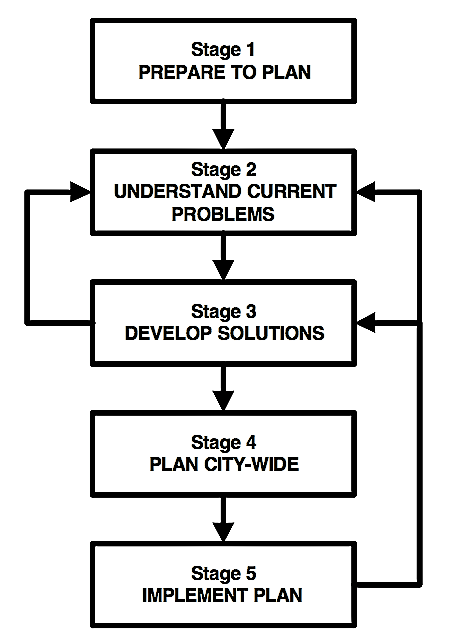
It is important that planning activities follow a logical sequence.
Stage 1 – Preparing to Plan
It will only be possible to develop a plan if there is general agreement on the need to plan. Therefore, in a first step, various groups with an interest in sanitation must be talked to, where necessary convinced of the benefits that they will gain from participating in and drawn into the planning process (see also stakeholder analysis starting by the stakeholder identification factsheet).
Where there are no national and/or state/provincial government legislation and procedures requiring a CSP to be produced, planning has to be sold to other stakeholders on its own merits. This can be done by:
- Encouraging them to join in gathering and analysing information about current problems and their causes.
- Arranging for representatives of local organisations to meet their counterparts in a town in which a successful planning exercise has already been carried out.
- Gaining support for planning from senior local administrators and politicians.
Stage 2 – Understand Current Problems
The starting point for developing better sanitation services will normally be analysis of current problems and their causes. Physical problems often result from deeper problems relating to limited institutional capacity and/or people’s sanitation-related behaviour. There’s a need to understand these underlying problems if the causes of problems are to be treated and not just their symptoms (to help you understand local problems, see the understand your system section).
The following basic questions can help to explore and understand the current sanitation problems:
- Who is responsible for existing services?
- What sanitation problems do we face?
- What are the causes of those problems?
- What resources are available to solve them?
Service users consultation should become part of the routine of municipal service delivery and be done during the investigation of the existing situation in light of:
- Users know about their neighbourhood, the way municipal services operate there, and the sort of improvements that might work (‘demand-side’ knowledge). This complements the ‘supply-side’ knowledge of the municipality and so helps to give a fuller understanding of the situation.
- The service provider can only find out about the services that people want and are willing to pay for by talking to them. This can help prevent money being wasted on services that people will not use.
- Users have responsibilities for the proper use and maintenance of sanitation infrastructure, but there is a need to talk to them to agree and clarify these responsibilities.
Stage 3 – Developing Solutions
The main steps required to develop solutions to sanitation problems are shown diagrammatically below.
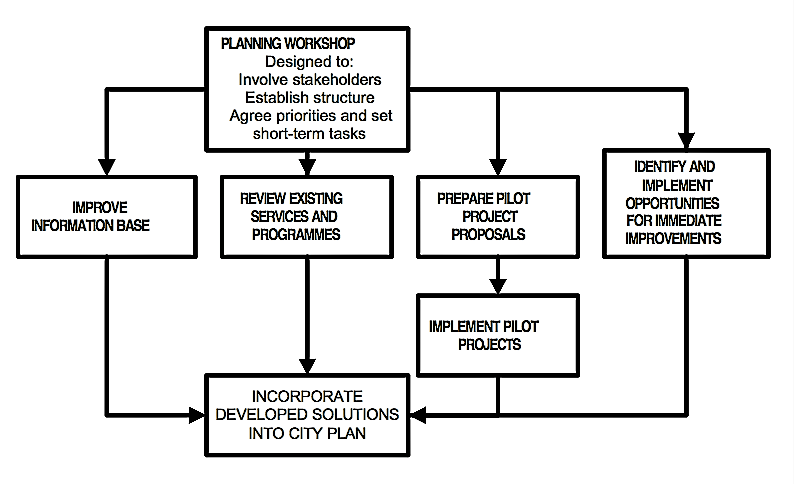
It also shows the need to:
- Develop an improved information base, including improved maps and records where appropriate;
- Review specific services and programmes in order to obtain more detailed information on specific problems identified in the course of the previous stage; and
- Pilot projects to test ideas, approaches and technologies before they are introduced on a citywide scale. Because of their relatively small scale, pilot projects can be prepared and implemented fairly quickly.
- The planning workshop: The planning workshop is a key point in the process. It provides the opportunity to 1) involve all stakeholders in problem analysis, 2) establish a structure for coordinated planning, and 3) agree priorities and assign short-term tasks.
- Immediate improvements: The planning workshop is likely to identify some improvements that are obvious and affordable and can be implemented immediately, provided that there is commitment from the parties involved.
- Developing a good information base: Good base maps are necessary for a number of reasons, in particular for drainage planning, mapping existing facilities and for showing the status of various areas. If initial investigation has revealed that some essential information is not available in a useable form, that information has to be produced.
- Detailed reviews of specific services: Though some improvements can be made immediately, in most cases a full review of specific services will be needed before lasting improvements can be made.
- Assessing options through piloting: New ideas and approaches should not be introduced citywide until they have been tested to see if they will work, are affordable and can be managed by the staff that are available.
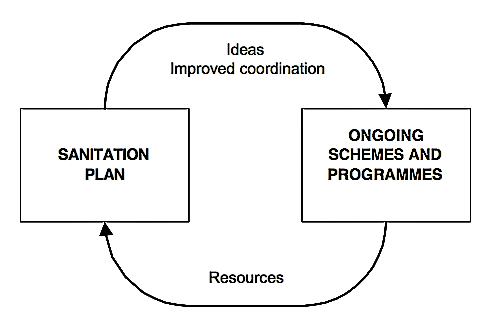
- Linking into existing schemes: Linking the various components of the CSP with existing schemes will help to ensure that resources are available to implement the plan.
For more information, see also the exploring and decision making section.
Stage 4 – Develop Citywide Municipal Plan
A CSP should include an overall goal, a statement of the rules, policies and principles underlying the plan and details of the current position, objectives, activities, responsibilities and resource requirements for each plan component.
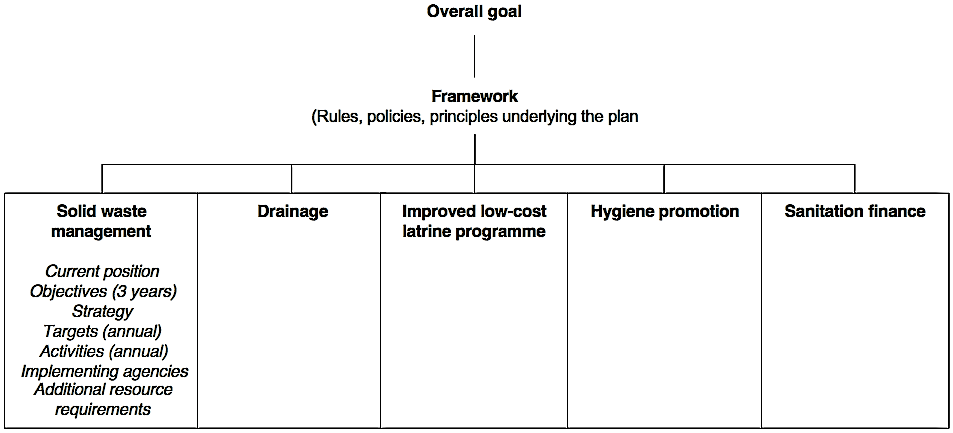
It is important for the plan to:
- Set priorities for action and investment, and explain clearly how these priorities have been established, and
- Have realistic ambitions, in other words the targets it sets must really be achievable within the specified time frame. Achievement of the first year’s objectives will build confidence amongst everyone involved. Conversely, if targets are set too high and not achieved, however, people will lose confidence in the plan and may ignore it.
It is important that both municipal and state authorities formally endorse the plan so that from now on, all concerned departments and agencies work within the framework it has established.
Stage 5 – Implementing the Plan
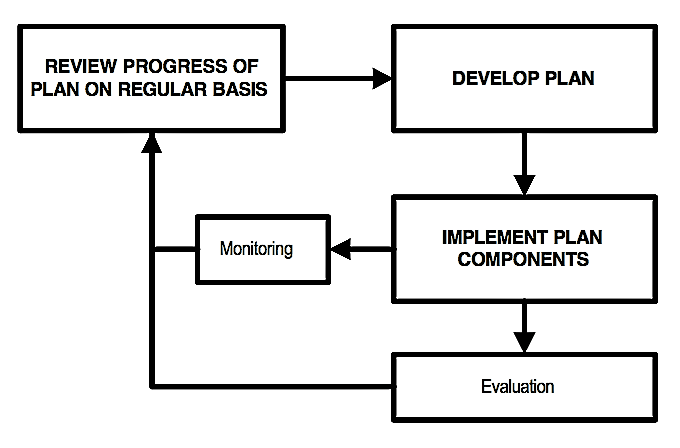
In one sense, implementation is the end of the plan process. However, this should not be seen as an end, but rather as a beginning. There’ll be a lot of learning from the process of implementation and it will be important that the lessons learned are fed back into future initiatives. See also project implementation for more info. After the plan has been implemented, it is important to monitor and evaluate whether it is having the desired effect and whether it has been implemented properly. Links between planning and implementation. Note the importance that it gives to monitoring and evaluation of plan outcomes and the use of that information to review progress with the plan and evaluate its effect from time to time (TAYLER et al. 2000).
After the plan has been implemented, it is important to monitor and evaluate whether it is having the desired effect and whether it has been implemented properly.
Subscribe here to the new Sanitation and Water Entrepreneurship Pact (SWEP) newsletter. SWEP is a network of organizations joining hands to help entrepreneurs design and develop lasting water and sanitation businesses.
Citywide sanitation strategy is a strategic planning process for sanitation sector development. In developing the strategy, several principles must be adopted. This includes mapping the existing condition using valid empirical data, which will serve as a foundation for devising the most effective strategy (WSP 2010).
National Urban Sanitation Policy
This document describes the framework set by the Government of India to meet its overall goal of transforming urban India into community-driven, totally sanitised, healthy and liveable cities and towns.
MOUD (2008): National Urban Sanitation Policy. New Delhi: Ministry of Urban Development (MoUD). URL [Accessed: 18.06.2019]Improving Sanitation in Small Towns in Latin America and the Caribbean – Practical Methodology for Designing a Sustainable Sanitation Plan
The document provides an overview of the issues involved in improving sanitation in small towns (typically defined as those with populations from 5,000 to 30,000), discusses the current situation of sanitation in small towns in Latin America, suggests a potential strategy to improve the sustainability of services, and provides a detailed step-by-step participatory methodology for designing sustainable sanitation services in small towns.
ROSENSWEIG, F. PEREZ, E. CORVETTO, J. TOBIAS, S. (2002): Improving Sanitation in Small Towns in Latin America and the Caribbean – Practical Methodology for Designing a Sustainable Sanitation Plan . (= Strategic Report 3 ). Arlington: The Environmental Health Project URL [Accessed: 07.10.2010]Strategic Planning for Municipal Sanitation – A Guide
This guide provides practical guidelines for the implementation of strategic sanitation concepts. Part A introduces important strategic concepts and is intended to put the rest of the guide into context. Part B, the heart of the guide, is divided into three sections, each containing information on the processes to be followed to develop a more strategic approach to sanitation service provision at a particular level. Part C contains a set of tools to assist strategic planning, training modules, and a section suggesting further sources of information.
TAYLER, K. COLIN, J. PARKINSON, J. (2000): Strategic Planning for Municipal Sanitation – A Guide. URL [Accessed: 18.06.2019]Marching Together with a Citywide Sanitation Strategy
This book provides an overview of the principles of preparing a citywide sanitation strategy. It provides a description of the position of the citywide sanitation strategy within the sanitation development planning process and the steps to develop a citywide sanitation strategy.
WSP (2010): Marching Together with a Citywide Sanitation Strategy. URL [Accessed: 18.06.2019]Strategic Planning for Municipal Sanitation – A Guide
This guide provides practical guidelines for the implementation of strategic sanitation concepts. Part A introduces important strategic concepts and is intended to put the rest of the guide into context. Part B, the heart of the guide, is divided into three sections, each containing information on the processes to be followed to develop a more strategic approach to sanitation service provision at a particular level. Part C contains a set of tools to assist strategic planning, training modules, and a section suggesting further sources of information.
TAYLER, K. COLIN, J. PARKINSON, J. (2000): Strategic Planning for Municipal Sanitation – A Guide. URL [Accessed: 18.06.2019]Sustainable Sanitation in cities: a framework for action
This book repared by partners of the Sustainable Sanitation Alliance (SuSanA) network is a real eye-opener. It takes a look at some of the methods that have worked well in the past, to guide us in solving the problems of the future. By addressing sanitation as a key element of the urban metabolism, and by linking sanitation with urban planning and neighbouring sectors like solid waste management or waste recycling, it allows for a holistic approach. In the cities of tomorrow, we will need to focus more on recycling energy. A good example being biogas generation from wastewater and sludges. Water will also become an increasingly scarce commodity. Greywater (from showers and sinks) can be treated in urban constructed wetlands or used to water and fertilise urban green spaces. Such examples of productive sanitation systems will form an integral part of infrastructure in sustainable cities.
LUETHI, C. PANESAR, A. SCHUETZE, T. NORSTROEM, A. MCCONVILLE, J. PARKINSON, J. SAYWELL, D. INGE, R. (2011): Sustainable Sanitation in cities: a framework for action. Sustainable Sanitation Alliance (SuSanA) & International Forum on Urbanism (IFoU), Papiroz Publishing House, The Netherlands URL [Accessed: 26.05.2019]Improving Sanitation in Small Towns in Latin America and the Caribbean – Practical Methodology for Designing a Sustainable Sanitation Plan
The document provides an overview of the issues involved in improving sanitation in small towns (typically defined as those with populations from 5,000 to 30,000), discusses the current situation of sanitation in small towns in Latin America, suggests a potential strategy to improve the sustainability of services, and provides a detailed step-by-step participatory methodology for designing sustainable sanitation services in small towns.
ROSENSWEIG, F. PEREZ, E. CORVETTO, J. TOBIAS, S. (2002): Improving Sanitation in Small Towns in Latin America and the Caribbean – Practical Methodology for Designing a Sustainable Sanitation Plan . (= Strategic Report 3 ). Arlington: The Environmental Health Project URL [Accessed: 07.10.2010]National Urban Sanitation Policy
This document describes the framework set by the Government of India to meet its overall goal of transforming urban India into community-driven, totally sanitised, healthy and liveable cities and towns.
MOUD (2008): National Urban Sanitation Policy. New Delhi: Ministry of Urban Development (MoUD). URL [Accessed: 18.06.2019]Marching Together with a Citywide Sanitation Strategy
This book provides an overview of the principles of preparing a citywide sanitation strategy. It provides a description of the position of the citywide sanitation strategy within the sanitation development planning process and the steps to develop a citywide sanitation strategy.
WSP (2010): Marching Together with a Citywide Sanitation Strategy. URL [Accessed: 18.06.2019]Urban Sanitation Indonesia: Planning for Progress
This field note examines the city-level planning and capacity building process, which is at the heart of Indonesia Sanitation Sector Development Program and is helping to signal the way forward for sector strategy.
WSP (2009): Urban Sanitation Indonesia: Planning for Progress. URL [Accessed: 06.10.2010]Urban Environmental Sanitation Planning: Lessons from Bharatpur, Rajasthan, India
This field note explains the environmental sanitation planning process undertaken in Bharatpur, the difficulties faced and some important lessons learned for developing viable sanitation services and infrastructure.
WSP (2000): Urban Environmental Sanitation Planning: Lessons from Bharatpur, Rajasthan, India. URL [Accessed: 22.04.2012]Community-Driven Sanitation Improvement in Deprived Urban Neighbourhoods
There is an international consensus that urban sanitary conditions are in great need of improvement, but sharp disagreement over how this improvement should be pursued. Both market-driven and state-led efforts to improve sanitation in deprived communities tend to be severely compromised, as there is a lack of effective market demand (due to collective action problems) and severe barriers to the centralized provision of low-cost sanitation facilities. In principle, community-driven initiatives have a number of advantages. This report investigates these challenges and opportunities.
MCGRANAHAN, G. (2013): Community-Driven Sanitation Improvement in Deprived Urban Neighbourhoods. Research Report. London, Bangladesh: London School of Hygiene and Tropical Medicine (LSHTM), International Center for Diarrhoeal Disease Research (ICDDR), International Institute for Environment and Development (IIED), WaterAid, Sanitation and Hygiene Applied Research for Equity (SHARE) URL [Accessed: 17.06.2019]Water and Environmental Sanitation Strategic Plan – Bihac
This document presents the Strategic Development Plan for Water and Environmental Sanitation of the municipality of Bihac, Federation of Bosnia and Herzegovina.
UNKNOWN (2007): Water and Environmental Sanitation Strategic Plan – Bihac. URL [Accessed: 18.06.2019]Addis Ababa Wastewater Master plan – Executive Summary
This report is the executive summary of the revision and update of the previous master plan prepared in 1993. It includes the results of studies, investigations and outline designs made in order to develop a strategy for the sewerage for the whole of Addis Ababa.
HENDRIKS, T. BEALE, D. (2002): Addis Ababa Wastewater Master plan – Executive Summary. URL [Accessed: 18.06.2019]City of Waterford Draft 2005 Urban Water Management Plan
This Urban Water Management Plan (UWMP) addresses the anticipated future urban demands that will be met by the newly formed City of Waterford Water Department from 2005-2030. The UWMP discuss the demands generated by anticipated urban development within the City of Waterford service area, and the supplies the City will use to meet these demands.
RMC (2005): City of Waterford Draft 2005 Urban Water Management Plan. URL [Accessed: 18.06.2019]City of Waterford Sewer System Master Plan - Final Report
This Sewer System Master Plan provides information required for the City of Waterford’s planning and financial efforts, and defines the sanitary sewer system improvements necessary to accommodate the city’s future land use development plans.
RMC (2006): City of Waterford Sewer System Master Plan - Final Report. URL [Accessed: 22.04.2012]City of Waterford Storm Drain Master Plan - Final Report

This report presents the results of a study to develop a master plan for storm drains in the proposed areas of annexation to the City of Waterford.
RMC (2006): City of Waterford Storm Drain Master Plan - Final Report. URL [Accessed: 18.06.2019]City of Waterford Water System Master Plan - Final Report
This Water System Master Plan provides information required for the City of Waterford’s planning and financial efforts, and defines the water system improvements necessary to accommodate the city’s future land use development plans.
RMC (2006): City of Waterford Water System Master Plan - Final Report. [Accessed: 22.04.2012]City of Waterford Wastewater Treatment Plant Assessment Report - Final Report
This report presents a wastewater treatment plant assessment for the City of Waterford.
RMC (2006): City of Waterford Wastewater Treatment Plant Assessment Report - Final Report. URL [Accessed: 18.06.2019]City of Palmdale Sewer Master Plan - Final Report
The Sewer Master Plan presents an analysis of the hydraulic capacity of the Palmdale’s sewer system under current and future flow conditions, recommended capital improvements required to ensure adequate capacity to serve new development, and an assessment of the structural condition of the city’s sewer system based on video inspections performed to date, and a recommended sewer repair/renewal/replacement program to maintain sound structural condition in the future.
RMC (2009): City of Palmdale Sewer Master Plan - Final Report. URL [Accessed: 18.06.2019]Palmdale Sewer System Management Plan
This Sewer System Management Plan presents SSMP presents Palmdale’s goals for the management, operation, and maintenance of its wastewater collection system.
RMC (2009): Palmdale Sewer System Management Plan. URL [Accessed: 18.06.2019]Glynn County Solid Waste Management Plan – Final Draft
This Solid Waste Management Plan updates the original Glynn County Solid Waste Management Plan, adopted in 1993, and the Five-Year Short Term Work Program Update, adopted in 2004.
BECK, R.W. (2007): Glynn County Solid Waste Management Plan – Final Draft. URL [Accessed: 07.10.2010]Challenges and Key Lessons in Improving Sanitation Services to the Urban Poor Drawing from East and Southern African Experience
This document compiles the experiences and lessons learnt from two urban sanitation projects: Maputo in Mozambique and Durban in South Africa
MORGAN, P. (2010): Challenges and Key Lessons in Improving Sanitation Services to the Urban Poor Drawing from East and Southern African Experience. Stockholm : Ecological Sanitation Research (EcoSanRes), Stockholm Environment Institute (SEI) URL [Accessed: 08.06.2019]Get to Scale in Urban Sanitation!
Taking urban sanitation to scale requires ‘scaling out’ models that work for poorer communities, and at the same time ‘scaling up’ sustainable management processes. This short note reports scale-out and scale-up experience from Maputo and Antananarivo.
WSUP (2013): Get to Scale in Urban Sanitation!. (= Practice Note , 10 ). London: Water and Sanitation for the Urban Poor (WSUP) URL [Accessed: 22.04.2019]Water Safety Plans - Training package. Facilitator handbook
This handbook is one third of a water safety plan (WSP) training package. It accompanies the WSP training workbook and WSP training PowerPoint presentations. The handbook is designed to be used by professional and non-professional trainers, who should have prior knowledge and understanding of WSPs, and who are facilitating WSP training based on the 2009 WSP manual of the International Water Association (IWA) and the World Health Organization (WHO). The training is targeted at all professionals involved in the management of drinking-water safety
WHO IWA (2012): Water Safety Plans - Training package. Facilitator handbook. WHO URL [Accessed: 08.04.2013]Water Safety Plans - Training package. Participant workbook
This workbook is designed to be used by participants attending a water safety plan (WSP) training workshop that has been organized around the materials developed by the International Water Association (IWA) and World Health Organization (WHO). The learning material included in this workbook relates explicitly to the theory sessions that will be presented and the designed exercises. It therefore cannot be used as a standalone document to train people on all WSP aspects.
WHO IWA (2012): Water Safety Plans - Training package. Participant workbook. WHO URL [Accessed: 08.04.2013]