

Executive Summary
A facilitator is literally defined as “one who helps others to learn or who helps to make things easy.” A facilitator helps participants to collaborate as they explore a topic or issue. The goal is to encourage participants to think productively and ultimately to articulate key ideas, to ask vital questions, to uncover variables, to find solutions, and/or to identify productive actions. The facilitator may or may not be a content expert (ROBERT 2009). The word trainer is often used interchangeably with facilitator, but the trainer usually connotes a facilitator who has content expertise. Both facilitators and trainers must understand how adults learn and how to draw out the best thinking of a group.
Facilitation: Managing the Process, not the Content
The process (how) and the content (what) are the two dimensions of any interaction between people. The content of any meeting is what is being discussed: the task at hand, the subjects being dealt with and the problems being solved. Because it’s the verbal portion of the meeting, the content is obvious and typically consumes the attention of the members.
The process on the other hand deals with how things are being discussed: the methods, procedures, format and tools used. The process also includes the style of the interaction, the group dynamics and the climate that’s established. Because the process is silent, it’s harder to pinpoint. It’s the aspect of most meetings that’s largely unseen and often ignored, while people are focused on the content. To put it shot, the core business of a facilitator is to manage the process and leave the content to the participants (BENS 2005).
Core Practices of a Facilitator
(Adapted from BENS 2005)
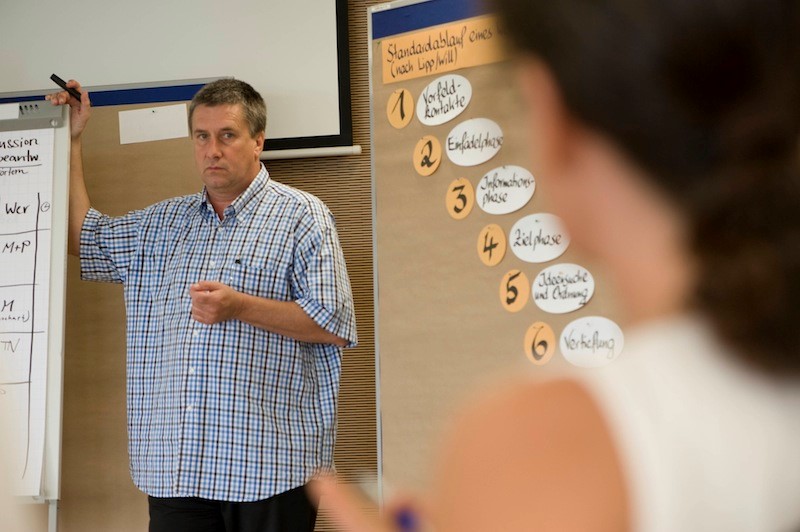
Regardless of the type of meeting or training facilitated, the following core practices should be followed:
- Stay neutral on content — the job of the facilitator is to focus on the process elements and avoid the temptation of exerting control over the content under discussion. While one can use questions and even make suggestions to help the group, facilitators in a decision making process never impose their opinions or take over decision-making powers.
- Listen actively — this is listening to understand more than judge. It also means using attentive body language and looking participants in the eye while they’re speaking. Eye contact can also be used to acknowledge points and prompt quiet people to take part.
- Ask questions — this is the most important tool facilitators possess. Questions can be used to test assumptions, invite participation, gather information and probe for hidden points. Effective questioning encourages people to delve past the symptoms to get at root causes.
- Paraphrase to clarify — facilitators paraphrase continuously during discussions. Paraphrasing involves repeating what people say to make sure they know they’re being heard, to let others hear their points a second time and to clarify key ideas.
- Synthesise ideas — ping-ponging ideas around the group will build consensus and commitment. When people comment and build on each other’s thoughts, it insures that the ideas recorded on the flip chart represent collective thinking.
- Stay on track — to keep discussions on track in the given timeframe is one of the main jobs of facilitators. Pointing out digressions whenever discussion veers off topic is one strategy; another is to write down all off-topic comments and suggestions on a separate “Parking Lot” sheet, posted on a nearby wall, for issues to be dealt with later.
- Give and receive feedback — “holding up a mirror” helps the group to see itself so it can make corrections. Also periodically ask for feedback about the pace, process and content.
- Test assumptions — facilitators always strive to bring the assumptions people are operating under out into the open and clarify them, so that they are clearly understood by everyone.
- Collect ideas — keeping track of both emerging ideas and final decisions on flipcharts or pin boards is important. Notes should be brief and concise. They must always reflect what the participants actually said, rather than an interpretation of the facilitator.
- Summarise clearly — an effective facilitator can listen to a complex set of ideas and then offer a concise and timely summary. Summaries can also be used to revive a discussion that has ground to a halt, or to end a discussion that needs to be wrapped up. Remember that summarising is one of the main ways to arrive at consensus.
How Neutral Does a Facilitator Need to Be?
Originally, facilitation was created to be a neutral role played by an unbiased outsider. The role of this neutral, third party is solely to support group decision-making without exerting influence over the outcome (BENS 2005). In team discussions and decision-making processes, facilitators must stick to this completely neutral role and only focus on process and stay out of the content. This means taking a pragmatic view of the different opinions coming from the members and staying objective to appear unbiased to everyone’s points.
Multiple Roles of Training Course Facilitators
Also in training, ideally, there should be a facilitator taking care of the learning process staying neutral, and experts taking care of the learning contents. However, very often this ideal job-sharing situation cannot be maintained in longer courses due to financial constraints. In such situations, the facilitator may have to take over additional roles and may be a combination of facilitator, expert, guide, coach and leader.
| Facilitator | Expert/ Teacher | Can one person be both? |
|
|
|
In the role of an expert or teacher, the facilitator teaches by showing how things are done, by example, by providing relevant and meaningful information, and by instruction where appropriate. The underlying intention here is to teach participants how to learn for themselves using their own experience as a benchmark.
In the role of guide, the facilitator provides wise counsel and appropriate advice; the intention here is to enable participants to become able to guide themselves, and to welcome responsibility.
In the role of coach, the facilitator provides direct instruction to fine tune individual performance; the underlying intention is to set high standards and to enable staff to become self managing.
In the role as a leader, facilitating team building is needed to promote a productive and more solid team. Moreover, the facilitator encourages group members to participate and interact and directs the group to a cohesive decision. The leader also stimulates a constructive and healthy debate among the team members (YOUNG and LANDALE 1999).
Responsibilities of Training Course Facilitators
A facilitator may need to call on a wide range of skills and tools, from problem solving and decision making, to team management and communications. The definition of facilitate is "to make easy" or "ease a process". What a facilitator does is plan, guide and manage a group event to ensure that the group's objectives are met effectively, with clear thinking, good participation and full buy-in from everyone who is involved. The facilitator should also act as a “referee” in the team. As a referee, order and regulation should be implemented during discussion. This also includes being able to control difficult and problematic group members to carry on with a smooth interaction and managing heated arguments on a professional level, so that defamation and misunderstandings during discussions do not happen (www.exforsys.com).
Besides managing the group, training facilitators are fully responsible for all issues related to the process of the training – from the agenda and the applied learning methodologies to the temperature in the room. The facilitator should have the following issues under his control at all times:
- Planning a training / learning methodology: The facilitator is fully responsible to coordinate all pre-training preparations including developing an agenda and selecting the methodology for the individual sessions.
- Learning environment: People need to feel comfortable to be able to learn effectively. This includes things like: comfortable temperature, enough fresh air, sufficient light, sufficient space, acoustics in the training room (need for microphone?), outside noise levels or other issues, that may influence a training. Read more on these issues in the logistics section.
- Material and logistics: Nothing worse for a facilitator if he runs out of material or the needed equipment is not available. Is an working LCD there? A screen? Are there enough pin boards, flip charts, markers? There are virtually hundreds of things to think of. Consult the logistics checklists in the logistics section for more details.
- Time management is one of the main jobs of a facilitator. A clear and realistic agenda is of course a precondition for this task, but as well the ability of the facilitator to allow a certain flexibility if it improves the training outcome. However, changes in the agenda must be clearly communicated to avoid confusion and frustration among participants. Read more on time management here.
- Ground rules: Together with the participants, the facilitator has to set meaningful guidelines, often called ground rules, that provide a framework to ensure open, respectful dialogue, and maximum participation. Using ground rules to build a safe learning climate is especially important in the field of education where many teaching practices are strongly linked to personal values and experiences. Read more on setting ground rules.
- Handling resource persons is often more demanding than handling participants. A facilitator needs to carefully select, instruct and guide experts so they deliver the right learning content in the right complexity in the given timeframe. Read more on the selection of resource persons.
A meeting without a facilitator is about as effective as a team trying to have a game without a referee (BENS 2005). This applies even more to decision making processes, where a neutral facilitator handling the process is inevitable to be successful. In training, professional facilitation will improve the learning impact and will make a simple series of expert lectures to a compact meaningful training course with a thread. If a full-time facilitator is not available, a resource person may have to take over the role as a facilitator, besides his other functions in a training course. This “switching hats” between e.g. facilitator and expert is demanding and might confuse participants if it is not communicated well.
Facilitating with ease! Core skills for facilitators, team leaders and members, managers, consultants and trainers
The Art of Facilitation

The Art of Facilitation (Web)
The Role of the Facilitator - Understanding What Facilitators Really DO
The Art of Facilitation
Core Roles of Facilitator

This pdf-file concentrates on the difficulty of being neutral as a facilitator. It is built up as a session with main objectives and at the end of session the facilitators should be able to be neutral and know what to do in order to reach this goal. It is also good practice for refreshing the skills.
RECOFTC (2002): Core Roles of Facilitator. Thailand: The International Association of Facilitators URL [Accessed: 17.05.2010]Delivering Effective WASH Training
This Trainer Manual is to support people who facilitate Delivering Effective WASH Training (DEWT). It is based on the practical experience of the CAWST, the Centre for Affordable Water and Sanitation Technology.
CAWST (2015): Delivering Effective WASH Training. Alberta: Centre for Affordable Water and Sanitation Technology CAWST URL [Accessed: 19.08.2015]Facilitation Cue Card
http://work911.com/
This website offers some basic explanations on the role of facilitators, and depicts which competencies and characteristics a facilitator should have in order to be good.
http://www.workshopexercises.com/
This site is intended to serve as a focal point for professionals to not only discover new things that they can do to boost their training, but also to serve as a social exchange space.
http://www.tellusconsultants.com/
A manual for group facilitators which highlights some basics qualities and responsibilities of a facilitator.
http://www.exforsys.com/
This site contains modules about effective facilitation.
http://www.mindtools.com/
This article gives a general overview about facilitation. It explains the role of a facilitator as well as what to do in order to make facilitation successful.