


Executive Summary
To develop successful training courses you need a combination of skills and expertise. Good logistical planning is one of the most crucial aspects of training delivery. If your participants are not comfortable physically and at ease psychologically, they will not benefit fully from the training content.
Starting
The first step in planning logistics for training is to develop a timetable. Set out what needs to happen by what date and assign responsibility for each task. Remember that there will always be occasions when you have little or no control over some or all of the logistics, in which case it is best to be flexible and work with your participants to make the best of the situation.
Sample Checklist:
- Setting date for training
- Specification of equipment needed
- Identification & booking of suitable venue
- Inviting speakers, including deadlines for handouts, summaries etc. & Confirmation
- Draft programme
- Advertising
- Registration & confirmation of participants
- Catering requirements and orders
- Copying of handouts and other training material
- Development of evaluation form
- Production of certificates
Venues and Classrooms
One of the most important factors in successful training is the venue or room in which the training is conducted. It is vital to choose your training venue well and, especially if you do not have much choice, to get the most out of the space you are working in. If there is no possibility of checking the venue in person beforehand, it is advisable to get to the venue early on the day of the training to sort out any problems.
Do not be afraid to reorganise furniture, open or shut windows and doors as necessary to ensure that participants are comfortable. If they are too hot or too cold, can hear outside noise, are sitting on hard chairs or chairs that are too soft their concentration may not be good.
Questions to Ask
- How many rooms will you need?
- Do you need break out or syndicate rooms for small group work and discussions?
- What size should the rooms be?
- What is the furniture like — do participants have somewhere to rest to write? Are the chairs comfortable?
- What is the best way to arrange the furniture — lecture style, around a large table, a circle of chairs ? (See also seating arrangements).
Factors Which Affect the Participants’ Comfort
- Light — natural or artificial
- Fresh air
- Outside noise levels
- Acoustics in the training room
- Temperature
Training Equipment
When planning training you need to make sure that you and your guest speakers have the necessary equipment to support your presentations. Check with the venue before booking and make sure that you have put your equipment requirements in writing.
Even if you have planned well and the venue is a reliable one, equipment can go wrong and let you down. Well in advance of the training day you should make sure your files are compatible with the hardware and software at the venue. Computer equipment is particularly prone to performance failure, so you need to check early on the day itself that the equipment works. It is a good idea to make sure you can reach a technician quickly to help solve any technical difficulties. It is important to have a back-up plan and to take along extra materials. If you have handouts you can speak to a handout instead of the OHPs. If the data projector equipment is not working, back-up overheads can be vital. If you are planning a video presentation you may need to talk through the programme and draw out the lesson that way.
Equipment Checklist
- Overhead projector and acetate slides: This is the most common machine for supporting visual aids to lectures and presentations. Overhead projectors are more reliable and common than computers in developing countries and organisations with fewer resources – however, they are more and more replaced with computer projectors.
- Flipchart: Flipcharts are similar to white boards in that the presenter can write on them in a spontaneous way to support the presentation. They can also be used for material that has been prepared in advance. It can be useful to give sheets of flipchart paper to break-out groups for their feedback sessions. As with whiteboards, you need to make sure you have special flipchart pens (which are different from those used for writing on whiteboards) (see also managing flipcharts).
- Pin boards and moderation material: Pin boards are very useful when doing group works. Brining along a sufficient supply of differently coloured cards helps in structuring presentations, or group works. Pin boards have the advantage over flipcharts that you can move around (or remove, and regroup) individual statements (see also managing coloured cards).
- Whiteboard: This is the modern equivalent of a blackboard, having a smooth shiny surface that can be written on and wiped clean. You will need to ensure you have several special whiteboard pens as they are designed to wipe off easily. You’ll also want to make sure they are not running out.
- Projectors: Data projector and computer set-up for PowerPoint or other presentation software.
- Projection screen: This is an essential piece of equipment for all of the visual aid machines mentioned above. The screen can be mounted on the wall like a roller blind or it can be free-standing. Whilst it is possible to use an even white wall for projection, a screen will ensure a clear and even image.
- Internet connexion: If you are going to do any presentation involving viewing websites, an Internet connexion is required.
- Other electronic equipment: You may also use other equipment such as microphones, headsets (if you are working with interpreters), laser pointers etc.
For a more comprehensive checklist, see the “Training Material” section further below.
Breaks and Catering
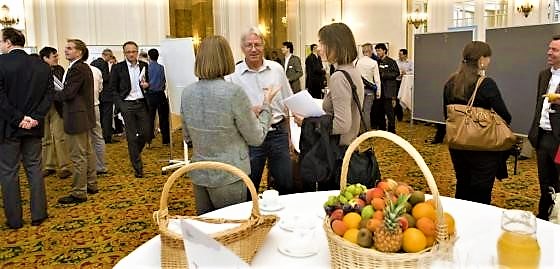
Scheduling and timing breaks and making sure that the catering and other facilities are adequate is essential for successful training. Whilst it is possible to serve lunch in the training room, it is usually better to have lunch in a different space — particularly as delivery of the food and crockery can be distracting and if the remains are not promptly cleared away, this can add unpleasant odours to the training room.
Choice of food can also be very important to the participants’ experience. You will need to assess in some way (perhaps with a tick box on the application form) whether there are any special dietary needs. You may want to select some vegetarian food as a matter of course but if you have participants that require kosher, vegan or gluten-free food you will want to cater for them too. There are some other important choices to make about catering.
Questions to Ask
- Do you want a formal sit-down meal?
- Do you want a buffet meal?
- Will you serve alcohol?
- Will the food be hot or cold?
- Will the food be light or heavy?
- When do you want tea and coffee served — in particular do you want tea and coffee as people arrive?
You will need to work out where the men’s and women’s toilets are and let the class know at the beginning of the course. Similarly, you should tell them where they may smoke in the breaks. It is also good practice to tell the class where the fire escapes are and the drill in the event of an emergency such as fire including the assembly point.
It has been always an issue whether logistics in training is a necessity or not. In many planning stages of a training, it is not uncommon to witness the absence of a logistics expert. This results not only in poor training planning but disorganised processes as well. Simply defined, logistics is the art or science of integrating all aspects of the program.If one of these key factors fails to deliver the standard, there will be definitely be a breakdown in the process. The goal of every training, one should remember, is to put a smile on the trainee’s face. If logistics is not applied on training framework, it will result to failure in participant satisfaction.
Training the Trainer Resource Pack

This resource pack is intended for anyone who wants some guidance or direction in planning, organising and delivering effective training for both professionals and support staff whatever their working or learning environment. The bulk of the pack addresses the various techniques for delivering training but it also covers the practical administrative tasks that are essential for successful training courses and which underpin the training content.
CROCKET, M. FOSTER, J. (2005): Training the Trainer Resource Pack. France: International Council on Archives URL [Accessed: 19.05.2010]Training the Trainer Resource Pack
This resource pack is intended for anyone who wants some guidance or direction in planning, organising and delivering effective training for both professionals and support staff whatever their working or learning environment. The bulk of the pack addresses the various techniques for delivering training but it also covers the practical administrative tasks that are essential for successful training courses and which underpin the training content.
CROCKET, M. FOSTER, J. (2005): Training the Trainer Resource Pack. France: International Council on Archives URL [Accessed: 19.05.2010]Quick-Guide to Events

This is a complete guide on how to organise an event. Originally written for staff of the University of South Austraila, most of the tips and tricks are universal. There is also a corresponding website (http://www.unisa.edu.au/mdu/events/howto.asp) which contains a summary of the guide.
UNIVERSITY OF SOUTH AUSTRALIA (2008): Quick-Guide to Events. Adelaide: University of South Austraila (UNISA) URL [Accessed: 29.11.2010]Delivering Effective WASH Training

This Trainer Manual is to support people who facilitate Delivering Effective WASH Training (DEWT). It is based on the practical experience of the CAWST, the Centre for Affordable Water and Sanitation Technology.
CAWST (2015): Delivering Effective WASH Training. Alberta: Centre for Affordable Water and Sanitation Technology CAWST URL [Accessed: 19.08.2015]Top Tips of planning an Event

Training Logistics Worksheet

Pre and Post planning To Do Checklist

http://www.ica-sae.org/
19.05.2010
http://www.unisa.edu.au/
This site contains a complete guide on how to organise an event. Though originally designed for staff of the University of South Australia, most of the tips and tricks are universal.
http://www.trainingreference.co.uk/
Another helpful website with many tips and tricks on event organisation, including logistics.